The Mahamrityunjaya Mantra, Its Meaning and Power
The mantra is:
ॐ त्र्यम्बकं यजामहे सुगन्धिं पुष्टिवर्धनम् | उर्वारुकमिव बन्धनान् मृत्योर्मुक्षीय माऽमृतात् ||
Translation: "We worship the three-eyed Lord Shiva who is fragrant and nourishes all beings. May he liberate us from the bondage of death, just as a ripe cucumber is naturally released from its vine, and may he not withhold from us immortality."
The cucumber metaphor is deeply significant: the cucumber does not die when it separates from the vine, it simply transitions to a new, complete state. The mantra asks for liberation from fear of death and from death itself, not through force, but through natural spiritual ripening.
This mantra simultaneously works on multiple levels:
- Physical: Activates the body's own healing intelligence
- Psychological: Dissolves fear, anxiety, and the dread of death
- Astrological: Directly counters malefic Saturn, Rahu, and the 8th house afflictions associated with illness and death
- Karmic: Clears past-life karma related to health and longevity
- Spiritual: Begins the process of liberation from the cycle of rebirth
Who Should Commission Mahamrityunjaya Jaap?
- Family members of someone undergoing serious surgery, cancer treatment, or ICU care
- People with terminal or chronic illnesses seeking healing on all levels
- Anyone who has survived a near-death experience (accident, heart attack, etc.) and seeks protection
- Those experiencing Sade Sati, Rahu Mahadasha, or 8th house planetary periods, cosmic death-related influences
- Families seeking protection for elderly parents with failing health
- Individuals who have a fear of death that disrupts daily life
- Anyone seeking longevity and protection as a preventive measure
- Those born during Gandanta (junction of water and fire signs), a sensitive astrological condition
The Science and Tradition of Jaap Counts
In the Vedic tradition, the number of mantra repetitions is not arbitrary, it is calculated based on the severity of the situation and the desired outcome:
- 25,000 Jaaps (Purashcharana basic): Appropriate for general health protection and mild to moderate illness. Completed by 2 3 Pandits in one day.
- 54,000 Jaaps: For serious illness, post-surgery recovery, or strong planetary afflictions. Completed by 4 5 Pandits over 1 2 days.
- 1,25,000 Jaaps (Maha Purashcharana): For life-threatening situations, terminal illness, or as a complete karmic remedy. Completed by 7 11 Pandits over 2 3 days.
All Jaap sessions are concluded with a Havan, a fire ceremony where 1/10th of the total Jaap count is offered as Ahutis into the sacred fire, sealing and amplifying the mantra's energy.
Step-by-Step Mahamrityunjaya Jaap Process
Sankalp: The ceremony begins with a detailed Sankalp in the name of the person for whom the Jaap is performed, including their birth star, gotra, and the specific purpose (health recovery, protection, longevity, etc.).
Ganesh Puja and Navagrah Invocation: Lord Ganesha is worshipped. The nine planets, especially Saturn (Shani), Rahu, and Ketu, which govern health and longevity, are appeased.
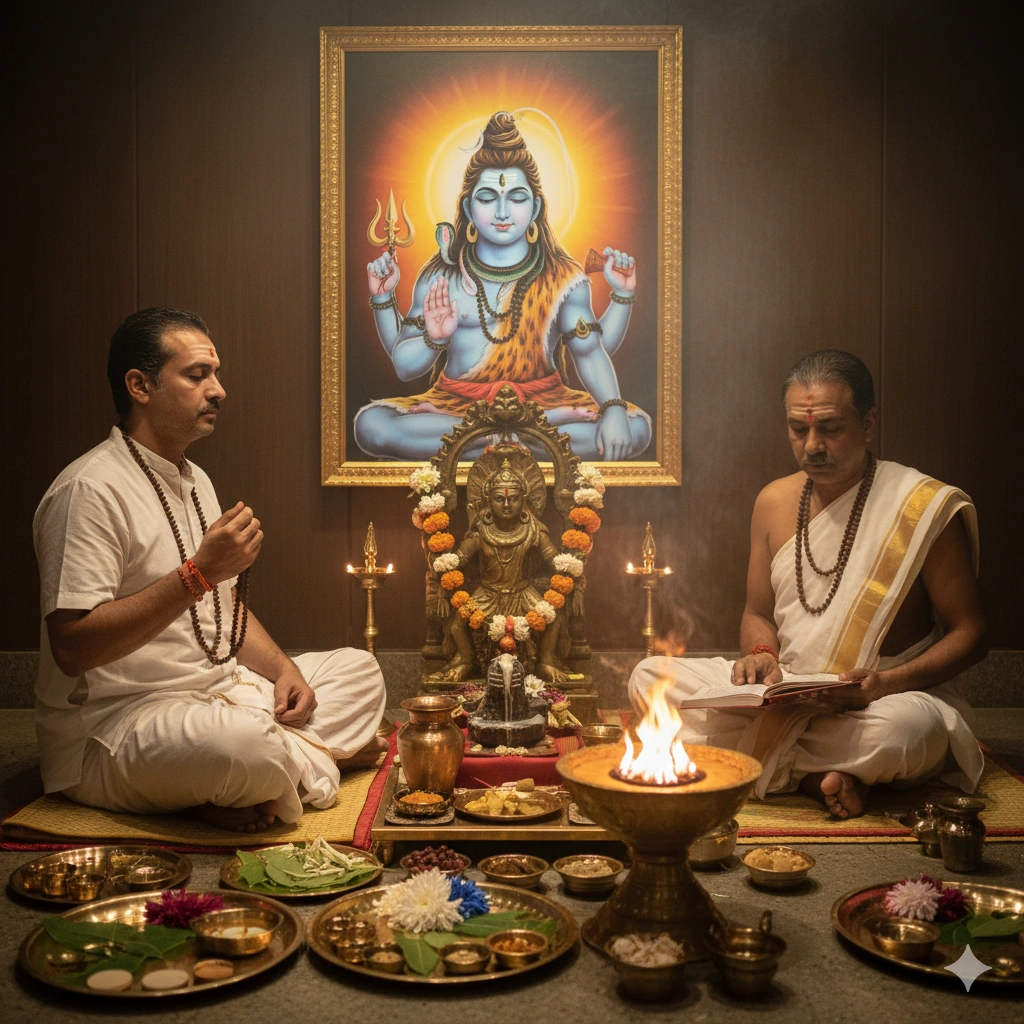
Lord Shiva Sthapana: A Shivalinga or image of Lord Tryambakam is established. Specific Abhishek with Panchamrit, Gangajal, and Bilva leaves is performed.
Mahamrityunjaya Jaap: Multiple trained Pandits sit in a circle and begin the systematic chanting. Each Pandit uses a Rudraksha Mala (108-bead garland). The number of malas per Pandit per day is carefully calculated to achieve the target count within the scheduled time.
Havan: Upon completing the Jaap, a grand Havan is performed. For every 10 Jaaps counted, one Ahuti of ghee and sesame is offered with the same mantra. Special herbs, Amrit (Giloy), Brahmi, Shatavari, and Ashwagandha, are added to the Havan for their healing properties.
Tarpan and Marjan: Water offerings to the ancestors (Pitrus) and a ritual sprinkle-purification of the patient (if present) or their surroundings are performed.
Mrityunjaya Kavacha: The Pandit ties a sacred Mrityunjaya Kavacha (protection thread) with specific mantras on the patient's wrist, creating a tangible protective energy field.
Benefits of Mahamrityunjaya Jaap
- Known to support remarkable recoveries even in medically challenging cases
- Reduces fear and anxiety during illness, creating mental peace
- Counters malefic planetary periods that trigger health crises
- Protects against accidents, sudden loss, and untimely death
- Cleanses negative karma related to health from past lives
- Creates a powerful aura of divine protection around the individual and family
Why Choose Vedic Pooja for Mahamrityunjaya Jaap in Pune?
This is not a ceremony to be entrusted to anyone. Mispronounced mantras in a Maha Purashcharana reduce the count's effectiveness entirely. Our Pandits are specifically trained in the phonetics of the Mahamrityunjaya Mantra and can maintain the chanting with correct pronunciation and rhythm through hours of continuous Jaap.
We can perform this ceremony at your home anywhere in Pune, Pashan, Baner, Aundh, Kharadi, Hinjewadi, or any other locality, or at a designated puja space. For extreme emergencies, we offer priority same-day arrangements.
Call or WhatsApp 8668552465. When life calls for divine intervention, we are here.