The Significance of Naamkaran Sanskar
The Naamkaran Sanskar is described in the Grihya Sutras, the ancient texts governing household ceremonies, as the official entry of the child into society. Before the naming ceremony, the child lives in a kind of sacred liminal space. With the Naamkaran, the child receives their social identity, their cosmic identity (linked to their birth Nakshatra), and their spiritual identity (linked to the family's deity and gotra).
According to the Vedic sage Vashishtha, a person's name should ideally:
- Begin with a sound corresponding to the birth Nakshatra's Pada (quarter)
- Have an even number of syllables (for girls) or odd number (for boys) in some traditions
- End in a long vowel sound (this strengthens the name's vibration)
- Invoke an auspicious quality or divine name
The ceremony also serves a protective function: by formally announcing the child's name to the gods, ancestors, and the community, the family invokes a collective field of protection and blessing around the child.
Traditional Types of Names in Naamkaran
In the Naamkaran ceremony, families traditionally choose up to four names for the child:
- Nakshatra Naam: Based on the syllable corresponding to the child's birth Nakshatra. This is the child's hidden spiritual name, known only to close family.
- Rashi Naam: Based on the child's Moon sign (Rashi). This is often the name used in astrological matters.
- Maas Naam: Based on the month of birth according to the Hindu calendar.
- Vyavaharik Naam: The social name used in daily life, chosen by the family for its beauty and meaning.
Our Pandits guide families through all these naming traditions and help choose syllables that are auspicious for the child's specific birth chart.
Ideal Time for Naamkaran Sanskar
According to the scriptures, Naamkaran is ideally performed:
- On the 11th day after birth (Ekadasha ceremony), the traditional timing
- Or between the 12th and 41st day, based on family tradition
- On an auspicious Tithi: Dwitiya, Tritiya, Panchami, Saptami, Dashami, Dwadashi, or Trayodashi
- On an auspicious Nakshatra: Any of the 27 except for Jyeshtha, Mula, Ardra, Ashlesha, or Vishakha
- During Shukla Paksha (waxing moon period)
Our astrologer-Pandits calculate the most auspicious Muhurat based on the child's exact birth time, date, and place.
Step-by-Step Naamkaran Sanskar Ritual Process
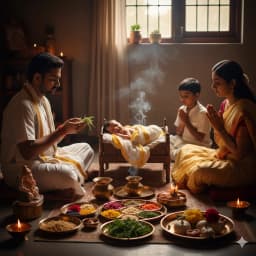
Purification of Space: The puja area is cleaned and purified with Gangajal. Fresh flowers, mango leaves, and banana leaves decorate the ceremony space.
Sankalp: The Pandit takes the formal Sankalp in the names of both parents, stating their gotra, the child's birth date, birth time, birth Nakshatra, and the intention of the ceremony.
Ganapati Puja: Lord Ganesha is invoked and worshipped to bless the child's new beginning and remove all obstacles from their life path.
Navagraha Puja and Jaap: The nine planetary deities are invoked and appeased. Specific mantras are chanted for the child's birth planet (Janma Graha) and the planet governing their birth Nakshatra (Nakshatra Swami).
Matrika Puja and Kshetrapal Puja: The seven divine mothers (Saptamatrikas) are invoked for the child's protection. The guardian deity of the land is also propitiated.
Jatkarma Revisiting: If the Jatkarma Samskara (performed at birth) was not formally done, the Pandit performs its mantras as part of this ceremony.
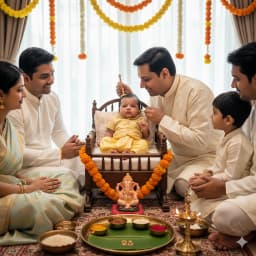
Naamkaran Mantra and Name Declaration: The father (or head of the family) takes the child in his lap and whispers the chosen name three times into the child's right ear, followed by the Pandit chanting the Naamkaran mantra: "Asya Shisho Naam Idam Bhavatu...", formally declaring the child's name to the gods, ancestors, and those present.
Surya Darshan: The child is brought outside (or near a window) to see the sun for the first time. The Pandit chants the Surya Namaskar mantra, invoking the sun's blessings of health, vitality, and long life.
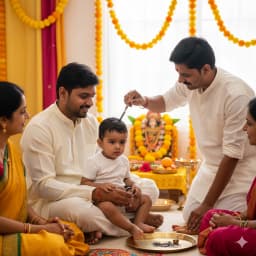
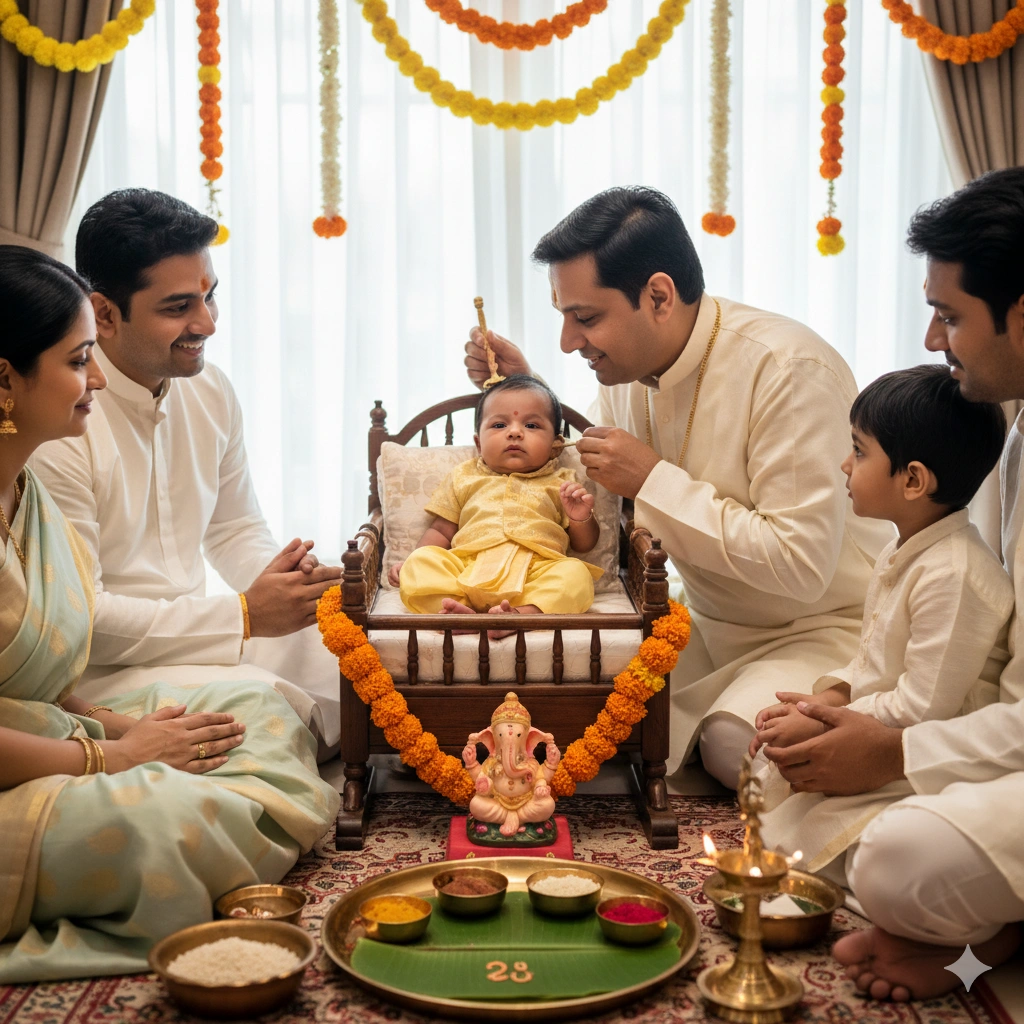
Medhajanan (Honey and Ghee): A small amount of pure honey mixed with pure ghee is placed on the child's tongue with a golden implement (or clean finger) while chanting: "Medhajanan Kara...", invoking intelligence and wisdom.
Ayushya Suktam: The Pandit chants the Ayushya Suktam, Vedic hymns specifically for long life and good health, over the child.
Aarti and Blessings: The family and guests bless the child. A small Havan is performed to consecrate the child's name in the sacred fire.
Benefits of Naamkaran Sanskar
- The child receives a vibrationally auspicious name that supports their natural strengths
- Planetary blessings are invoked for health, intelligence, and longevity
- The family's ancestral blessings are formally channeled to the child
- The community's spiritual support is gathered around the child from the earliest stage of life
- The child's birth chart is activated with protective mantras
What's Included
- Experienced Pandit trained in Samskara rituals
- Complete Samagri: Gangajal, flowers, banana leaves, mango leaves, honey, ghee, puja thali, incense, lamps
- Nakshatra calculation and auspicious name syllable guidance
- Ayushya Suktam and Navagraha mantras
- Havan for name consecration
- Prasad distribution
Why Choose Vedic Pooja for Naamkaran Sanskar in Pune?
Your child's naming ceremony is a once-in-a-lifetime moment. Our Pandits approach it with the reverence, warmth, and procedural correctness that this sacred occasion deserves. We serve all areas of Pune, from Viman Nagar and Kharadi to Aundh and Pashan, and we bring all required samagri so your family can focus entirely on the joy of the moment.
Our Pandits also speak warmly in Hindi and Marathi so every family member, including grandparents, can understand and participate fully in this meaningful ceremony.
Call or WhatsApp 8668552465 to book your Naamkaran Sanskar in Pune.