
Our Authentic Vedic Pujas
Explore a wide range of traditional Vedic rituals, performed with devotion and precision by trusted Pandit Jis.
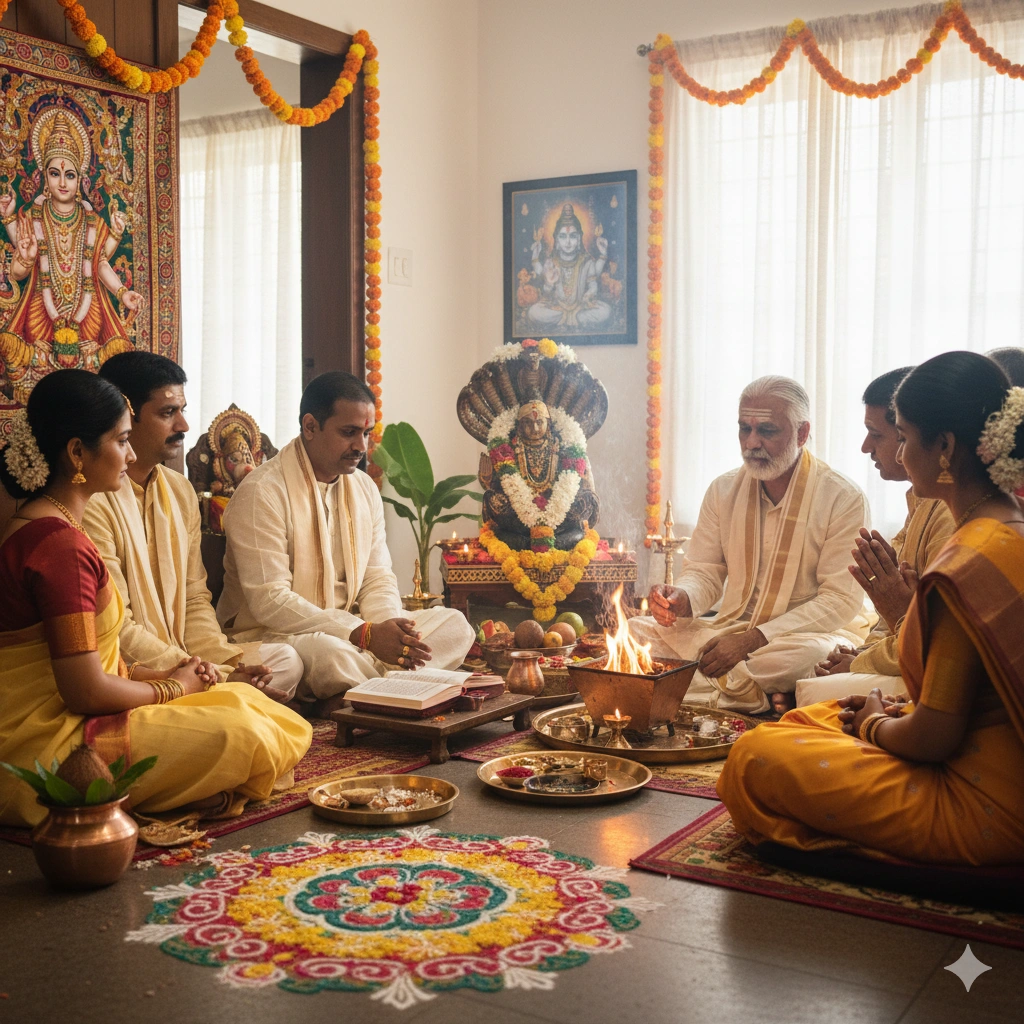
Griha Pravesh Pooja (Housewarming Puja / Vastu Shanti / Gruhapravesham)
(8 Reviews)
Moving into a new home is one of the most sacred and joyful events in a family's life. Whether you call it Griha Pravesh Pooja, Griha Pravesh Puja, Grah Pravesh Puja, or Graha Pravesh Puja, the essence remains the same: a Vedic ceremony that purifies your new space, dissolves negativity, and draws in lasting peace and prosperity. Known in South India as Gruhapravesham or Gruha Pravesham, and in Maharashtra as Gruhapravesh Puja Pune, this timeless ritual bridges the physical act of moving with a powerful spiritual transformation.
At Vedic Pooja, we have performed over 5,000 successful Housewarming Ceremonies across Pune and the PCMC region. Our verified, Gurukul-trained Pandits travel to every corner of the city — from Wakad and Baner to Kharadi and Hadapsar — bringing authenticity, discipline, and devotion to every ritual. If you are looking for the best Housewarming Pandit Pune or searching for a trusted Pandit for housewarming Pune, your search ends here.
What Is Griha Pravesh? A Timeless Vedic New Home Blessing Ceremony
In Vedic tradition, a house is far more than a structure of concrete and steel. It is a living entity — a Vastu — that absorbs and radiates energy. When a building is newly constructed, renovated, or remains unoccupied, it can accumulate stagnant, negative, or disruptive energies. The Griha Pravesh Puja (also called Housewarming Ceremony, House Warming Ceremony Pune, or New Home Blessing Ceremony) is the prescribed Vedic solution: a comprehensive set of rituals designed to cleanse the space, invoke divine guardians, and establish a field of positive vibration before the family makes their first entry.
Whether it is a new home puja, a new flat puja, a new house puja, or even a new apartment puja Pune, the ceremony sets the energetic foundation of your home for years and decades to come. Families moving into their first independent home, couples receiving builder flat possession, or investors taking flat possession puja after registration — all can benefit equally from this sacred ritual.
Who Needs a Griha Pravesh Puja?
New homes: The most common scenario. Any first entry to new house puja is incomplete without the Griha Pravesh ritual performed on an auspicious Muhurat.
Resale and second-hand homes: A resale flat puja or second-hand house puja is equally important. The previous residents' energy patterns are embedded in the walls, floors, and corners of the house. A proper Vastu Shanti ceremony resets this entirely.
Rented accommodations: Thinking a puja is only for owned homes? Think again. A rented house entry puja — often called Vastu Shanti for rented flat — is highly recommended in Vedic Shastra. Families moving into a rented apartment in Pune, Pimpri, or Chinchwad routinely opt for this compact ceremony to ensure harmony from day one.
Office spaces: The same positive energy principles apply to commercial properties. An Office Griha Pravesh or Office Vastu Shanti blesses the workspace with prosperity, team harmony, and business growth. Whether it is a startup in Hinjewadi Tech Park or a shop in Koregaon Park, our Pandits are equipped for office ceremonies.
Builder flat possession ceremony Pandit Pune: Purchasing a flat directly from a builder is a milestone moment. Our builder flat possession ceremony Pandit Pune service ensures that the moment you receive your keys, the home is consecrated and blessed before anyone spends a single night inside.
The Key Rituals — Step by Step
Our expert Pandits in Pune conduct a complete, uncompromised ceremony. Every ritual has deep Vedic significance:
1. Dwar Puja (Door Puja for New Home): The ceremony begins at the main door — the gateway between the outer world and your sacred personal space. The Dwar Puja involves decorating the entrance with a mango-leaf Toran, drawing Swastika and Rangoli designs using Kumkum and turmeric, and chanting protective mantras. This Door puja for new home establishes a sacred barrier that prevents negative energies from ever crossing your threshold.
2. Gau Puja (Cow Worship) and Milk Boiling Ceremony:
In Vedic Dharma, the cow (Gau Mata) is considered the dwelling of all 33 crore deities. In the traditional Gau Puja, the cow is symbolically worshipped and, if possible, made to enter the home first. Following this, the lady of the house performs the iconic Milk boiling ceremony new house — she boils milk in the kitchen until it overflows, symbolizing the overflow of prosperity, abundance, and happiness that the home will enjoy.
3. Kalash Sthapana New Home:
A sacred copper Kalash (pot) filled with Ganga Jal, a coin, betel nut, and five types of leaves is installed — typically in the northeast corner (Ishanya), the most auspicious direction in Vastu Shastra. The Kalash Sthapana new home ritual establishes a divine container of cosmic energy that sustains the entire ceremony.
4. Vastu Shanti Puja (Vastu Puja):
This is the heart of the ceremony. The Vastu Purusha Mandal — a sacred geometric diagram representing the deity of the plot — is drawn and worshipped. Vastu Shanti, also spelled Vastu Shanti Pooja or Vastu Shanti Puja, involves seeking forgiveness from the Vastu Devata for any disturbances caused during construction, and requesting blessings for the home's future occupants. This is also referred to simply as Vastu Puja and directly addresses Vastu Dosh Nivaran at new home.
5. Navagraha Shanti at New Home:
The nine cosmic planets (Sun, Moon, Mars, Mercury, Jupiter, Venus, Saturn, Rahu, and Ketu) each exert a unique influence over human life. The Navagraha Shanti at new home ritual involves making offerings — specific flowers, grains, and colored threads — to each of the nine planetary deities. This pacifies any malefic planetary influence on the residents and ensures smooth, healthy progress in career, relationships, and health.
6. Havan for New Home (Sacred Fire Ritual):
The climax of the Griha Pravesh is the Havan for new home — a sacred fire ceremony in which the Pandit chants Vedic mantras while making offerings (Ahutis) of pure cow ghee, sesame seeds, and special havan samagri into the consecrated fire. The Havan at new house generates powerful healing vibrations; the sacred smoke penetrates every room, eliminating bacteria, neutralizing electromagnetic disturbances, and filling the home with positive Prana. This is also sometimes referred to as the Moving into new home puja when combined with the entry rituals.
Finding the Right Griha Pravesh Muhurat in Pune
Timing is not merely a tradition — it is a science. In Jyotish (Vedic astrology), performing a Griha Pravesh Muhurat on an incorrect day can negate the benefits of even the most elaborate ceremony. Our expert astrologers calculate the ideal Shubh Muhurat for house entry Pune based on:
- The birth star (Janma Nakshatra) and Rashi of the head of the family
- The Tithi (lunar day) and Paksha (waxing/waning period)
- Auspicious Nakshatras: Rohini, Mrigashira, Uttara Phalguni, Hasta, Chitra, Swati, Anuradha, Uttara Ashadha, Uttara Bhadrapada, Revati, and Shravana
- Avoiding Rahu Kaal, Gulik Kaal, Bhadra, and Chandrabala checks
For those planning ahead: Griha Pravesh Muhurat 2025 and Griha Pravesh Muhurat 2026 Pune listings are available with us. Several auspicious dates fall in the months of Magh, Phalgun, Vaishakh, and Jyeshtha — the most recommended seasons in the Panchang for new home entry. Contact us for a personalised Griha Pravesh Muhurat 2026 consultation.
Serving All Major Areas of Pune and PCMC
Our Pandits travel across the entire Pune metropolitan area for Griha Pravesh in Wakad, Baner, Kharadi, Hinjewadi, Kothrud, Hadapsar, Viman Nagar, Pimple Saudagar, Aundh, PCMC, Pimpri, Chinchwad, Koregaon Park, Kalyani Nagar, Bavdhan, Pashan, and Magarpatta. Wherever you are in Pune, when you search for Pandit for Griha Pravesh near me Pune, Vedic Pooja is the answer.
Gृहप्रवेश पूजा पुणे (Gruhapravesh Puja Pune) | गृहप्रवेश पूजन (Gruhapravesh Poojan) | नवीन घर पूजा (Navin Ghar Puja) | वास्तुशांती पूजा (Vastushanti Puja) | गृहप्रवेश मुहूर्त 2026 पुणे | नवीन फ्लॅट पूजा पुणे | पुण्यात गृहप्रवेशासाठी पंडित — we bring all these traditions together under one seamless, trustworthy service.
Why Vedic Pooja Is Pune's Most Trusted Griha Pravesh Service
1. Certified, Background-Verified Pandits: Every Pandit on our platform has undergone a thorough verification process. They bring deep Shastric knowledge, fluency in Sanskrit mantras, and the calm, confident presence that makes your ceremony truly divine.
2. Complete Samagri Included: Forget running to multiple shops. We deliver 100% authentic, premium-grade Puja Samagri — pure cow ghee, Havan wood (Aam ki lakdi), Navagraha samagri, decorative items, and more. Nothing is compromised.
3. Muhurat Guidance Included: Every booking comes with a free Muhurat consultation. We calculate the most auspicious time for your Housewarming Ceremony based on your family's Kundali.
4. Transparent, All-Inclusive Pricing: No last-minute surprises. No hidden charges. What you see is what you pay. Our packages are clearly structured for Basic, Standard, and Premium requirements.
5. Fully Customisable Ceremonies: Want to add a Satyanarayan Katha after the Griha Pravesh? A Rudrabhishek for extra blessings? A Sundarkand Path? We customise every ceremony to your specific spiritual and family requirements.
6. Pan-Pune Coverage: From Gruha Pravesh in Viman Nagar to Gruhapravesham in Hadapsar, from a new flat puja in Pimple Saudagar to an office Griha Pravesh in Baner — we cover it all, on time, every time.
Step into your new home with the full blessings of the Vedas. Book your Griha Pravesh Pandit Pune with Vedic Pooja today. Call or WhatsApp us for a personalized Muhurat consultation, package details, and booking. Your new beginning deserves a sacred, authentic, and beautiful start — and we are here to make that happen.
*गृह प्रवेश पूजा | ग्रह प्रवेश पूजा | नया घर पूजा | वास्तु शांति | गृह प्रवेश मुहूर्त 2026 | पुणे में गृह प्रवेश पंडित | नए फ्लैट की पूजा | द्वार पूजा | कलश स्थापना | हवन | Griha Pravesh Puja Pune | Housewarming Pandit Pune | Vastu Shanti Puja | Gruhapravesham Pune*
From
₹5,100
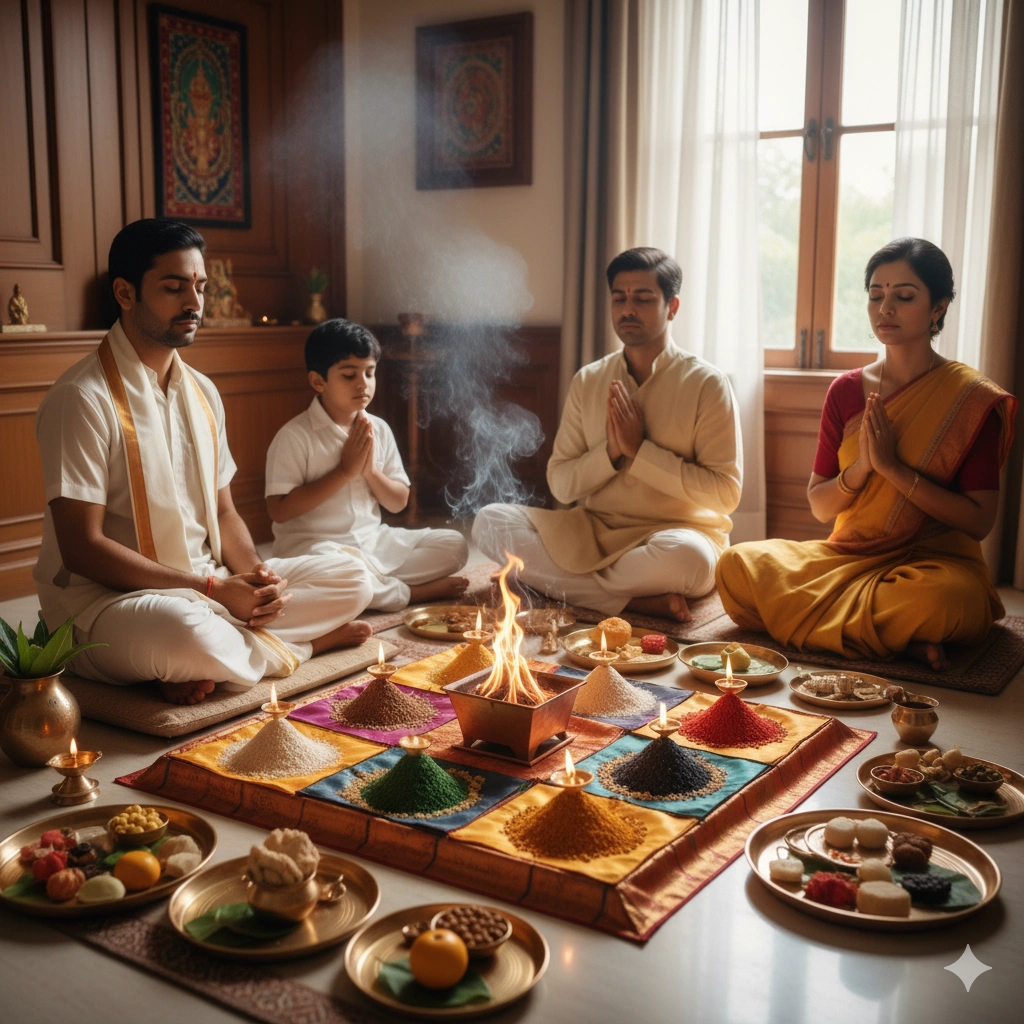
Navagraha Shanti
(8 Reviews)
The celestial bodies have a profound and undeniable impact on human life. According to Vedic astrology, our past karmas determine the planetary positions at the time of our birth. These nine planets, known as the Navagrahas-Surya (Sun), Chandra (Moon), Mangal (Mars), Budh (Mercury), Guru (Jupiter), Shukra (Venus), Shani (Saturn), Rahu, and Ketu-govern different aspects of our existence, including health, wealth, career, relationships, and mental peace.
When these planets are well-placed, life flows smoothly with success and happiness. However, when certain planets are afflicted or poorly positioned in the horoscope, they create 'Doshas' or malefic effects. This can lead to unexpected obstacles, financial losses, chronic illnesses, delays in marriage, and constant mental stress. To mitigate these negative influences and amplify the positive ones, the Navagraha Shanti Puja is highly recommended.
At Vedic Pooja, we offer specialized Navagraha Shanti Puja services performed by expert astrologers and verified Pandits in Pune. Whether you are experiencing the dreaded Shani Sade Sati, Mangal Dosh, or Rahu-Ketu afflictions, our Pandits possess the deep Vedic knowledge required to appease the planets and bring harmony back into your life.
Understanding the Navagrahas and Their Influences
Each of the nine planets controls a specific domain of human life:
1. Surya (Sun): Represents the soul, father, authority, health, and career growth. A weak Sun causes lack of confidence and obstacles in professional life.
2. Chandra (Moon): Governs the mind, emotions, mother, and mental stability. An afflicted Moon leads to anxiety, depression, and emotional turbulence.
3. Mangal (Mars): The planet of energy, courage, property, and marriage. Mangal Dosh (Kuja Dosha) is famous for causing delays and disharmony in marital life.
4. Budh (Mercury): Controls intelligence, speech, business, and communication. A weak Mercury leads to poor decision-making and business losses.
5. Guru (Jupiter): The planet of wisdom, wealth, marriage, and children. A strong Jupiter brings immense fortune, while a weak one causes delays in education and childbirth.
6. Shukra (Venus): Governs love, luxury, arts, and marital bliss. Afflicted Venus leads to relationship issues and financial struggles.
7. Shani (Saturn): The planet of karma, discipline, and justice. Shani's malefic periods (like Sade Sati or Dhaiya) are known to bring severe hardships, delays, and life lessons.
8. Rahu: A shadow planet that causes sudden events, illusions, addictions, and unknown fears.
9. Ketu: Another shadow planet associated with spirituality, but its affliction causes isolation, mysterious diseases, and obstacles in spiritual growth.
The Navagraha Shanti Ritual Process
Our Pandits in Pune perform the Navagraha Shanti Puja with utmost devotion and strict adherence to the Vedic guidelines. The process involves:
1. Sankalpam: The person suffering from the Dosha takes a solemn vow (Sankalpa) specifying their name, gotra, and the purpose of the puja.
2. Navagraha Sthapana & Kalash Puja: The idols or yantras of the nine planets are installed on specific grains and colored cloths corresponding to each planet. A Kalash (copper pot) is established to invoke Lord Varun.
3. Avahan & Mantra Jaap: The specific Vedic mantras for all nine planets are chanted. If a particular planet is highly malefic (e.g., Shani or Rahu), special emphasis and extra mantra jaap (up to 1,25,000 times) are performed for that specific deity.
4. Navagraha Havan: A sacred fire is lit, and specific woods (Samidhas) assigned to each planet are offered into the fire along with pure cow ghee. For example, Ark wood is used for the Sun, Palash for the Moon, Khadir for Mars, and Peepal for Jupiter.
5. Purnahuti & Aarti: The ceremony concludes with the final offering (Purnahuti) to the fire, followed by the Aarti and distribution of Prasad.
6. Daan (Donation): An essential part of Navagraha Shanti is donating specific items related to the afflicted planet (e.g., black sesame seeds for Saturn, jaggery for the Sun) to the needy or the priest.
Benefits of Navagraha Shanti Puja
* Removes Obstacles: Clears the path to success by mitigating planetary hurdles in career, business, and education.
* Improves Health: Helps in recovering from chronic or undiagnosed illnesses caused by planetary afflictions.
* Marital Harmony: Resolves delays in marriage and brings peace to troubled married lives (especially for Mangliks).
* Financial Stability: Removes debts and attracts wealth and prosperity.
* Mental Peace: Alleviates stress, anxiety, and unknown fears, bringing mental clarity and emotional balance.
Why Book Our Pandits for Navagraha Shanti in Pune?
Navagraha Shanti is a highly complex ritual that requires perfect pronunciation of Sanskrit mantras and precise knowledge of planetary materials (Samagri). Our verified Vedic Pandits in Pune are experts in astrology and karma-kanda. We provide all the specialized Samagri, including the specific colored cloths, grains, and woods required for all nine planets. We cater to all areas in Pune, offering both home-based and temple-based puja options. Book now to align your stars and unlock a prosperous future.
From
₹4,100
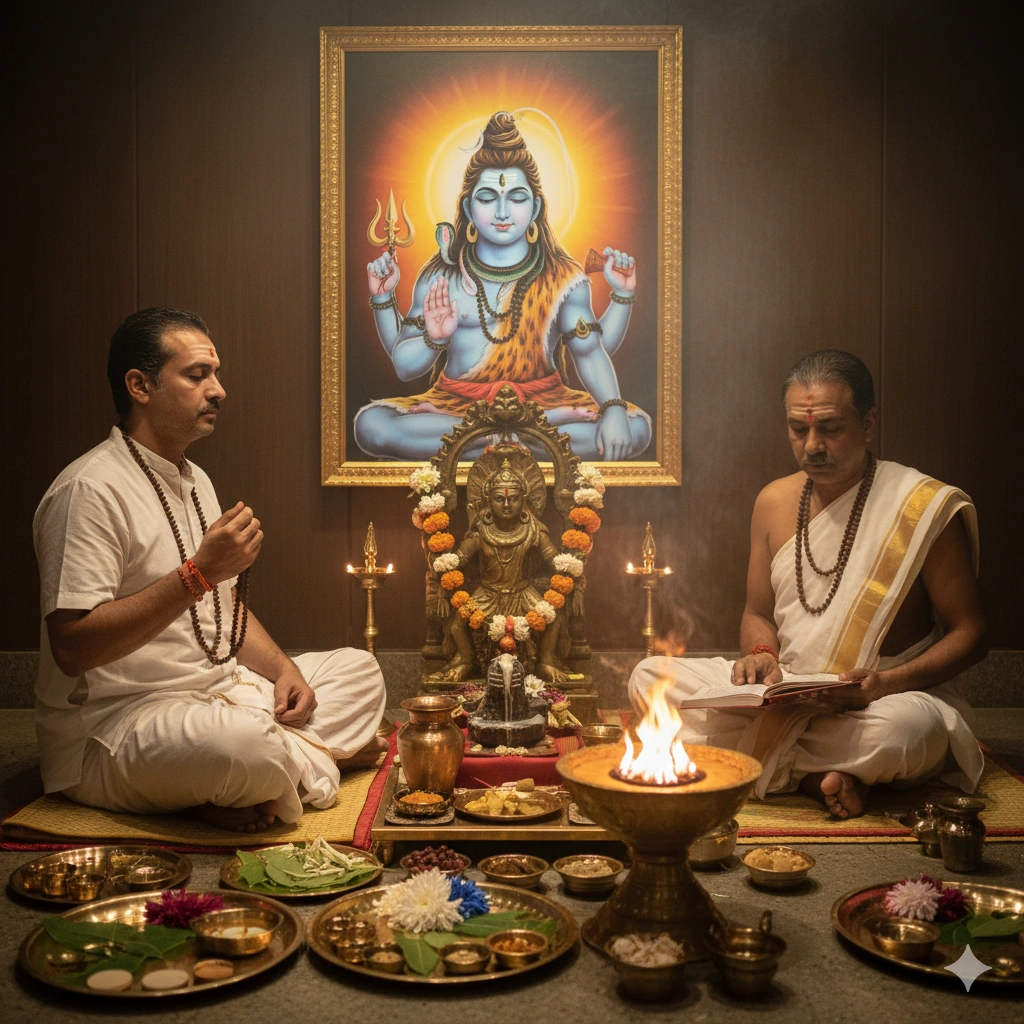
Mahamrityunjaya Jaap
(8 Reviews)
There are moments in life when the ground beneath us gives way, when a loved one faces a serious illness, when a medical prognosis is frightening, when accidents happen, or when the shadow of untimely death looms over a family. In these moments of extreme vulnerability, the Vedic tradition offers something extraordinary: the Mahamrityunjaya Mantra, the great mantra for the conquest of death. Inscribed in the Rig Veda (7.59.12) and also in the Krishna Yajurveda, this mantra is addressed to Lord Tryambakam, the three-eyed Lord Shiva, and is considered the most powerful mantra for physical healing, life protection, and liberation from the cycle of birth and death. When chanted in large numbers (25,000, 54,000, or 1,25,000 repetitions) by trained Vedic Pandits through the Mahamrityunjaya Jaap ceremony, its healing, protective, and transformative power reaches dimensions that the rational mind can barely comprehend. Families across Pune, from the medical corridors of Hadapsar to the homes of Kothrud and Viman Nagar, have turned to this sacred Jaap in their most challenging moments, and found remarkable grace.
The Mahamrityunjaya Mantra, Its Meaning and Power
The mantra is:
ॐ त्र्यम्बकं यजामहे सुगन्धिं पुष्टिवर्धनम् | उर्वारुकमिव बन्धनान् मृत्योर्मुक्षीय माऽमृतात् ||
Translation: "We worship the three-eyed Lord Shiva who is fragrant and nourishes all beings. May he liberate us from the bondage of death, just as a ripe cucumber is naturally released from its vine, and may he not withhold from us immortality."
The cucumber metaphor is deeply significant: the cucumber does not die when it separates from the vine, it simply transitions to a new, complete state. The mantra asks for liberation from fear of death and from death itself, not through force, but through natural spiritual ripening.
This mantra simultaneously works on multiple levels:
- Physical: Activates the body's own healing intelligence
- Psychological: Dissolves fear, anxiety, and the dread of death
- Astrological: Directly counters malefic Saturn, Rahu, and the 8th house afflictions associated with illness and death
- Karmic: Clears past-life karma related to health and longevity
- Spiritual: Begins the process of liberation from the cycle of rebirth
Who Should Commission Mahamrityunjaya Jaap?
- Family members of someone undergoing serious surgery, cancer treatment, or ICU care
- People with terminal or chronic illnesses seeking healing on all levels
- Anyone who has survived a near-death experience (accident, heart attack, etc.) and seeks protection
- Those experiencing Sade Sati, Rahu Mahadasha, or 8th house planetary periods, cosmic death-related influences
- Families seeking protection for elderly parents with failing health
- Individuals who have a fear of death that disrupts daily life
- Anyone seeking longevity and protection as a preventive measure
- Those born during Gandanta (junction of water and fire signs), a sensitive astrological condition
The Science and Tradition of Jaap Counts
In the Vedic tradition, the number of mantra repetitions is not arbitrary, it is calculated based on the severity of the situation and the desired outcome:
- 25,000 Jaaps (Purashcharana basic): Appropriate for general health protection and mild to moderate illness. Completed by 2–3 Pandits in one day.
- 54,000 Jaaps: For serious illness, post-surgery recovery, or strong planetary afflictions. Completed by 4–5 Pandits over 1–2 days.
- 1,25,000 Jaaps (Maha Purashcharana): For life-threatening situations, terminal illness, or as a complete karmic remedy. Completed by 7–11 Pandits over 2–3 days.
All Jaap sessions are concluded with a Havan, a fire ceremony where 1/10th of the total Jaap count is offered as Ahutis into the sacred fire, sealing and amplifying the mantra's energy.
Step-by-Step Mahamrityunjaya Jaap Process
1. Sankalp: The ceremony begins with a detailed Sankalp in the name of the person for whom the Jaap is performed, including their birth star, gotra, and the specific purpose (health recovery, protection, longevity, etc.).
2. Ganesh Puja and Navagrah Invocation: Lord Ganesha is worshipped. The nine planets, especially Saturn (Shani), Rahu, and Ketu, which govern health and longevity, are appeased.
3. Lord Shiva Sthapana: A Shivalinga or image of Lord Tryambakam is established. Specific Abhishek with Panchamrit, Gangajal, and Bilva leaves is performed.
4. Mahamrityunjaya Jaap: Multiple trained Pandits sit in a circle and begin the systematic chanting. Each Pandit uses a Rudraksha Mala (108-bead garland). The number of malas per Pandit per day is carefully calculated to achieve the target count within the scheduled time.
5. Havan: Upon completing the Jaap, a grand Havan is performed. For every 10 Jaaps counted, one Ahuti of ghee and sesame is offered with the same mantra. Special herbs, Amrit (Giloy), Brahmi, Shatavari, and Ashwagandha, are added to the Havan for their healing properties.
6. Tarpan and Marjan: Water offerings to the ancestors (Pitrus) and a ritual sprinkle-purification of the patient (if present) or their surroundings are performed.
7. Mrityunjaya Kavacha: The Pandit ties a sacred Mrityunjaya Kavacha (protection thread) with specific mantras on the patient's wrist, creating a tangible protective energy field.
Benefits of Mahamrityunjaya Jaap
- Known to support remarkable recoveries even in medically challenging cases
- Reduces fear and anxiety during illness, creating mental peace
- Counters malefic planetary periods that trigger health crises
- Protects against accidents, sudden loss, and untimely death
- Cleanses negative karma related to health from past lives
- Creates a powerful aura of divine protection around the individual and family
Why Choose Vedic Pooja for Mahamrityunjaya Jaap in Pune?
This is not a ceremony to be entrusted to anyone. Mispronounced mantras in a Maha Purashcharana reduce the count's effectiveness entirely. Our Pandits are specifically trained in the phonetics of the Mahamrityunjaya Mantra and can maintain the chanting with correct pronunciation and rhythm through hours of continuous Jaap.
We can perform this ceremony at your home anywhere in Pune, Pashan, Baner, Aundh, Kharadi, Hinjewadi, or any other locality, or at a designated puja space. For extreme emergencies, we offer priority same-day arrangements.
Call or WhatsApp 8668552465. When life calls for divine intervention, we are here.
From
₹11,000
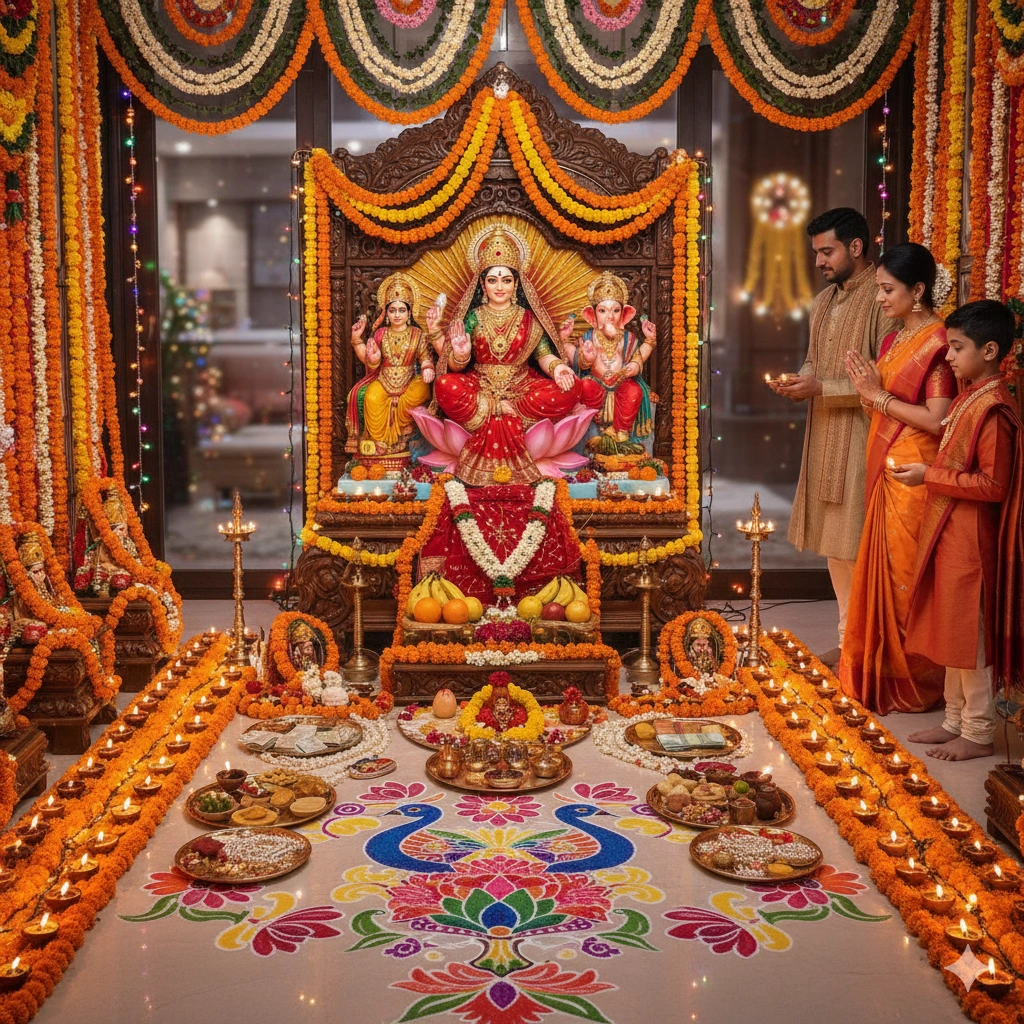
Lakshmi Puja (Diwali Puja / Deepawali Laxmi Puja)
(0 Reviews)
There is one night in the Hindu calendar when the entire universe leans toward abundance — when, according to ancient tradition, Goddess Lakshmi herself descends to earth and walks from home to home, blessing those whose doors are open, whose lamps are lit, and whose hearts are pure and welcoming. That night is Diwali, the festival of lights, and the Diwali Puja performed on this evening is not merely a ritual — it is a divine rendezvous with the goddess of all wealth, beauty, and grace. Known by many names across India — Deepawali Puja, Deepavali Lakshmi Puja, Diwali ki Puja, or simply Lakshmi Puja — this ceremony is the single most important annual ritual for prosperity in the Hindu tradition. When performed with the correct Vedic procedure, pure samagri, and genuine devotion, it can shift the financial trajectory of a family in ways that feel almost miraculous. At Vedic Pooja, our experienced Pandits bring this sacred Diwali Puja at home to families and businesses across Pune — from the tech corridors of Hinjewadi, Kharadi, and Viman Nagar to the residential heartlands of Kothrud, Hadapsar, Baner, Wakad, and Koregaon Park — with the completeness and reverence this extraordinary night deserves.
The Many Names of One Sacred Night
Across different regions of India, this festival and its central puja carry multiple beloved names. In the north it is called Diwali Puja or Deepawali Puja; in the south it is Deepavali Lakshmi Puja; in Maharashtra it is लक्ष्मीपूजन (Lakshmipujan) and दिवाळी पूजा (Diwali Puja). The Goddess herself is called Lakshmi, Laxmi, or Mahalakshmi — and the combined worship of Goddess Lakshmi and Lord Ganesha, known as Ganesh Lakshmi Puja Diwali or Ganesh Laxmi Puja together, forms the heart of every household celebration. Whether your family calls it Mahalakshmi Puja Diwali, Lakshmi Ganesh Puja Diwali, or simply Goddess Lakshmi Worship on the night of lights — the essence is identical: welcoming the divine mother of prosperity into your home at the most auspicious moment of the year.
The Spiritual and Astrological Significance of Diwali Puja
Diwali falls on the Amavasya (new moon night) of the month of Kartik — making it Kartik Amavasya Puja, the most powerful Amavasya of the entire year. This is astronomically the darkest night of autumn, yet it is the night chosen for the greatest illumination of lamps. This paradox is intentional: it is precisely in the darkest moment that the light of Lakshmi's grace shines most brilliantly.
Astrologically, Diwali's Amavasya occurs when the Sun is in Libra (Tula Rashi), the sign of balance, justice, and beauty. The moon is in complete shadow, creating a void that, in Tantric tradition, is actually a portal of maximum receptivity. It is on this Amavasya Lakshmi Puja night that spiritual practices bear fruit most rapidly and divine grace flows most freely.
This night arrives just two days after Dhanteras — and the Dhanteras Puja connection is deeply significant. On Dhanteras, Lord Dhanvantari and Goddess Lakshmi are welcomed with the purchase of gold or silver. On Diwali's Amavasya, that invitation is completed through the full Laxmi Puja, locking in the blessing for the entire coming year.
The Complete Diwali Puja: Who Is Worshipped
Goddess Lakshmi does not come alone on Diwali night. The complete Diwali ki Puja involves a sacred assembly:
- Lord Ganesha — Remover of obstacles, first worshipped in every Hindu ceremony. The Ganesh Laxmi Puja together is considered non-negotiable for Diwali.
- Goddess Lakshmi (Mahalakshmi) — The central deity: goddess of wealth, beauty, and divine fortune. Also invoked through Shri Sukta Path and Lakshmi Suktam recitation.
- Goddess Saraswati — Knowledge and wisdom, invoked for complete and lasting prosperity.
- Lord Kubera — The divine treasurer of the gods. Kubera Puja on Diwali is essential, especially for business owners. The combined Kuber Lakshmi Puja ensures both the attraction and the retention of wealth.
Invoking all four together on this night creates what the tradition calls the "Chaturvidha Purushartha" blessing — prosperity in all four dimensions: Dharma (righteousness), Artha (wealth), Kama (fulfillment), and Moksha (liberation).
The Critical Importance of Pradosh Muhurat and Lakshmi Puja Muhurat
Diwali Puja is performed in the Pradosh Kaal — the period after sunset and before the night progresses too far. Within this window, there is a specific 45–90 minute period called the Pradosh Muhurat Diwali or Shubh Muhurat, coinciding with the Vrischik Lagna (Scorpio ascendant), which is the absolute peak for Lakshmi invocation. Beginning the puja at precisely this Lakshmi Puja Muhurat is not a formality — it is the difference between an ordinary ritual and a powerfully effective one.
Our Pandits calculate the precise muhurat for each family's home based on:
- The exact local sunset time in Pune
- The Amavasya tithi start and end timing
- The favorable Lagna (ascendant) for Goddess Lakshmi Worship
- The Nishitha Kaal (midnight period), significant in Tantric Lakshmi traditions
For Diwali 2025 Puja and Diwali 2026 Puja Pune, our team will publish the precise local muhurat timings well in advance so families can plan their celebrations perfectly.
Step-by-Step Deepawali Puja Process
1. Home Preparation and Purification
The home is thoroughly cleaned — Goddess Lakshmi is known to avoid untidy homes. Rangoli is drawn at the entrance. Diyas (earthen lamps) are arranged in all directions to welcome the Goddess.
2. Sankalp
The Pandit takes the formal Sankalp in the host family's name, invoking the presence of Goddess Lakshmi on this most auspicious Kartik Amavasya night.
3. Ganesh Puja
Lord Ganesha is worshipped first — he opens all doors so the Goddess may enter freely. The Ganesh Laxmi Puja together formally begins.
4. Lakshmi-Ganesh Sthapana
The silver or golden idols (or sacred images) of Goddess Lakshmi and Lord Ganesha are ritually established on the puja altar. New coins and currency notes are placed before the idols as symbols of the wealth being blessed.
5. Kubera Puja on Diwali
Lord Kubera, the divine treasurer, is invoked through specific mantras to oversee and protect the material prosperity invited through the puja. The Kuber Lakshmi Puja is especially recommended for entrepreneurs, shopkeepers, and professionals.
6. Shodashopachara — Sixteen Sacred Offerings
Complete offerings are made to the Goddess: lotus flowers (Lakshmi's favorite), rose petals, saffron-infused water, sandalwood paste, gold or silver jewelry placed before the idol, silk cloth, kheer (sweet rice), coconut, and sweet betel leaves.
7. Shri Sukta Path and Lakshmi Suktam Recitation
The sixteen hymns of the Shri Sukta from the Rig Veda — also called Lakshmi Suktam — are chanted with full pronunciation and correct Vedic intonation, each verse accompanied by an Ahuti (offering) of lotus seeds and ghee in a small fire. This Shri Sukta Path is the most powerful Vedic invocation for Goddess Lakshmi's permanent presence in the home.
8. Business Lakshmi Puja — Bahi Khata Puja and Account Book Blessing
For business owners, traders, and professionals, this is one of the most meaningful parts of Diwali Puja. Account books (Bahi-Khata), laptops, cash registers, business tools, shop equipment, and important financial documents are placed before Goddess Lakshmi and formally blessed for the coming year. This Business Lakshmi Puja / Bahi Khata Puja / account book puja Diwali tradition ensures that every tool of livelihood carries the Goddess's blessings into the new financial year.
9. Maha Aarti
The grand Diwali Lakshmi Aarti — including "Jai Lakshmi Mata" and "Jay Laxmi Ramana" — is performed with a multi-wick lamp. The entire household participates, making this the emotional and devotional peak of the ceremony.
10. Havan (Premium)
For families seeking the deepest possible blessing, a Lakshmi Havan with specific herbs, lotus seeds, saffron, and ghee is performed as the final act of the Deepavali Lakshmi Puja.
11. Prasad Distribution
Kheer, sweets, and fruits are distributed as Prasad. New currency notes are gifted as blessings to all present.
Why a Pandit for Diwali Puja Matters
Many families attempt a self-performed Diwali Puja without realizing how much depends on correct Sanskrit pronunciation, the precise order of rituals, the accurate calculation of muhurat, and the proper preparation of samagri. A trained Diwali pandit in Pune brings all of this expertise to your home, ensuring that the puja is not just beautiful but genuinely effective according to the Vedic tradition.
If you are searching for a pandit for Diwali Puja Pune or a pandit for Lakshmi Puja Pune, our team at Vedic Pooja is fully equipped and experienced. We serve all major Pune localities including Wakad, Baner, Kharadi, Hinjewadi, Kothrud, Hadapsar, Viman Nagar, and Koregaon Park. Whether you want Diwali puja at home Pune for a small family gathering or a large corporate Business Lakshmi Puja at your office, we customize the ceremony to your needs.
Benefits of Diwali Lakshmi Puja
- Annual renewal of the family's living relationship with the Goddess of Prosperity
- Blessing of all financial accounts, business assets, and tools of livelihood
- Removal of financial blockages accumulated over the previous year
- Invitation for new income streams and abundance in the coming year
- Protection of existing wealth, investments, and property
- Harmony, joy, and Lakshmi's grace in the home for the entire year
- Specific Business Lakshmi Puja benefits for entrepreneurs and traders
Serving Pune for Diwali 2025 and Diwali 2026
Diwali is the busiest night of the year for puja bookings in Pune, and our team is specifically organized to serve as many families as possible with individual, dedicated attention. We do not rush ceremonies. Each family — whether in Diwali Puja in Wakad, Baner, Kharadi, Hinjewadi, Kothrud, Hadapsar, Viman Nagar, or Koregaon Park — receives the complete, unhurried ceremony that this important night deserves.
For Diwali 2025 Puja and Diwali 2026 Puja Pune bookings, early reservation is essential as slots fill within days of opening. Call or WhatsApp us at 8668552465 to secure your preferred time slot for Lakshmi Puja Muhurat on the most auspicious night of the year.
From
₹3,100
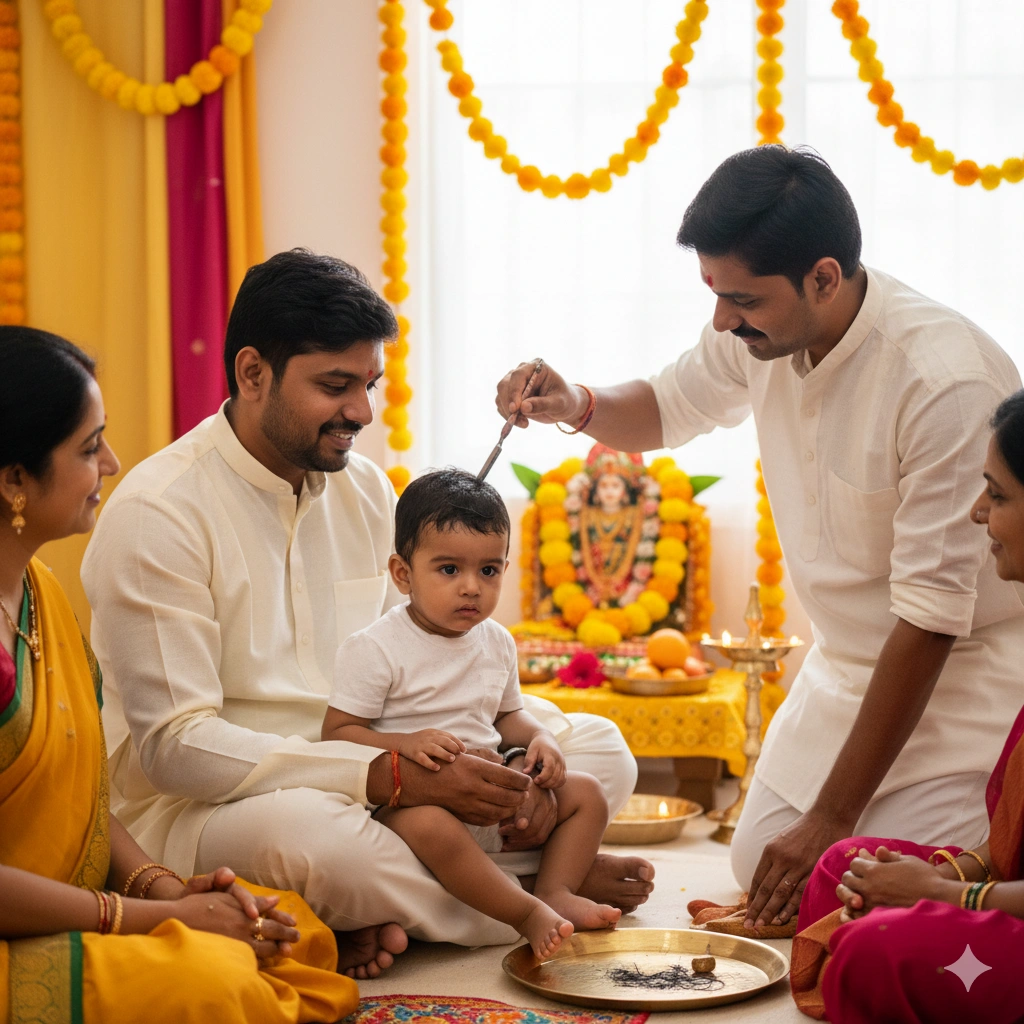
Mundan Sanskar
(8 Reviews)
Among the sixteen Samskaras (sacred rites of passage) prescribed in the Vedic tradition for a complete human life, Mundan Sanskar, the first head shaving of a child, holds a place of profound spiritual and physiological importance. This is not a mere haircut. It is a sacred ceremony that marks a child's transition from infancy into conscious childhood, and it carries the blessings of health, intelligence, long life, and spiritual purification. The ritual acknowledges a beautiful Vedic truth: the hair a child is born with carries the karma and vibrations of past lives. By shaving it off in a sacred ceremony with Vedic mantras, the child is symbolically born anew, free from past impressions, open to the blessings of this life. Across Pune, in the family-oriented localities of Kothrud, Hadapsar, Aundh, and Pimpri-Chinchwad, parents celebrate this milestone with great joy and devotion.
The Spiritual Significance of Mundan Sanskar
The Grihya Sutras, the ancient texts governing household ceremonies, prescribe Mundan as one of the most important Samskaras. The ceremony is also called Chudakarma (Chuda = tuft of hair, Karma = action) and Vapana Karma.
From a spiritual standpoint, the hair carried from birth is believed to accumulate negative energies and past-life impressions. By removing it with proper Vedic mantras under an auspicious Muhurat, the child's life is 'reset' on a higher frequency. The sacred energy of the mantras, combined with the physical act of shaving, creates a powerful spiritual transformation.
From a physiological standpoint, many traditional families and even modern pediatricians acknowledge that the scalp stimulation during Mundan promotes better blood circulation in the scalp, leading to healthier and thicker hair growth. The newborn hair, often thin and uneven, is replaced by stronger, more uniform growth.
Best Age and Time for Mundan Sanskar
According to the scriptures, Mundan should ideally be performed in the child's first or third year of life. Some traditions prefer the fifth or seventh year. The key factors are:
- Odd number of years: 1st, 3rd, or 5th year
- Auspicious Tithi: Dwitiya, Tritiya, Panchami, Saptami, Dashami, Dwadashi, or Trayodashi
- Auspicious Nakshatra: Ashwini, Mrigashira, Punarvasu, Pushya, Hasta, Chitra, Swati, Jyeshtha, Shravana, Dhanishtha, or Revati
- Auspicious Day: Monday, Wednesday, Thursday, or Friday
- Shukla Paksha preferred (waxing moon phase)
Our Pandits will calculate the most auspicious Muhurat for your child's Mundan based on the exact birth details.
Step-by-Step Mundan Sanskar Ritual Process
1. Sankalp: The Pandit takes a formal Sankalp in the child's name, birth star (Nakshatra), and gotra. The parents also take the Sankalp, declaring their intention to perform this sacred Samskara.
2. Ganapati Puja: Lord Ganesha is invoked and worshipped to remove all obstacles from the ceremony.
3. Matrika Puja: Seven divine mothers (Saptamatrikas) are invoked and worshipped for the protection of the child.
4. Navagraha Puja: The nine planetary deities are appeased to ensure their favorable influence on the child's life.
5. Mandal Rachana: An auspicious diagram is drawn and the child is seated in the father's lap or in a special chair in the center.
6. Kesh Sparsha Mantra: The Pandit chants specific mantras while gently touching the child's hair with blades of Darbha grass (sacred grass), a symbolic pre-shaving.
7. Pratham Kshaur (First Shave): The barber (Naapit) performs the actual shaving, beginning from the right side. The child's parents apply a paste of turmeric, ghee, and curd to the shaved areas.
8. Shikha Kharana: If the family tradition includes keeping a Shikha (a tuft of hair at the top), a small portion is left unshaved at this time.
9. Balarka Puja: The cut hair is offered to water (a river, lake, or bucket of clean water) or wrapped in fresh Darbha grass and offered at a sacred site. This represents the formal release of past-life impressions.
10. Aarti and Blessings: The child is dressed in new clothes, adorned with turmeric, and blessed by the Pandit with mantras for long life, intelligence, and health.
Benefits of Mundan Sanskar
For the Child:
- Releases past-life karmic impressions and negative energy accumulated in birth-hair
- Promotes healthier, stronger hair growth
- Stimulates the central nervous system through scalp ritual
- Establishes a spiritual identity and connection with the family's lineage
- Brings blessings of good health, intelligence, and longevity
For the Family:
- Strengthens family bonds through a shared sacred ceremony
- Fulfills the Vedic obligation of performing the child's Samskaras
- Attracts divine blessings for the entire household
Astrological Benefits:
- Neutralizes malefic planetary influences present at birth
- Activates positive planetary periods (Dashas and Antardashas) in the child's chart
What's Included in Our Mundan Sanskar Service
- Experienced Pandit trained in Samskara rituals
- Complete Mundan Samagri: Darbha grass, turmeric paste, ghee, curd, flowers, Gangajal, new cloth for the child, Puja Thali
- Mantra recitation throughout the ceremony
- Arrangement for a skilled barber (Naapit) if required
- Post-ceremony blessing and Prasad
Why Choose Vedic Pooja for Mundan Sanskar in Pune?
A child's first Samskara sets the spiritual tone for their entire life. We understand the sacredness of this moment and bring both procedural correctness and heartfelt care to every Mundan we perform.
Our Pandits are trained in Grihya Sutra procedures and carry complete, fresh samagri to your home in Pune, whether in Wakad, Baner, Kharadi, or any other locality. We also coordinate with a skilled barber to make the shaving process gentle and safe for young children.
Call or WhatsApp 8668552465 to book your child's Mundan Sanskar in Pune today.
From
₹3,100
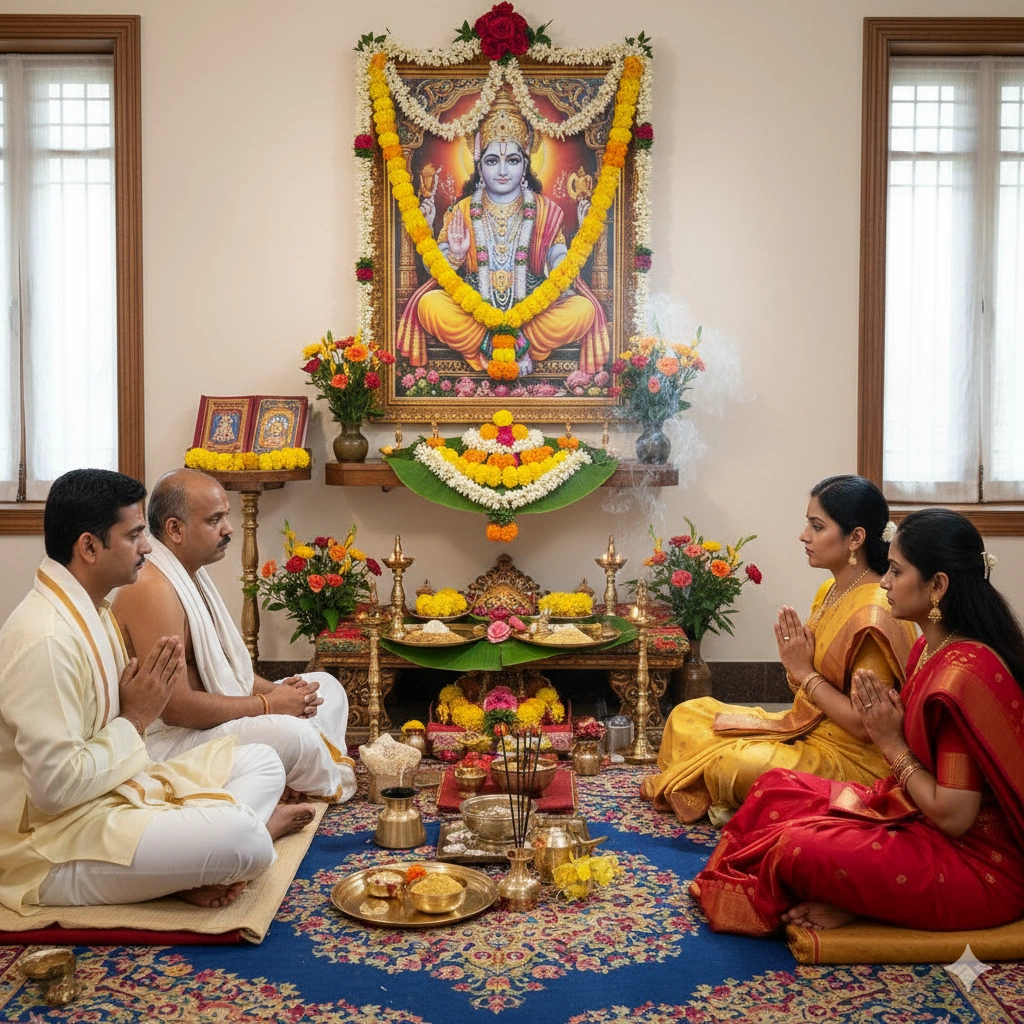
Satyanarayan Puja
(8 Reviews)
There are moments in life that deserve to be offered back to the Divine, a new home, a promotion, the completion of a long journey, the arrival of a child, or simply a heart full of gratitude. Sri Satyanarayan Puja is precisely this offering. It is one of the most beloved and widely performed Vedic rituals in Hindu households, dedicated to Lord Satyanarayan, the form of Lord Vishnu who embodies truth (Satya) and sustenance (Narayan). When performed with complete devotion and proper Vedic procedures, this puja fills a home with grace, abundance, and unwavering peace. Across Pune, from the IT corridors of Hinjewadi to the family colonies of Kothrud, thousands of families choose this sacred ceremony to mark life's most precious milestones.
The Spiritual Significance of Satyanarayan Puja
The glory of this puja is narrated in the Skanda Purana through the Satyanarayan Katha, a series of five chapters (adhyayas) that illustrate what happens when this puja is performed with full faith and what happens when it is neglected. The stories are not mere mythology; they carry deep psychological and spiritual truths about the relationship between human devotion and divine grace.
Lord Satyanarayan is the Supreme Reality in its most benevolent, approachable form. He does not demand extravagant ceremonies or expensive materials, only sincerity, cleanliness of heart, and the intention to share the blessings with family, friends, and the community. The Prasad of this puja (made from banana, milk, sugar, and flour) is a symbol of this simplicity, yet it carries immense spiritual potency.
The puja is believed to fulfill desires (Kama), bestow wealth (Artha), support spiritual liberation (Moksha), and guide the family toward righteous living (Dharma), all four Purusharthas of life.
Who Should Perform Satyanarayan Puja?
This puja is deeply versatile. Any family going through any of the following should strongly consider it:
- New homeowners moving into a flat in Wakad, Baner, or Viman Nagar, to invite prosperity from the first day
- Newly married couples seeking a harmonious, blessed beginning
- Business owners in Pimpri-Chinchwad or Kharadi who have launched a new venture
- Parents after a child is born, joins school, or clears a major exam
- Individuals who have recovered from illness or emerged from a difficult phase
- Anyone who simply wishes to express gratitude to the Divine
There is no restriction based on caste, community, or social standing. Satyanarayan Puja is for every sincere heart.
Ideal Timing and Muhurat for Satyanarayan Puja
While this puja can be performed on any auspicious day, certain dates and tithis are considered especially powerful:
- Purnima (Full Moon), The most traditional day for Satyanarayan Puja. The full moon heightens spiritual energy and makes the puja's blessings more potent.
- Ekadashi, The eleventh day of both fortnights, sacred to Lord Vishnu
- Sankranti days, Makar Sankranti and other solar transitions
- Auspicious personal dates, Birthdays, anniversaries, house-warming days
Our experienced Pandits in Pune will calculate the precise Muhurat based on the Hindu Panchang, the Tithi, the Nakshatra of the day, and your family's janma kundali to ensure the ceremony begins at the most auspicious moment. We also guide you on avoiding Rahu Kaal, Yamaganda, and other inauspicious time windows.
Step-by-Step Ritual Process
Our certified Pandits perform the complete, unabridged Satyanarayan Puja as prescribed in the scriptures:
1. Purification and Sankalp: The Pandit purifies the puja space with Ganga Jal. The head of the family takes a formal Sankalp, a sacred resolve, declaring the intention, name, gotra, and the purpose of the puja. This is the spiritual contract between the devotee and the Divine.
2. Gauri-Ganesh Puja: No Vedic ritual begins without seeking the blessings of Lord Ganesha (the remover of obstacles) and Goddess Gauri. The Pandit establishes the Kalash (a copper or silver pot filled with water, a betel nut, a coin, and mango leaves) as the physical symbol of divinity.
3. Navagrah Puja: The nine planetary deities are invoked and appeased to ensure their favorable influence during and after the ceremony.
4. Satyanarayan Sthapana: Lord Satyanarayan's image or idol is ritually installed. Sixteen sacred offerings (Shodashopachara) are made, including Aavahan (invocation), Padya (water for feet), Arghya (water for hands), Achamana (water for sipping), Snana (bath), Vastra (cloth), Yajnopavita (sacred thread), Gandha (sandalwood paste), Akshata (rice), Pushpa (flowers), Dhupa (incense), Dipa (lamp), Naivedya (food), and Tamboola (betel leaves).
5. Satyanarayan Katha: The Pandit recites all five chapters of the Satyanarayan Katha in Sanskrit, with the key stories translated for the family's understanding. This is the devotional heart of the entire ceremony.
6. Aarti: A beautiful, soulful Aarti is performed, first to Lord Satyanarayan, then to Goddess Lakshmi, and to the Navagrah. This is one of the most moving moments of the entire puja.
7. Prasad Distribution: The traditional Prasad, made from ripe bananas, pure cow milk, pure sugar, and wheat flour, is prepared with devotion and distributed to all present. The Katha explicitly warns that one must not disrespect or avoid the Prasad.
8. Mantra Pushpanjali and Visarjan: The ceremony concludes with a final flower offering and a formal request to Lord Satyanarayan to bless the family and return to his divine abode.
Benefits of Performing Satyanarayan Puja
Spiritual Benefits:
- Deepens the family's connection with Lord Vishnu's cosmic grace
- Fulfills long-held wishes and spiritual desires
- Creates an atmosphere of divine presence in the home
- Purifies past karma and protects against future hardships
Material Benefits:
- Known to attract financial stability and business growth
- Removes obstacles in career, education, and legal matters
- Brings harmony in marital and family relationships
- Invites prosperity and material well-being
Mental and Emotional Benefits:
- Creates peace of mind and reduces anxiety
- Strengthens family bonds through shared devotion
- Restores hope and faith during difficult periods
- Creates a foundation of gratitude and contentment
What is Included in Our Service
When you book Satyanarayan Puja through Vedic Pooja in Pune, we bring everything:
- Experienced, verified Pandit (1 to 2 based on package)
- Complete Puja Samagri: Kalash, Gangajal, Flowers, Roli, Haldi, Chandan, Dhoop, Deepak, Incense Sticks, Panchamrit items, Puja Thali, Fruits, Betel Leaves, and dedicated Satyanarayan Prasad materials
- Recitation of the complete five-chapter Katha
- Aarti and Mantra Pushpanjali
- Post-puja guidance on maintaining the spiritual energy of your home
Why Choose Vedic Pooja for Satyanarayan Puja in Pune?
With hundreds of pooja service providers in Pune, the question is simple: who can you truly trust?
At Vedic Pooja, every Pandit in our network is personally vetted. They are trained in traditional Vedic systems, fluent in Sanskrit, Hindi, and Marathi, and have performed this puja hundreds of times. They understand that a puja is not just a transaction, it is a deeply personal family moment.
We serve every part of Pune, including Hadapsar, Pashan, Aundh, Viman Nagar, Kharadi, and the newer IT hubs of Wakad and Hinjewadi. Whether your home is a compact apartment or a sprawling villa, our Pandits bring the same reverence and completeness to every ceremony.
Our promise to you: The puja will begin on time, every mantra will be recited correctly, and your family will feel the tangible spiritual upliftment that a proper Satyanarayan Puja delivers. No shortcuts. No hurried ceremonies. Just authentic Vedic devotion, delivered to your doorstep.
Book your Satyanarayan Puja in Pune today. Call or WhatsApp us at 8668552465 for an instant booking confirmation and free Muhurat consultation.
From
₹3,100

Shubh Vivah (Hindu Wedding Ceremony / Shaadi Puja / Lagna Vidhi)
(0 Reviews)
## Shubh Vivah — The Most Sacred of All Hindu Samskaras
Marriage — called Vivah Sanskar or Lagna Vidhi in the Vedic tradition — is regarded as the most sacred and life-defining of the sixteen Samskaras (sacraments) prescribed in Hinduism. It is far more than the legal union of two individuals. A Hindu Wedding Ceremony is the profound merging of two souls, two families, two lineages (Gotras), and two destinies into one harmonious journey. Every chant recited, every fire kindled, and every vow taken during the Hindu Marriage Ceremony is a carefully composed Vedic prayer that invokes the blessings of the Almighty, the Pancha Bhuta (five elements of nature), the nine planets (Navagrahas), and the ancestors (Pitru Devata) — all bearing witness to the eternal commitment being made.
At Vedic Pooja, our mission is to make your wedding not just a ceremony, but a deeply meaningful spiritual experience that you and your family will cherish forever. We provide highly experienced, verified, and eloquent Pandits for Shubh Vivah across all of Pune and PCMC. Whether you are planning a grand destination wedding, an intimate home ceremony, or a traditional Shaadi Puja at a heritage hall, our team ensures that every mantra is chanted with perfect Vedic pronunciation, every ritual is explained in simple language, and every moment is handled with the reverence it deserves.
---
Pre-Wedding Rituals: Setting the Sacred Stage
A complete Hindu Wedding begins days before the actual Lagna Puja. Our Pandits are available to conduct all pre-wedding rituals as part of a holistic wedding package.
Haldi Ceremony Puja (Pithi Puja): The Haldi Ceremony is one of the most joyful pre-wedding traditions. Our Pandit performs the Haldi Puja by invoking Goddess Gauri and applying turmeric paste to the bride and groom separately. The turmeric is considered a purifying, antibacterial, and auspicious element that prepares the couple's body, mind, and aura for the sacred Vivah Vidhi ahead. The Haldi Ceremony Puja is filled with folk songs, family participation, and genuine spiritual energy.
Mehendi Ceremony Puja: The Mehendi Ceremony is traditionally accompanied by prayers for the bride's marital bliss. Our Pandit recites Mangalashtak and specific mantras from the Vivah Panchang so that this beautiful ritual carries full Vedic sanctity alongside the festive celebration.
Mandap Muhurat & Gotra Puja: Before the wedding day, the sacred Mandap (canopy) is established and a Gotra Puja is performed. This ritual invokes the bride's and groom's ancestral lineage (Gotra), honoring the forefathers and seeking their blessings. For inter-caste or inter-Gotra weddings, a special Gotra Pravesh Sankalp is recited by our Pandit, sanctifying the union across family lines. This ritual is also relevant when choosing the Vivah Muhurat 2025 or Vivah Muhurat 2026 — our Pandits carefully consult the Lagna Panchang and Vivah Panchang to identify the most auspicious date and time based on the couple's horoscopes and nakshatra compatibility.
---
The Main Wedding Day: Step-by-Step Rituals of the Hindu Marriage Ceremony
On the Shubh Muhurat Vivah day, our Pandit arrives at your venue well in advance to set up the Mandap, arrange the Samagri, and prepare for a flawless ceremony. Here is a detailed walkthrough of the Hindu Wedding Rituals we perform:
1. Ganesh Puja & Punyavahachan
Every auspicious occasion in the Hindu tradition begins with the worship of Lord Ganesha, the remover of obstacles. Our Shaadi Ka Pandit performs a comprehensive Ganesh Puja followed by Punyavahachan — a water-based purification ritual using a Kalash (sacred pot) that sanctifies the wedding venue and all participants.
2. Baraat Swagat & Dwar Puja
When the groom arrives with his Baraat (wedding procession), the bride's family formally welcomes him with a Tilak, Aarti, and a traditional Dwar Puja. This ancient ritual acknowledges the groom as a divine guest — an avatar of Lord Vishnu — arriving to receive the greatest gift (Kanyadaan).
3. Var Mala (Jaimala / Varmala Ceremony)
The Jaimala or Var Mala ceremony is the exchange of flower garlands between the bride and groom. In the Varmala Ceremony, both partners mutually accept each other in the presence of their families, marking the beginning of their shared journey. Our Pandit recites specific Vedic mantras during this joyful moment, connecting the ceremony to its spiritual roots.
4. Kanyadaan (Kanya Daan Ceremony)
The Kanyadaan is universally regarded as the greatest act of charity (Maha Daan) that a father can perform. In the Kanya Daan Ceremony, the bride's parents place her right hand into the groom's right hand, symbolically entrusting her life, happiness, and future into his care. Water is poured over their joined hands as the Pandit recites the Kanyadaan Sankalp Mantra from the Rig Veda. This moment is profoundly emotional and spiritually transformative — often the most moving part of the entire Hindu Wedding Ceremony.
5. Hast Milap & Granthi Bandhan
Immediately following Kanyadaan, the Hast Milap ritual is performed — the formal clasping of the bride's and groom's hands. Our Pandit then ties the Granthi Bandhan (sacred knot) using the bride's dupatta/saree and the groom's uttariya (shawl), symbolizing that their lives, fates, and souls are now irrevocably bound together.
6. Mangal Phera (Circling the Sacred Fire)
The couple walks around the Agni (sacred fire, the eternal witness) four times in what is called Mangal Phera. Each circuit represents one of the four Purusharthas — the four supreme goals of a human life: Dharma (righteous living), Artha (prosperity), Kama (love and desire), and Moksha (spiritual liberation). The fire is not just a ritual prop; in the Vedic worldview, Agni carries the prayers, intentions, and promises directly to the gods.
7. Saptapadi — Saat Phere — The Seven Steps Wedding Vows
The Saptapadi, popularly known as Saat Phere (the Seven Steps), is the most legally and spiritually significant ritual of the Vivah Puja. The couple takes seven steps together — each step accompanied by a Vedic Sankalp (vow) — covering the seven pillars of a blessed married life: nourishment, strength, prosperity, happiness, progeny, longevity, and undying friendship. Once the Seven Steps Wedding ritual is complete, the marriage is both spiritually sealed and legally binding under Indian law. Our Pandit explains each vow meaningfully so that the couple and their guests connect deeply with the ceremony.
8. Sindoor Daan & Sindoor Ceremony
After Saptapadi, the groom applies Sindoor (vermilion) to the bride's hair parting (Maang). The Sindoor Dan or Sindoor Ceremony is one of the most iconic and emotionally charged moments of the Hindu Marriage Ceremony. The Sindoor signifies that the bride is now a Suhagan — a blessed married woman — and marks the groom's lifelong commitment to her well-being.
9. Mangalsutra Ceremony
The groom ties the Mangalsutra (a sacred black-beaded gold necklace) around the bride's neck, chanting the Mangalsutra Mantra. The Mangalsutra Ceremony is a vow of protection, love, and eternal companionship. The Mangalsutra is not merely ornamental — it is a Vedic symbol that connects the couple spiritually and is worn by the bride as a mark of a blessed and complete life.
10. Ashirvad & Vidai Ceremony
The wedding concludes with the Ashirvad — blessings from the Pandit, parents, and elders — followed by the deeply emotional Vidai Ceremony. The Vidai is the formal farewell of the bride from her parents' home. Our Pandit recites specific Griha-Pravesh prayers and Mangal Sutras to protect the bride as she begins her new journey.
---
Griha Pravesh After Wedding
Upon arriving at her new home, the bride is welcomed in a ritual called Griha Pravesh after wedding (also known as Gruhapravesh). Our Pandit performs a Lakshmi Puja and a protective Vastu Shanti as the new bride enters the threshold for the first time, ensuring that prosperity, peace, and divine blessings fill the home from the very first moment.
---
Vivah Muhurat 2025 & Vivah Muhurat 2026 — Choosing the Auspicious Date
Choosing the right date is as important as the ceremony itself. Our Pandits are experts in Vivah Muhurat 2025 and Vivah Muhurat 2026 calculations. Using the Lagna Panchang and Vivah Panchang, we analyze the couple's Kundali (horoscope), Nakshatra (birth star), Tithi (lunar day), and the positions of Jupiter and Venus to identify the most Shubh Vivah Muhurat Pune — maximizing the couple's compatibility, prosperity, and spiritual harmony for their life ahead. Muhurat consultation is included in all our packages.
---
Special Wedding Services in Pune
Wedding Pandit Pune — All Areas Covered:
Our Marriage Pandit Pune team covers every corner of the city and surrounding areas, including Wakad, Baner, Kharadi, Hinjewadi, Kothrud, Hadapsar, Viman Nagar, Koregaon Park, Kalyani Nagar, Pimpri, Chinchwad, PCMC, Aundh, and Deccan. Whether you are searching for a Hindu Wedding Pandit near me Pune or need a Wedding Pandit dispatched to a resort in Lavasa or Lonavala, our network is ready.
Inter-Caste Wedding Puja Pune:
We fully support and celebrate love across communities. Our Pandits are trained and experienced in conducting Inter-Caste Wedding Puja Pune with sensitivity and full Vedic authority. Special Gotra-resolution mantras and a customized Sankalp are prepared for such weddings.
Court Marriage Puja Pandit Pune:
Many couples complete a Court Marriage and then wish to sanctify their union with a religious ceremony. Our Court Marriage Puja Pandit Pune services offer a comprehensive Vedic Vivah Vidhi post-registration, giving the couple the spiritual and traditional validation that their families seek.
Destination Wedding Pandit Pune:
Planning a grand resort wedding? Our Destination Wedding Pandit Pune service is fully portable. Our Pandits travel to venues in Mulshi, Mahabaleshwar, Alibaug, and beyond, carrying all the required Samagri and ensuring the ceremony maintains full Vedic authenticity regardless of the setting.
Wedding Anniversary Puja (Vivah Varshgant Puja):
For couples celebrating their milestone anniversaries, we offer the Vivah Varshgant Puja — a renewal of wedding vows performed with Vedic mantras, a Havan, and the re-tying of the Granthi Bandhan. This is a beautiful way to reaffirm your commitment and invite fresh blessings into your marriage.
---
Why Vedic Pooja is the Most Trusted Marriage Ceremony Pandit in Pune
* Multi-Lingual Pandits: Our Shaadi Ka Pandit team conducts ceremonies fluently in Marathi, Hindi, Sanskrit, and English — ensuring every guest, from every background, understands and connects with the ceremony.
* Complete Samagri Included: Forget the last-minute shopping chaos. Our Standard and Premium packages include 100% of the Marriage Puja Samagri — Havan wood, ghee, Navagraha items, Haldi, Kumkum, flowers, and more.
* Punctuality Guaranteed: Lagna Muhurats are sacred windows of time. Our Pandits are famous for arriving 30–45 minutes early to set up and begin precisely on schedule.
* Team of Pandits for Grand Weddings: Large-scale Marriage Rituals Pune at venues in Hadapsar or Kharadi may require coordinated chanting. Our Premium package includes a synchronized team of 3 Pandits.
* End-to-End Coverage: From Sakharpuda (Engagement Puja) and Haldi Ceremony Puja to Griha Pravesh after wedding and Vivah Varshgant Puja, we are your single spiritual partner for every milestone.
Book your Wedding Pandit Pune today. Call or WhatsApp us to confirm your Shubh Vivah Muhurat Pune, discuss your venue, and receive a customized quote tailored to your dream Hindu Wedding.
From
₹11,000
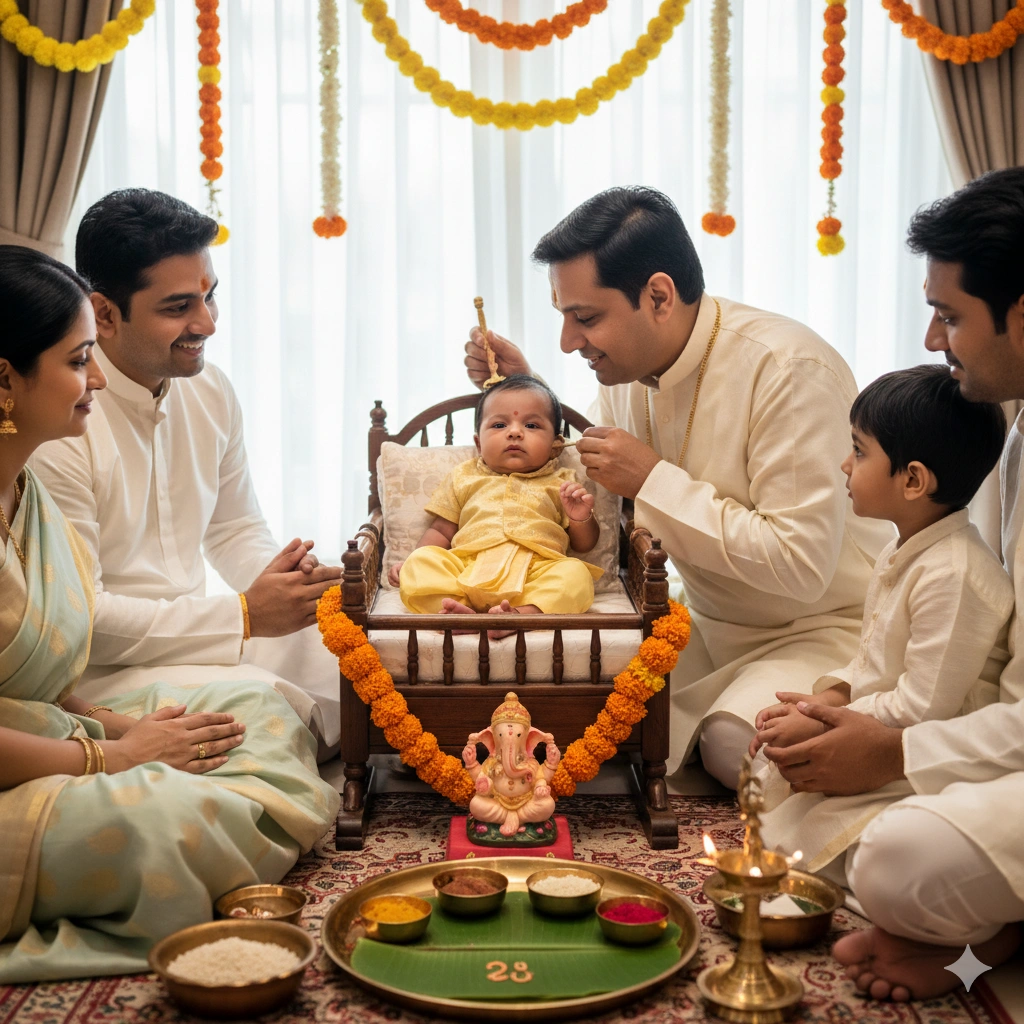
Naamkaran Sanskar
(8 Reviews)
A name is not just a label. In the Vedic tradition, a name carries the seed of a person's destiny. The vibrations of the syllables in a name, when chosen according to the birth Nakshatra, Rashi, and the alignment of planetary energies, become a daily mantra that the child hears every time they are called. This is why Naamkaran Sanskar, the sacred naming ceremony of a newborn, is one of the most carefully considered and spiritually charged of all sixteen Vedic Samskaras. When performed with the correct Vedic procedures on an auspicious Muhurat, the Naamkaran ceremony plants the seeds of good health, strong character, long life, and auspicious destiny for the child. Families across Pune, from the residential colonies of Kothrud and Hadapsar to the modern societies of Wakad and Baner, perform this beautiful ceremony to give their newborn the best spiritual beginning possible.
The Significance of Naamkaran Sanskar
The Naamkaran Sanskar is described in the Grihya Sutras, the ancient texts governing household ceremonies, as the official entry of the child into society. Before the naming ceremony, the child lives in a kind of sacred liminal space. With the Naamkaran, the child receives their social identity, their cosmic identity (linked to their birth Nakshatra), and their spiritual identity (linked to the family's deity and gotra).
According to the Vedic sage Vashishtha, a person's name should ideally:
- Begin with a sound corresponding to the birth Nakshatra's Pada (quarter)
- Have an even number of syllables (for girls) or odd number (for boys) in some traditions
- End in a long vowel sound (this strengthens the name's vibration)
- Invoke an auspicious quality or divine name
The ceremony also serves a protective function: by formally announcing the child's name to the gods, ancestors, and the community, the family invokes a collective field of protection and blessing around the child.
Traditional Types of Names in Naamkaran
In the Naamkaran ceremony, families traditionally choose up to four names for the child:
1. Nakshatra Naam: Based on the syllable corresponding to the child's birth Nakshatra. This is the child's hidden spiritual name, known only to close family.
2. Rashi Naam: Based on the child's Moon sign (Rashi). This is often the name used in astrological matters.
3. Maas Naam: Based on the month of birth according to the Hindu calendar.
4. Vyavaharik Naam: The social name used in daily life, chosen by the family for its beauty and meaning.
Our Pandits guide families through all these naming traditions and help choose syllables that are auspicious for the child's specific birth chart.
Ideal Time for Naamkaran Sanskar
According to the scriptures, Naamkaran is ideally performed:
- On the 11th day after birth (Ekadasha ceremony), the traditional timing
- Or between the 12th and 41st day, based on family tradition
- On an auspicious Tithi: Dwitiya, Tritiya, Panchami, Saptami, Dashami, Dwadashi, or Trayodashi
- On an auspicious Nakshatra: Any of the 27 except for Jyeshtha, Mula, Ardra, Ashlesha, or Vishakha
- During Shukla Paksha (waxing moon period)
Our astrologer-Pandits calculate the most auspicious Muhurat based on the child's exact birth time, date, and place.
Step-by-Step Naamkaran Sanskar Ritual Process
1. Purification of Space: The puja area is cleaned and purified with Gangajal. Fresh flowers, mango leaves, and banana leaves decorate the ceremony space.
2. Sankalp: The Pandit takes the formal Sankalp in the names of both parents, stating their gotra, the child's birth date, birth time, birth Nakshatra, and the intention of the ceremony.
3. Ganapati Puja: Lord Ganesha is invoked and worshipped to bless the child's new beginning and remove all obstacles from their life path.
4. Navagraha Puja and Jaap: The nine planetary deities are invoked and appeased. Specific mantras are chanted for the child's birth planet (Janma Graha) and the planet governing their birth Nakshatra (Nakshatra Swami).
5. Matrika Puja and Kshetrapal Puja: The seven divine mothers (Saptamatrikas) are invoked for the child's protection. The guardian deity of the land is also propitiated.
6. Jatkarma Revisiting: If the Jatkarma Samskara (performed at birth) was not formally done, the Pandit performs its mantras as part of this ceremony.
7. Naamkaran Mantra and Name Declaration: The father (or head of the family) takes the child in his lap and whispers the chosen name three times into the child's right ear, followed by the Pandit chanting the Naamkaran mantra: "Asya Shisho Naam Idam Bhavatu...", formally declaring the child's name to the gods, ancestors, and those present.
8. Surya Darshan: The child is brought outside (or near a window) to see the sun for the first time. The Pandit chants the Surya Namaskar mantra, invoking the sun's blessings of health, vitality, and long life.
9. Medhajanan (Honey and Ghee): A small amount of pure honey mixed with pure ghee is placed on the child's tongue with a golden implement (or clean finger) while chanting: "Medhajanan Kara...", invoking intelligence and wisdom.
10. Ayushya Suktam: The Pandit chants the Ayushya Suktam, Vedic hymns specifically for long life and good health, over the child.
11. Aarti and Blessings: The family and guests bless the child. A small Havan is performed to consecrate the child's name in the sacred fire.
Benefits of Naamkaran Sanskar
- The child receives a vibrationally auspicious name that supports their natural strengths
- Planetary blessings are invoked for health, intelligence, and longevity
- The family's ancestral blessings are formally channeled to the child
- The community's spiritual support is gathered around the child from the earliest stage of life
- The child's birth chart is activated with protective mantras
What's Included
- Experienced Pandit trained in Samskara rituals
- Complete Samagri: Gangajal, flowers, banana leaves, mango leaves, honey, ghee, puja thali, incense, lamps
- Nakshatra calculation and auspicious name syllable guidance
- Ayushya Suktam and Navagraha mantras
- Havan for name consecration
- Prasad distribution
Why Choose Vedic Pooja for Naamkaran Sanskar in Pune?
Your child's naming ceremony is a once-in-a-lifetime moment. Our Pandits approach it with the reverence, warmth, and procedural correctness that this sacred occasion deserves. We serve all areas of Pune, from Viman Nagar and Kharadi to Aundh and Pashan, and we bring all required samagri so your family can focus entirely on the joy of the moment.
Our Pandits also speak warmly in Hindi and Marathi so every family member, including grandparents, can understand and participate fully in this meaningful ceremony.
Call or WhatsApp 8668552465 to book your Naamkaran Sanskar in Pune.
From
₹3,100
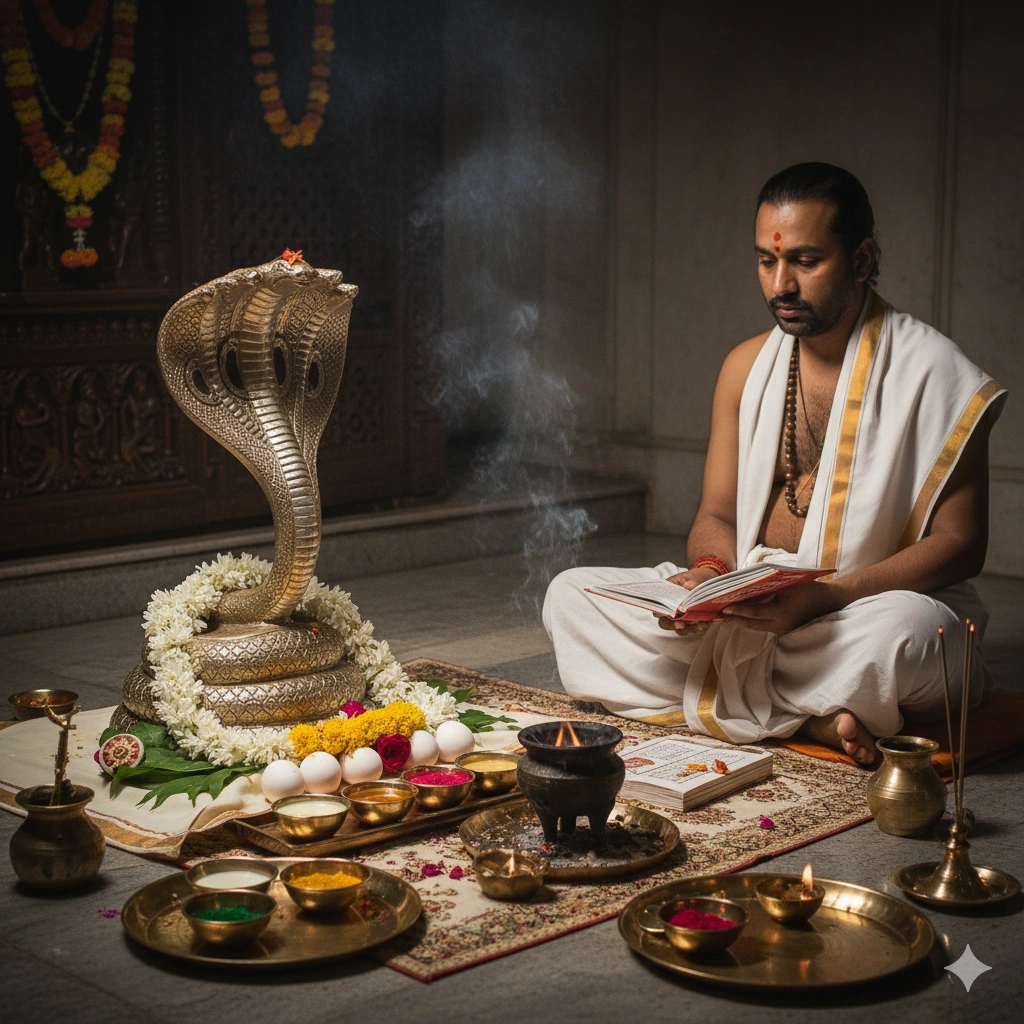
Kaal Sarp Dosh Shanti
(8 Reviews)
Imagine waking up every morning with the feeling that something is holding you back, that no matter how hard you work, success slips through your fingers, relationships strain under invisible pressure, and life refuses to flow. For millions of people, this is not imagination but a lived reality rooted in a powerful astrological condition called Kaal Sarp Dosh. If an astrologer has told you or a family member that all seven planets in the birth chart are placed between Rahu and Ketu, you have this Dosh. And while it sounds daunting, Vedic astrology provides a definitive remedy: the Kaal Sarp Dosh Shanti Puja. At Vedic Pooja, our experienced Pandits have helped hundreds of families across Pune, from Hadapsar to Wakad, from Kharadi to Aundh, break free from this cosmic restriction and step into the life they deserve.
Understanding Kaal Sarp Dosh
In a birth chart (Kundali), Rahu and Ketu are the shadow planets, the north and south lunar nodes. When all seven visible planets (Sun, Moon, Mars, Mercury, Jupiter, Venus, Saturn) are positioned on one side of the Rahu-Ketu axis, a condition called Kaal Sarp Yoga (or Dosh) is formed. The word 'Kaal' means time and death, 'Sarp' means serpent, together, this Dosh creates a serpent-like constriction around the chart's potential.
There are twelve types of Kaal Sarp Dosh depending on the position of Rahu in the chart:
- Anant Kaal Sarp Dosh (Rahu in 1st house), affects personality and self-image
- Kulik Kaal Sarp Dosh (Rahu in 2nd house), impacts finances and family
- Vasuki Kaal Sarp Dosh (Rahu in 3rd house), affects communication and siblings
- Shankhpal Kaal Sarp Dosh (Rahu in 4th house), impacts home and mother
- Padma Kaal Sarp Dosh (Rahu in 5th house), affects children and creativity
- Mahapadma Kaal Sarp Dosh (Rahu in 6th house), causes health and enemy troubles
- Takshak Kaal Sarp Dosh (Rahu in 7th house), strains marriage and partnerships
- Karkotak Kaal Sarp Dosh (Rahu in 8th house), creates hidden fears and sudden losses
- Shankhnaad Kaal Sarp Dosh (Rahu in 9th house), reduces luck and father's support
- Patak Kaal Sarp Dosh (Rahu in 10th house), blocks career growth
- Vishadhar Kaal Sarp Dosh (Rahu in 11th house), hampers income and social growth
- Sheshnag Kaal Sarp Dosh (Rahu in 12th house), creates expenditure and spiritual confusion
The severity varies by chart, but the common thread is a persistent feeling of limitation despite genuine effort.
Common Symptoms of Kaal Sarp Dosh
People with Kaal Sarp Dosh often report:
- Recurring nightmares involving snakes or water
- Unexplained failures despite hard work and intelligence
- Delays in marriage, children, career advancement
- Strained family relationships and constant disagreements
- Health issues that are difficult to diagnose or treat
- Financial instability, money comes but disappears quickly
- A persistent feeling of being 'cursed' or unlucky
Who Should Perform Kaal Sarp Dosh Shanti?
This puja is recommended for:
- Anyone whose Kundali has been confirmed to have Kaal Sarp Dosh by a qualified astrologer
- People experiencing consistent failures in career or business despite good qualifications
- Those facing unexplained health issues, especially related to anxiety or the nervous system
- Couples facing delays or difficulties in marriage
- Parents of children with learning difficulties or developmental challenges
- Anyone experiencing recurring snake-related dreams
Before booking, our team can arrange a brief Kundali verification with our expert astrologer to confirm the presence and type of Kaal Sarp Dosh and recommend the most appropriate ritual.
Step-by-Step Kaal Sarp Dosh Shanti Ritual Process
1. Kundali Review and Sankalp: The ceremony begins with the Pandit reviewing the birth chart. A formal Sankalp is taken in the person's name, gotra, and birth details, stating the exact type of Kaal Sarp Dosh being remedied.
2. Ganesh Puja and Navagrah Sthapana: Lord Ganesha is invoked to remove obstacles from the ritual itself. The nine planets are established in the puja space.
3. Nag-Nagin Sthapana: Silver or clay idols of Nag (male serpent) and Nagin (female serpent) are ritually installed and worshipped. These represent the serpent deities who govern the Rahu-Ketu axis.
4. Rahu-Ketu Puja: Specific mantras for Rahu and Ketu are chanted, appeasing both shadow planets. Offerings of blue flowers, coconut, and black sesame seeds are made.
5. Kaal Sarp Dosh Nivaran Jaap: The specific Kaal Sarp Dosh Nivaran Mantra is chanted a minimum of 108 times (premium packages include 1,008 or 10,008 repetitions for severe cases).
6. Mahamrityunjaya Jaap: For cases where health is affected, the Mahamrityunjaya Mantra is chanted 108 times to seek Lord Shiva's healing protection.
7. Havan: A sacred fire is lit. Offerings of ghee, sesame, rice, and specific herbs are made into the Havan with Rahu and Ketu beej mantras. The Havan's smoke purifies the aura and neutralizes the dosh's energy patterns.
8. Nag Visarjan: The Nag-Nagin idols are ritually immersed in water (or a flowing body of water if available), symbolizing the release of the serpent's constriction from the person's life.
9. Prasad and Remedies: The Pandit provides specific post-puja remedies, wearing of specific gemstones, dietary recommendations, and protective mantras for daily chanting.
Best Location for Kaal Sarp Dosh Shanti
For the most powerful results, this puja is traditionally performed at one of the following:
- Trimbakeshwar, Nashik, one of twelve Jyotirlingas and the most powerful location for Kaal Sarp Dosh Shanti
- Rameshwaram, Tamil Nadu
- At home, equally valid and effective when performed by a qualified Pandit with proper Vedic procedures
For families in Pune who cannot travel to Trimbakeshwar, our Pandits perform the complete ritual at your home in Pune with the same procedures, mantras, and samagri used at pilgrimage sites.
Benefits of Kaal Sarp Dosh Shanti Puja
Immediate Effects (1–3 months):
- Reduction in recurring nightmares
- Mental clarity and reduced anxiety
- Improved sleep and physical health
Medium-Term Effects (3–12 months):
- Noticeable improvement in career and business opportunities
- Resolution of relationship conflicts
- Financial stability beginning to establish
Long-Term Effects:
- Removal of the serpent's constriction from the natal chart's potential
- Freedom to live the life that one's other planetary placements would normally support
- Spiritual growth and liberation from past-life karma related to serpent deities
Best Muhurat for Kaal Sarp Dosh Shanti
- Nag Panchami, the most auspicious day of the year for all serpent-related pujas
- Amavasya (New Moon), particularly powerful for Rahu-Ketu rituals
- Naag Panchami in Shravan, doubly powerful due to Shravan's connection with Lord Shiva
- Eclipses (Solar/Lunar), should be avoided for positive rituals; best for Rahu-Ketu specific work under guidance
Why Choose Vedic Pooja for Kaal Sarp Dosh Shanti in Pune?
This is not a ritual to be performed casually. The serpent deities are powerful and respond strongly to both devotion and procedural correctness. A hurriedly performed or improperly chanted Kaal Sarp Dosh puja can fail to deliver results or even disturb the practitioner.
Our Pandits are specifically trained in Rahu-Ketu remedial rituals. They carry all required Nag-Nagin idols, Rahu-Ketu specific samagri, blue and mixed flowers, and all Havan materials. We serve the entire Pune region, Viman Nagar, Pimpri-Chinchwad, Baner, Kothrud, Pashan, and beyond.
We also provide a free 15-minute post-puja consultation to guide you on long-term remedies, dietary changes, and protective mantras specific to your type of Kaal Sarp Dosh. Our goal is not just to perform the ritual, but to genuinely help your life transform.
Call or WhatsApp 8668552465 today. Your life's potential is waiting to be unlocked.
From
₹8,100
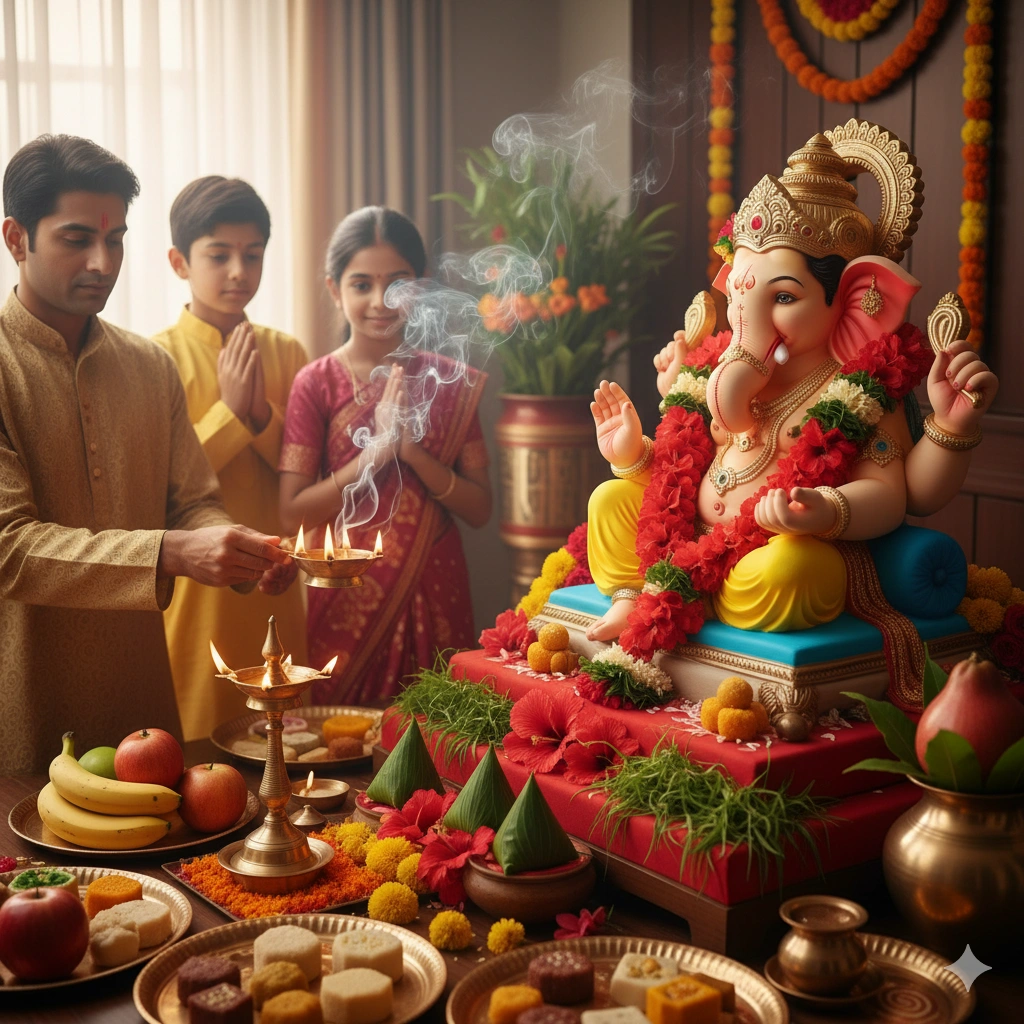
Ganesh Puja (Ganapati Puja / Ganesh Chaturthi Puja)
(8 Reviews)
In the Vedic tradition, no sacred work, no new beginning, and no ceremony of significance is commenced without first invoking Lord Ganesha — the first-worshipped deity, the remover of all obstacles, and the lord of wisdom and auspicious beginnings. Known variously as Ganesh Puja, Ganpati Puja, Ganapati Puja, Ganesha Puja, Vinayaka Puja, and Vighnesh Puja, this ancient ritual is the foundational act of every Hindu ceremony. Whether it is a business launch, a new home, a wedding, or a spiritual practice, Ganesh Puja forms the auspicious gateway through which divine blessings flow. Families across Pune — from the tech corridors of Hinjewadi and Wakad to the traditional homes of Kothrud and Pimpri Chinchwad — perform Ganpati Puja before every major life event, knowing that Vighnaharta must be pleased first.
The Many Names and Forms of Lord Ganesha
Lord Ganesha is worshipped under 108 names, each reflecting a distinct aspect of his divine nature. Vinayaka Puja (without a superior, the self-governing lord) is performed to awaken leadership and independence. Vighnesh Puja addresses the lord specifically as the master of all obstacles. Vighnaharta Puja invokes his grace to remove those obstacles from one's life path. Whether you call it Ganapati Puja, Ganesha Puja, or Ganesh Puja, the essence remains the same: aligning your intentions with the cosmic intelligence that Lord Ganesha embodies before any undertaking begins.
In Maharashtra, Ganesh Chaturthi Puja holds a uniquely exalted place. This is the day Lord Ganesha was born, and the Ganesh Chaturthi Puja at home transforms every household into a living temple. The ritual of Ganapati Sthapana at home in Pune — whether for one and a half days, five days, or eleven days — is performed by millions of families every Bhadrapada. Our pandits are specialists in authentic Ganapati Sthapana at home in Pune, following the complete Vedic procedure that includes Pranapratishtha, Shodashopachara Puja, and daily Aarti rituals.
Ganesh Puja for New Business and Work Beginnings
One of the most powerful and widely requested services we offer is Ganesh Puja for new business. Whether you are launching a startup in Hinjewadi, opening a retail outlet in Kharadi, registering a company in PCMC, or entering into a major contract in Baner, performing Ganesh Puja before starting work is considered indispensable in the Vedic tradition. This is an obstacle removal puja at its most practical: it clears the energetic and karmic path so that your business efforts meet with divine support rather than friction.
Ganesh Puja before starting work is not merely superstition — it is an ancient technology of intention-setting. The Sankalp performed at the beginning of the puja formally declares your purpose before the divine witness, creating a sacred contract between your intention and cosmic intelligence. Businessmen, entrepreneurs, and professionals across Pune who have made Ganesh Puja for new business a part of their founding ritual consistently report a smoother launch, better partnerships, and unexpected positive developments.
Sankashti Chaturthi Puja — Monthly Devotion to Lord Ganesha
For devoted worshippers of Lord Ganesha, Sankashti Chaturthi Puja is the monthly ritual performed on the fourth day of the Krishna Paksha (dark fortnight). Sankashti literally means "deliverance from a great peril," and Sankashti Puja is specifically performed to remove accumulated obstacles, difficulties, and afflictions from one's life. Families in Pune who observe a monthly fast and perform Sankashti Chaturthi Puja report steady improvement in health, finances, and relationships.
If you are looking for a Sankashti Puja pandit in Pune who can perform the complete ritual including Chandra Darshan (viewing the moon) and the recitation of the Sankashti Stotra, our experienced Pandits are available across all areas of Pune including Wakad, Baner, Kothrud, Kharadi, Hinjewadi, and Pimpri Chinchwad PCMC.
Ganesh Lakshmi Puja — The Dual Blessing of Prosperity
A particularly auspicious combination performed before business ventures, on Diwali, and at new home inaugurations is the Ganesh Lakshmi Puja (also spelled Ganesh Laxmi Puja). In this puja, Ganesh is always worshipped first — as Prathamapujya — followed by Goddess Lakshmi, the deity of wealth and abundance. The logic is deeply Vedic: without removing obstacles first (Ganesh's domain), Lakshmi's blessings cannot flow unimpeded. The Ganesh Lakshmi Puja thus ensures that the path to prosperity is both cleared and then abundantly filled. This dual puja is highly recommended for new business openings, annual business blessings, and Diwali celebrations in Pune.
The Sacred Rituals: Durva Archana, Ganesh Atharvashirsha, and Modak Bhog
Durva Archana — The Grass That Pleases Ganesha Most
Among all offerings made to Lord Ganesha, Durva (the bent, three-bladed sacred grass) holds the highest place. Our Pandits perform Durva Archana with either 21 Durva puja (each blade offered with a specific name of Ganesha) in the standard ceremony, or the elaborate 108 Durva puja in which all 108 names of Lord Ganesha are chanted with a corresponding Durva offering. The 108 Durva puja is a deeply moving ritual that typically takes 45–60 minutes and creates a profoundly elevated spiritual atmosphere in the home. It is included in our Premium package.
Ganesh Atharvashirsha — The Upanishad of Lord Ganesha
The Ganesh Atharvashirsha (also known as Ganpati Atharvashirsh Path) is an ancient Upanishadic text dedicated entirely to the supreme nature of Lord Ganesha. It begins with the declaration that Ganesha is Brahman itself — the ultimate reality — and proceeds to describe his cosmic form, his relationship with the Panchatatvas (five elements), and the immense benefits of his worship. Our Pandits chant the Ganesh Atharvashirsha with correct Vedic intonation and pronunciation. The chanting of Ganpati Atharvashirsh Path fills the home with powerful vibrations that pacify planetary afflictions and clear negative energies accumulated over time. This is included in our Standard and Premium packages.
Modak Bhog — The Offering of Joy
Lord Ganesha's favorite food is the Modak — a sweet dumpling made from coconut, jaggery, and rice flour that represents the sweetness of spiritual liberation. The offering of Modak Bhog is an essential part of every Ganesh Puja. In our service, Modak is prepared or procured specifically for the puja and offered to Lord Ganesha before being distributed as Prasad to all present.
Sukhakarta Dukhaharta Aarti
No Ganesh Puja is complete without the famous Sukhakarta Dukhaharta aarti composed by Sant Samarth Ramdas in Marathi. This devotional hymn, sung universally across Maharashtra, summarizes Ganesha's divine role: the creator of joy and the destroyer of sorrow. Our Pandits lead the congregation in this aarti with genuine devotion, creating an atmosphere that even non-religious participants find deeply moving.
Siddhivinayak Puja at Home
For devotees who cannot visit the Siddhivinayak Temple in Mumbai, we offer Siddhivinayak Puja at home in Pune. Siddhivinayak — the Lord who grants Siddhi (attainment) and Vinayaka (the supreme guide) — is worshipped with special focus on fulfilling a specific wish or completing a long-delayed goal. The Siddhivinayak Puja at home follows the same authentic ritual format as temple worship, performed by our Pandits with the complete Shodashopachara and Atharvashirsha recitation.
Step-by-Step Ganesh Puja Ritual Process
1. Purification (Shuddhi): The puja space is purified with Gangajal. The Pandit performs Aachaman and establishes the sacred Mandala.
2. Sankalp: The head of the household declares the purpose, occasion, family name, gotra, and blessings sought.
3. Ganesh Sthapana / Ganapati Sthapana: The idol is ritually installed through Pranapratishtha.
4. Shodashopachara Puja: Sixteen sacred offerings including Padya, Arghya, Snana, Vastra, Gandha, Akshata, Pushpa, Dhupa, Deepa, and Naivedya.
5. Durva Archana: 21 Durva puja or 108 Durva puja depending on the package.
6. Modak Bhog: Fresh Modaks are offered to Lord Ganesha.
7. Ganesh Atharvashirsha / Ganpati Atharvashirsh Path: Chanted by the Pandit with correct Vedic pronunciation.
8. Sukhakarta Dukhaharta Aarti: The congregation joins the Pandit in this beloved aarti.
9. Pradakshina and Visarjan: Three circumambulations, followed by concluding prayers.
Who Should Perform Ganesh Puja?
- Entrepreneurs in Wakad, Kharadi, Baner, or PCMC performing Ganesh Puja for new business
- Students before exams or a new academic term
- Families beginning Griha Pravesh, Bhoomi Pujan, or any major life event
- Devotees performing Ganesh Chaturthi Puja at home with Ganapati Sthapana
- Anyone observing Sankashti Chaturthi Puja monthly for obstacle removal
- Those performing Ganesh Lakshmi Puja or Ganesh Laxmi Puja for prosperity
- Anyone seeking a Siddhivinayak Puja at home to fulfil a specific wish
Ganesh Puja 2025 and Ganesh Chaturthi 2026 Pune
For Ganesh Puja 2025 and Ganesh Chaturthi 2026 Pune celebrations, early booking is strongly recommended as our Pandits are in high demand. We serve Wakad, Baner, Kharadi, Hinjewadi, Kothrud, Pimpri Chinchwad, and PCMC areas comprehensively. Whether you need a pandit for Ganesh Puja in Pune for a small family ceremony or an elaborate multi-day Ganesh Chaturthi Puja at home, we have packages to suit every need.
Why Choose Vedic Pooja?
As the most trusted Ganpati pandit in Pune and the surrounding areas, Vedic Pooja brings authenticity, punctuality, and genuine devotion to every ceremony. Our Pandits know the complete Ganesh Atharvashirsha by heart, perform correct Durva Archana, and create a truly sacred atmosphere that families remember for years. Book your pandit for Ganesh Puja in Pune — including Wakad, Baner, Kharadi, Hinjewadi, Kothrud, and Pimpri Chinchwad PCMC. Call or WhatsApp: 8668552465.
From
₹2,500
Durga Saptashati Path
(8 Reviews)
Among all the sacred texts of the Hindu tradition, the Devi Mahatmyam, popularly known as the Durga Saptashati, occupies a singular position of power. Composed of 700 verses divided into 13 chapters, it narrates three great battles through which the Divine Mother Durga triumphed over various demonic forces. But these are not stories of external warfare, they are profound metaphors for the inner battle between light and darkness, consciousness and ignorance, divine grace and ego. When recited by a trained Pandit with correct pronunciation and ritual procedure, the Durga Saptashati is considered one of the most powerful tools for invoking the protective, empowering energy of the Divine Mother. Whether you are facing enemies (both external adversaries and internal fears), seeking financial recovery, praying for health, or simply wish to invoke the supreme power of Adi Shakti into your life, the Durga Saptashati Path performed by Vedic Pooja's expert Pandits in Pune delivers exactly this.
The Three Stories and Their Significance
The Durga Saptashati is structured around three interconnected stories, each representing a specific dimension of the Divine Mother's power:
First Story (Chapters 1): Madhu-Kaitabha Vadha
The demon brothers Madhu and Kaitabha, born from the earwax of Lord Vishnu, represent Rajas (passion/aggression) and Tamas (inertia/darkness). They threaten to overwhelm cosmic order. Goddess Mahamaya puts them under her spell and Lord Vishnu slays them. This story invokes the Devi's power to overcome deep-rooted inertia and unbridled desire.
Second Story (Chapters 2–4): Mahishasura Mardini
The most celebrated section, the battle with Mahishasura, the buffalo demon who represents ego, arrogance, and animal consciousness. The gods combine all their powers to create Goddess Durga. After nine days of battle, she slays Mahishasura. This story is the core of Navratri and invokes the power to overcome ego-driven suffering.
Third Story (Chapters 5–13): Shumbha-Nishumbha Vadha
The most complex section. Shumbha and Nishumbha (pride and self-deprecation, two faces of the same ego) and their army of demons are vanquished by the Divine Mother through Goddess Kali, Goddess Chamunda, and ultimately by Goddess herself. This invokes the deepest transformative power of the Devi.
Powerful Sections Within the Saptashati
- Devi Kavach (Armor): Read before the path for protection, one of the most powerful protective texts in Hinduism
- Argala Stotra: The bolt, a hymn that 'bolts' the Devi's energy into manifestation
- Kilak Stotra: The pin, removes the 'pin' blocking the path's full power
- Navarna Mantra ("Om Aim Hreem Kleem Chamundaye Vichche"): The central mantra, chanted as a framing practice for the entire path
Who Should Commission Durga Saptashati Path?
- People facing legal battles, enemy conflicts, or workplace challenges, the Devi specifically destroys adversarial forces
- Anyone going through severe financial losses or business failures
- Families with chronic health problems that resist conventional treatment
- Those affected by negative energies, black magic, or evil eye (Nazar)
- Women seeking empowerment, confidence, and protection, the Devi is the supreme protector of women
- Anyone performing Navratri celebrations at home
- Those seeking liberation from fear in any form
Step-by-Step Durga Saptashati Path Ritual Process
1. Sankalp: The Pandit takes the Sankalp in the host family's name, declaring the purpose of the recitation.
2. Ganesh Puja: Lord Ganesha is invoked.
3. Navarn Mantra Jaap: 108 repetitions of the Navarna Mantra establish the Devi's energy in the space.
4. Devi Kavach, Argala, and Kilak Recitation: These three protective preambles are recited before the main Saptashati.
5. Complete 13-Chapter Recitation: All 700 verses are recited in order, with specific Nyasa (ritual hand gestures) at the beginning of each chapter.
6. Havan: After the recitation, a Havan is performed with offerings of specific herbs for each chapter's deity, guggul, sesame, and red sandalwood for the most powerful effect.
7. Aarti: A grand Devi Aarti, including the 'Jai Ambe Gauri' Aarti, is performed.
8. Prasad Distribution: Sweet Prasad (kheer, puri, halwa) is distributed.
Benefits of Durga Saptashati Path
- Invokes the supreme protective power of Goddess Durga against all adversities
- Removes obstacles from career, business, legal matters, and relationships
- Destroys negative energies, black magic, and malefic planetary influences
- Brings financial recovery and stability
- Empowers the individual with courage, clarity, and divine strength
- Purifies the home's energy field completely
Best Time for Durga Saptashati Path
- Navratri (both Chaitra and Sharad), the most powerful period
- Fridays, the Devi's day of the week
- Ashtami and Navami tithis, the 8th and 9th lunar days, dedicated to the Devi
- Any month's Krishnapaksha Ashtami (especially Masik Durgashtami)
Why Choose Vedic Pooja for Durga Saptashati Path in Pune?
The Saptashati is technically demanding, its pronunciation, the Nyasa procedures, and the preamble texts require specific training. Our Pandits have mastered this text and perform it with the devotion and precision that Goddess Durga's primary scripture deserves.
We serve all areas of Pune, including Viman Nagar, Hadapsar, Aundh, Baner, and Hinjewadi. Call or WhatsApp 8668552465.
From
₹7,000
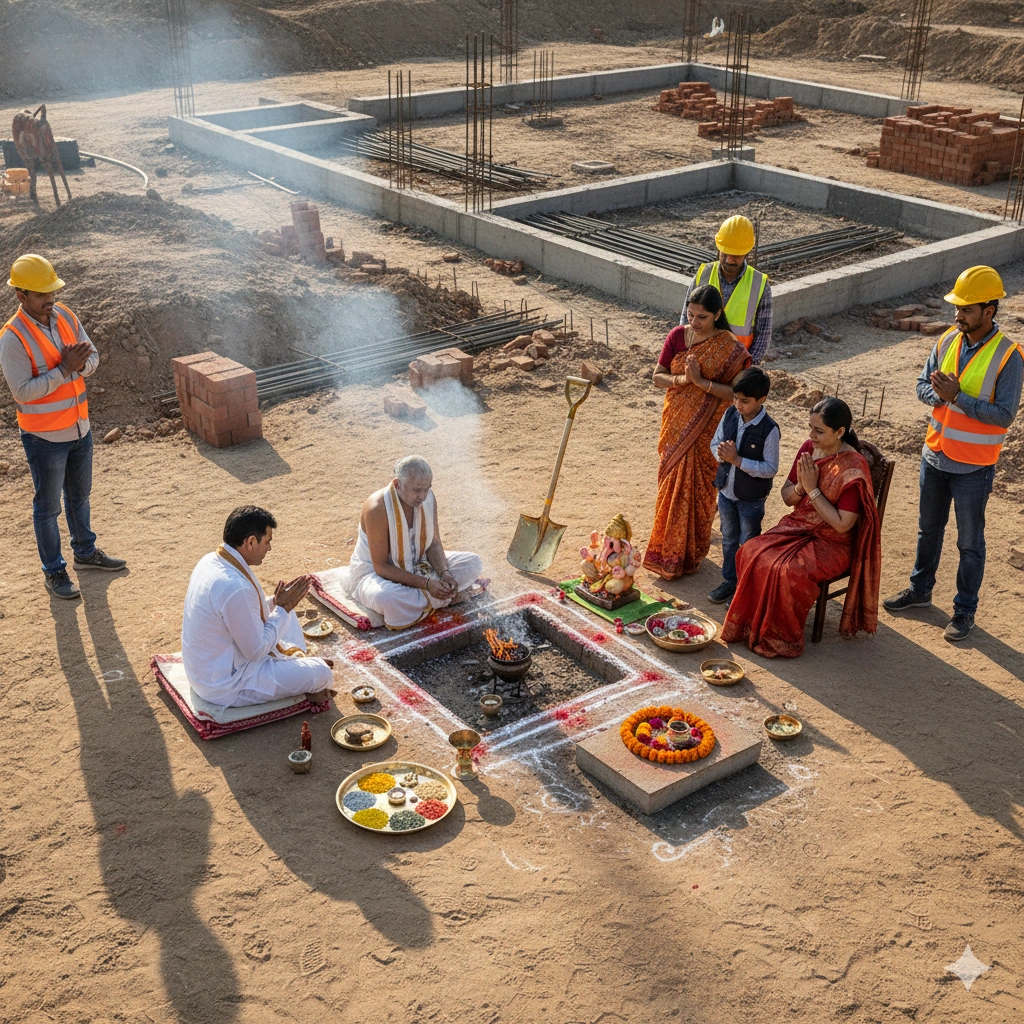
Bhoomi Pujan
(8 Reviews)
The land beneath any structure is not just earth and soil, it is a living entity, inhabited by the Bhoomi Devi (the Earth Goddess) and governed by the Vastu Purusha, the cosmic being that resides in every plot of land. When construction begins on a site without first seeking the permission and blessings of these powerful deities, the scriptures warn of structural problems, financial overruns, accidents during construction, and persistent misfortune for future occupants. Bhoomi Pujan, the sacred ground-breaking ceremony performed before any construction begins, is the Vedic answer to this challenge. It formally honors the earth, invites divine permission for construction, and establishes a protective energy field for everything built upon that land.
Whether you are building a villa in Wakad, an office complex in Kharadi, a factory in Pimpri-Chinchwad, or a commercial property in Hadapsar, Bhoomi Pujan is the essential first step that sets the entire project on an auspicious foundation. Vedic Pooja has successfully conducted over 1,500 Bhoomi Pujan ceremonies for Pune's top real estate developers and individual homeowners.
The Vedic Philosophy Behind Bhoomi Pujan
According to the Vastu Shastra, every plot of land has a Vastu Purusha, a divine being that lies with his head in the northeast and his feet in the southwest. The layout of every building must respect his posture. Before disturbing the earth with construction, the Vastu Purusha must be formally requested to cooperate, and any existing negative energies in the soil (from previous structures, deaths, conflicts, or natural accumulations) must be cleansed.
The Bhoomi Devi, Mother Earth, is one of the most revered deities in the Vedic tradition. The Prithvi Sukta, a hymn from the Atharva Veda, beautifully describes the Earth as the mother of all beings. Before digging her, Vedic tradition requires a formal apology and request, this is the essence of Bhoomi Pujan.
Who Should Perform Bhoomi Pujan?
- Anyone beginning construction of a residential home, apartment, bungalow, or independent house
- Builders and developers launching new residential or commercial projects in Pune's IT corridors like Hinjewadi and Magarpatta
- Business owners constructing a new factory, warehouse, or office building in industrial zones like Chakan or Bhosari
- Families who have purchased a plot and are about to begin building
- Anyone whose construction has been troubled by delays, accidents, or financial overruns, a retrospective Bhoomi Pujan can help even in these cases
Best Time (Muhurat) for Bhoomi Pujan
The Muhurat for Bhoomi Pujan is among the most precisely calculated in Vedic astrology, because the energy established at the ground-breaking moment influences the entire construction and all future occupants.
Key factors our Pandits consider:
- Tithi: Dwitiya, Tritiya, Panchami, Saptami, Dashami, or Dwadashi are auspicious
- Nakshatra: Rohini, Uttara Phalguni, Uttara Ashadha, Uttara Bhadrapada, Hasta, Chitra, Anuradha, or Shravana
- Day: Monday, Wednesday, Thursday, or Friday preferred
- Lagna: The ascendant at the time of Bhoomi Pujan should be strong and unafflicted
- Sun's position: Uttarayana (January 14 to July 14) is traditionally most auspicious for all construction beginnings
Step-by-Step Bhoomi Pujan Ritual Process
1. Site Survey and Sanctification: The Pandit surveys the plot for energy disturbances. The site is swept clean and purified with Gangajal.
2. Sankalp: A formal Sankalp is taken in the name of the landowner, stating the purpose (construction of a home/office/factory), the exact location, and the family's gotra.
3. Ganapati Puja: Lord Ganesha is invoked to remove all obstacles from the construction process, from permits and finances to weather and labor.
4. Bhoomi Devi Puja: The Earth Goddess is formally invoked with the Prithvi Sukta mantras. A symbolic apology is offered for the disturbance about to be made, and her blessings are sought.
5. Vastu Purusha Mandal: A sacred geometric diagram representing the Vastu Purusha is drawn on the ground. The nine zones of the plot are identified and honored.
6. Kshetrapal Puja: The guardian deity of the specific land area is propitiated to ensure peaceful and cooperative energy from the land's existing spiritual occupants.
7. Navagraha Puja: The nine planets are invoked to ensure favorable cosmic influences during and after construction.
8. Pratham Khanan (First Digging): The head of the family (or the senior-most person present) performs the symbolic first digging with a golden shovel or clean iron tool, while the Pandit chants the Bhoomi Pujan mantras. Five holes are dug, in the northeast, northwest, southeast, southwest, and center of the plot.
9. Neev Sthapana (Foundation Laying): A small amount of gold, silver, copper, or at minimum five grains, are placed in the northeast hole. This is the spiritual foundation of the entire structure.
10. Havan (Vastu Homa): A sacred fire is lit at the center of the plot. 108 offerings of ghee, rice, sesame, and specific Vastu herbs are made with the Vastu Purusha mantras. The fire's energy consecrates the entire site.
11. Aarti and Prasad: The ceremony concludes with an Aarti to Bhoomi Devi and distribution of Prasad among all present, workers, engineers, family members.
Benefits of Bhoomi Pujan
- Removes negative energies from the land before construction begins
- Ensures smooth construction with fewer delays, accidents, and unexpected costs
- Establishes the foundation of the structure on an energetically harmonious base
- Invites the blessings of the Earth Goddess on all future occupants
- Activates the Vastu potential of the plot for maximum prosperity
- Workers on the site benefit from a protected, harmonious energy field
What's Included
- Experienced Vastu-trained Pandit
- Complete Bhoomi Pujan Samagri: Gangajal, soil, five grains, copper vessel, flowers, ghee, sesame, Havan herbs
- Prithvi Sukta recitation
- Vastu Purusha Mandal drawing
- Symbolic first digging ceremony
- Havan with Vastu mantras
- Foundation materials (gold/silver token or symbolic items)
Why Choose Vedic Pooja for Bhoomi Pujan in Pune?
Pune's real estate sector is one of India's most active, with new construction starting every day in localities like Baner, Balewadi, Undri, Wagholi, Kharadi, and Hinjewadi. Our Pandits have performed Bhoomi Pujans for individual homeowners, reputed builders, and large commercial projects across the Pune metropolitan area.
We understand the time-sensitive nature of construction schedules and ensure that the Bhoomi Pujan can be scheduled at the auspicious Muhurat without disrupting your project timeline.
Call or WhatsApp 8668552465 to book your Bhoomi Pujan in Pune, residential, commercial, or industrial.
From
₹5,100
Rudrabhishek (Shiv Abhishek / Sawan Shiv Puja at Home)
(8 Reviews)
If there is one ritual in all of Hinduism that carries the direct, unfiltered power of Lord Shiva's grace, it is Rudrabhishek — also known as Rudra Abhishek, Rudrabhishekam, or Shiv Abhishek. Ancient, potent, and profoundly transformative, this sacred Shivalinga Puja involves the ritual bathing of the Shivling with continuous chanting of the Sri Rudram and Chamakam (Shri Rudram Chamakam, also called Namakam Chamakam) from the Krishna Yajurveda. It is considered the highest form of Mahadev Puja — a complete worship of Lord Shiva that purifies the self, removes obstacles, and draws the boundless compassion of Mahadev into every corner of your life.
For centuries, kings, sages, and householders across India have performed Rudrabhishek and Shiva Abhishek to seek protection from adversity, cure from illness, relief from planetary afflictions, and the supreme blessings of Lord Mahadev. Today, families across Pune — from Kothrud to Kharadi, from Wakad to Viman Nagar — are rediscovering the immense power of Shiv Puja at home when performed by trained Vedic Pandits who truly know the tradition.
The Vedic Origin and Significance of Rudrabhishekam
The word 'Rudra' comes from the Sanskrit root meaning 'one who drives away suffering' or 'the roarer.' Lord Rudra is the fierce, compassionate form of Lord Shiva, the one who destroys illness, sin, and cosmic imbalance with his divine energy. The Shri Rudram, the central text chanted during this Shivlinga Abhishek, is one of the oldest and most powerful hymns in the Vedas, dating back over 3,000 years.
The Chamakam (the second part of the Rudram) is a petition to Lord Shiva asking for everything a human being could ever need — health, longevity, wealth, children, wisdom, strength, and ultimately liberation. It is one of the most comprehensive prayers ever composed. Together, the Namakam Chamakam forms a two-part Vedic masterpiece: the Namakam salutes the thousand forms of Rudra, and the Chamakam petitions for every form of blessing.
According to the Shiva Purana, even the gods perform Rudrabhishek to overcome calamities. When Indra was defeated by demons, when the sage Markandeya prayed for his life, when the sun lost its brilliance — Rudrabhishekam was the answer.
Who Should Perform Rudrabhishek / Shiv Abhishek?
Rudrabhishek and Shiva Abhishek are among the most universally beneficial pujas — they help virtually every person facing any of these situations:
- Health problems: Chronic illness, unexplained weakness, recurring diseases — the healing vibrations of Rudrabhishekam support the body's recovery
- Saturn and Mars afflictions: Sade Sati, Dhaiya, Mangal Dosh, Rahu-Ketu periods — Shiv Abhishek specifically counters these harsh planetary influences
- Mental stress and anxiety: The Sri Rudram's frequencies have a well-documented calming effect on the nervous system
- Financial instability: Unexpected business losses, career setbacks, debt — Rudrabhishek opens blocked channels of prosperity
- Family disputes and relationship problems: Restores harmony and removes the seeds of conflict
- Spiritual seekers: Anyone on a Shaivite spiritual path who wishes to deepen their connection with Lord Shiva through Shivalinga Puja
- Devotees observing Somvar Vrat Puja (Monday Shiv Puja): Somwar Ka Puja performed with full Rudram chanting multiplies the merit of the vrat many times over
- Pradosh Vrat Puja observers: The twilight Pradosh period combined with Rudrabhishekam is extraordinarily powerful for wish-fulfillment
- Maha Shivaratri Puja: Performing Rudrabhishek on Shivaratri Puja at home is considered equal to visiting twelve Jyotirlingas
Special Significance During Shravan Maas (Sawan)
Among all occasions, Sawan Shiv Puja holds the most exalted place for devotees of Lord Shiva. The entire month of Shravan Maas — known as Sawan or Shravan — is dedicated to Lord Shiva. Every Monday in this month, called Shravan Somvar Puja or Sawan Somvar Puja, is an occasion of immense spiritual merit. Families and devotees across India arrange Sawan Puja and Sawan Rudrabhishek at their homes, seeking Lord Shiva's blessings for health, prosperity, and family welfare.
The Shravana Puja tradition teaches that what one achieves through a year of regular Shiv Puja can be achieved within the single month of Shravan. Our Pandits are especially experienced in organizing Sawan Rudrabhishek, Shravan Maas Puja, and Monday Shiv Puja (Somvar Vrat Puja) at homes across Pune, Pimpri Chinchwad, and PCMC during this sacred month. Booking early during Sawan is strongly recommended as demand is very high.
Abhishek Materials — Panchamrit Abhishek and Jalabhishek
In Rudrabhishek, the Shivling is bathed with specific sacred substances, each carrying deep symbolic meaning:
- Jalabhishek (Pure Water / Gangajal): The most fundamental offering. Gangajal purifies accumulated karma. Jalabhishek represents surrender, clarity, and peace of mind.
- Panchamrit Abhishek (Panchamruta Pooja): The Shivling is bathed with Panchamrit — a sacred mixture of milk (Dudh Abhishek / Doodh Abhishek / Milk Abhishek on Shivling), curd, honey, sugar, and ghee. Each element of this Panchamrit Abhishek bestows specific blessings: milk for purity and children, curd for health and prosperity, honey for sweetness in relationships, sugar for joy, and ghee for longevity.
- Sugarcane Juice (Ikshurasa): Sweetness in life and relationships
- Coconut Water: Material prosperity and fertility
- Bhasma (Sacred Ash): Renunciation of ego and path to ultimate liberation
- Bilva Archana / Bel Patra Puja: This is an inseparable part of Rudrabhishekam. Offering 108 Bilva Patra (108 Bilva leaves) or even 1,008 Bilva Patra with the chanting of Lord Shiva's names is called Bilva Archana. Each Bilva leaf represents the holy trinity — Brahma, Vishnu, Mahesh — and is Lord Shiva's most beloved offering. The merit of performing Bilva Archana is described in scriptures as equal to offering rare gems and gold.
- Dhatura, Madar: Traditional offerings that please Lord Shiva's fierce Rudra aspect
Number of Rudram Recitations — 11 Rudram, 21 Rudram, Ekadasha Rudra
The power of Rudrabhishek scales with the number of Rudram recitations performed:
- Laghu Rudrabhishek: 11 Rudram recitations (Ekadasha Rudra) with a single Pandit — ideal for homes, weekly pujas, and Shravan Somvar Puja
- Standard Rudrabhishek: 21 Rudram recitations with 2 Pandits — recommended for important life events, Maha Shivaratri Puja, and Pradosh Vrat Puja
- Maha Rudrabhishek: 51 or 121 Rudram recitations with multiple Pandits — the full grandeur of Rudrabhishekam for major remedies and spiritual milestones
Our packages include Laghu Rudrabhishek (11 Rudram / Ekadasha Rudra), mid-tier 21 Rudram, and premium Maha Rudrabhishek, ensuring every family can access the appropriate level of this powerful ritual.
Step-by-Step Rudrabhishek Ritual Process
1. Sankalp: The family head declares the purpose — for health, peace, planetary remedy, or devotion. The Pandit recites the Sankalp mantra invoking the family's name, gotra, and current Panchang (nakshatra, tithi, etc.).
2. Ganapati Puja and Navagrah Invocation: Lord Ganesha is worshipped first, followed by invocation of the nine planets.
3. Kalash Sthapana: A sacred Kalash is established as the embodiment of the Divine with mango leaves, coconut, and sacred water.
4. Shivalinga Puja (Shivling Puja): The Shivlinga is ritually cleansed and the Pandit performs Aavahan (invocation) of Lord Shiva into the Lingam.
5. Sri Rudram Chanting with Abhishek: The soul of the ceremony. The Pandit chants the Namakam (Sri Rudram's eight sections with 'Namas' salutations) while continuously performing Panchamrit Abhishek, Jalabhishek, Dudh Abhishek, and other offerings over the Shivlinga.
6. Chamakam Recitation: Following each set of Rudram, the Chamakam is chanted as a petition for all worldly and spiritual blessings.
7. Bilva Archana (108 Bilva Patra): 108 or 1,008 Bilva leaves are offered to the Shivalinga, each with a specific name of Lord Shiva.
8. Maha Aarti: A grand Aarti with a multi-wick lamp to Lord Shiva, Goddess Parvati, Lord Ganesha, and Lord Kartikeya.
9. Prasad and Visarjan: Sacred Prasad (milk-based sweets and Bilva leaves) is distributed, and Lord Shiva is formally requested to continue his protection.
Benefits of Rudrabhishek
Spiritual Benefits: Direct connection with Lord Shiva's cosmic energy; accelerates spiritual awakening; cleanses accumulated karma from multiple lifetimes; protects against negative energies and evil eye.
Health Benefits: Vibrations of Sri Rudram promote healing; relieves chronic disease and supports longevity; balances the five elements (Pancha Mahabhutas) in the body.
Material Benefits: Removes obstacles in career and business; attracts financial prosperity; fulfills long-standing desires.
Planetary Remedial Benefits: Specifically recommended for Saturn afflictions (Sade Sati, Shani Dhaiya); counters Mangal Dosh and Rahu-Ketu transits; neutralizes Pitra Dosh effects.
Best Time (Muhurat) for Rudrabhishek
- Somvar Vrat Puja / Monday Shiv Puja / Somwar Ka Puja: Lord Shiva's own day — even simple Rudrabhishek on Monday is highly effective
- Pradosh Vrat Puja: The 13th Tithi twilight period — one of the most sacred windows for Shiv Abhishek
- Maha Shivaratri Puja / Shivaratri Puja at home: The most powerful night of the year for all Shiva rituals
- Shravan Maas Puja / Sawan Puja / Shravan Somvar Puja / Sawan Somvar Puja: The entire month of Shravan is dedicated to Lord Shiva
- Shiva Chaturdashi: The 14th lunar day of each fortnight
Pandit for Rudrabhishek in Pune — All Areas Served
Rudrabhishekam requires a Pandit who has mastered the Sri Rudram and Shri Rudram Chamakam in their original phonetic form — because every syllable of the Vedic mantra carries sacred energy. At Vedic Pooja, every pandit for Rudrabhishek in Pune is trained in authentic Vedic chanting from recognized Vedapathshalas and has performed Rudrabhishek, Panchamrit Abhishek, and Bilva Archana hundreds of times.
We bring all required Abhishek materials — Panchamrit, Gangajal, Bilva leaves, Bhasma, and special Abhishek vessels — fresh and purified.
We serve all areas of Pune including Rudrabhishek pandit Wakad, Rudrabhishek pandit Baner, Rudrabhishek pandit Kharadi, Rudrabhishek pandit Hinjewadi, Rudrabhishek pandit Kothrud, Rudrabhishek pandit Hadapsar, Rudrabhishek pandit PCMC, and Rudrabhishek pandit Pimpri Chinchwad — as well as Pashan, Aundh, Viman Nagar, Pimple Saudagar, Nibm, and surrounding areas. Whether you wish to perform Shiv Puja at home, at a nearby Shiva temple, or at a venue of your choice, we arrange everything seamlessly.
Book your Rudrabhishek, Sawan Shiv Puja, or Shravan Maas Puja today. Call or WhatsApp 8668552465 for same-day booking availability and free Muhurat consultation.
From
₹5,101
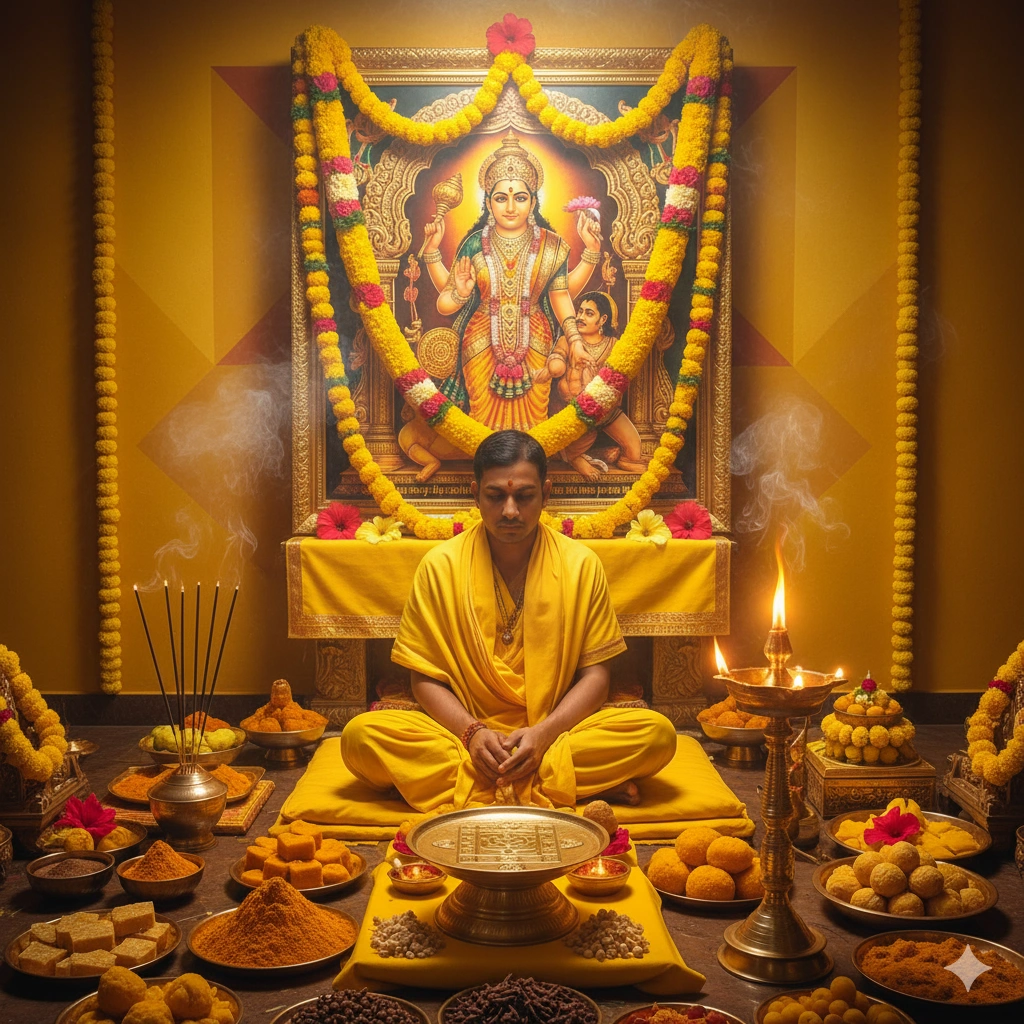
Baglamukhi Puja
(8 Reviews)
In the Shakta tradition of Hinduism, there exist ten supreme cosmic powers known as the Dasha Mahavidyas, each embodying a specific aspect of the Divine Mother's transformative energy. Among them, Goddess Baglamukhi holds a uniquely powerful position: she is the goddess of stillness and control, the one who 'grabs the tongue' of falsehood and enemy forces, and the supreme protector of devotees against legal battles, adversaries, black magic, competitors, and destructive speech. Her name itself is significant, 'Bagla' means crane (the bird of patience and precision) and 'Mukhi' means faced. She is the one who paralyzes the forces of darkness with the precision of a crane striking its prey. Families and individuals across Pune, from business owners in Kharadi to professionals in Hinjewadi, have found in Baglamukhi Puja an extraordinary tool for protection, victory over adversaries, and the removal of obstacles that seem impervious to ordinary effort.
The Symbolism and Power of Goddess Baglamukhi
Goddess Baglamukhi is depicted in brilliant yellow, yellow being the color of turmeric (Haldi), which is both purifying and powerful. She is seated on a yellow throne (a lotus of yellow color), dressed in yellow, adorned with yellow jewels, and her devotees offer yellow flowers and turmeric-based items during her worship.
In her right hand, she holds a club (Gada), the weapon with which she strikes the demons of falsehood and negativity. In her left hand, she pulls the tongue of a demon, symbolizing her power to silence lies, manipulation, slander, and all forms of destructive speech. On the spiritual level, this represents the silencing of the restless, lying mind (the demon) by the goddess of pure, still consciousness.
Her Mantra, "Om Hleem Baglamukhi Sarvadushtanaam Vaacham Mukham Padam Stambhaya Jihvaam Kiilaya Budhim Vinaashaya Hleem Om Swaha", is one of the most potent mantras in the entire Tantric-Vedic tradition for stopping adversarial forces.
Who Should Perform Baglamukhi Puja?
This puja is specifically designed for situations involving adversarial forces and active threats:
- Legal battles: Court cases, property disputes, criminal charges, Baglamukhi's energy creates unusual clarity and victories in legal matters
- Business competition: Rivals using unfair means, corporate sabotage, or predatory competition
- Black magic and evil eye: The strongest puja for protection against Tantra, Mantra used by enemies
- Career obstacles: Colleagues or superiors creating deliberate obstacles
- Slander and false accusations: When reputation is being attacked through false statements
- Exam success: Students facing competitive examinations, Baglamukhi is known to grant sharp, paralyzing focus
- Health protection: When illness is suspected to have a non-physical origin
The Yellow Significance
Baglamukhi Puja is performed entirely in yellow, the Pandit wears a yellow dhoti, the altar is decorated with yellow flowers (Sunflower, Yellow Marigold, Yellow Roses), the samagri is turmeric-based, the Havan includes turmeric sticks, and even the devotee is advised to wear yellow clothing during the puja. This mono-chromatic discipline is not aesthetic whim, it is a Tantric alignment of the entire ceremony with the Goddess's energy signature.
Step-by-Step Baglamukhi Puja Ritual Process
1. Sankalp: The Pandit takes the Sankalp in the devotee's name, clearly stating the purpose, whether for legal victory, enemy removal, protection from black magic, or another specific intention.
2. Ganesh Puja: Brief invocation of Lord Ganesha.
3. Baglamukhi Yantra Sthapana: A specially energized Baglamukhi Yantra (a geometric copper plate) is installed as the central focal point of the puja.
4. Goddess Invocation: Goddess Baglamukhi is invoked into the Yantra with her specific beeja mantras. The invocation uses the Shodasha Upachar (16 offerings) with all yellow items.
5. Baglamukhi Mantra Jaap: The core Baglamukhi mantra is chanted, 5,000 (basic), 11,000 (standard), or 21,000 (premium) times. Multiple Pandits participate, using yellow Hakik (agate) malas for counting.
6. Havan: The Havan is performed with turmeric sticks, yellow sesame, yellow flowers, ghee, and specific Baglamukhi herbs. Every Ahuti is offered with the Baglamukhi mantra.
7. Shatru Nashak Ritual (Enemy Removal): In cases involving adversaries, a specific sub-ritual is performed, writing the opponent's name on a piece of turmeric-stained paper and placing it under the Yantra with specific mantras. This is a Stambhana (paralysis) ritual that binds the adversarial force.
8. Aarti and Visarjan: A Baglamukhi Aarti is performed and the Goddess is bid farewell with reverence.
9. Post-Puja Remedies: The Pandit provides specific ongoing remedies, wearing a yellow thread, carrying turmeric on specific days, and continued chanting of a simplified protection mantra.
Benefits of Baglamukhi Puja
- Paralyzes adversarial forces, giving the devotee advantage in conflicts
- Creates protection from black magic, Tantra attacks, and malicious intentions
- Grants victory in court cases and legal disputes
- Silences slander, false accusations, and destructive gossip
- Removes blocks placed by competitors in business or career
- Grants focus, clarity, and decisive intelligence in examinations
- Protects the physical body from harm in high-risk situations
Best Time for Baglamukhi Puja
- Tuesday, also considered auspicious for Baglamukhi due to Mars connection
- Ashtami Tithi, the 8th lunar day, associated with power deities
- During adversarial situations, this puja can be performed at any time when active protection is needed
Why Choose Vedic Pooja for Baglamukhi Puja in Pune?
Baglamukhi Puja belongs to the Tantric-Vedic tradition and requires Pandits who have specific training in the Mahavidya worship system. Incorrect procedures or improperly energized Yantras can be ineffective. Our Pandits are trained in Shakta Tantra procedures and perform this puja with the precision, yellow ceremony setup, and devotional intensity that Goddess Baglamukhi's worship requires.
We serve all of Pune, Baner, Aundh, Pashan, Viman Nagar, Hadapsar, Kharadi, and beyond. Call or WhatsApp 8668552465 for confidential consultation and booking.
From
₹7,500
.db34c8a1.webp)
Office Opening Puja (Vastu Puja)
(0 Reviews)
Every successful business in India begins with the same act of humility and wisdom: seeking divine blessings before the first customer walks in, the first deal is signed, or the first laptop is opened. Office Opening Puja, also called Udyog Pravesh Puja or Vastu Puja for commercial spaces, is the business equivalent of Griha Pravesh, and it is equally important. The space where your team will work, where decisions will be made, and where prosperity will (or will not) accumulate is a living energy field. Its orientation, room placements, and the energy it has absorbed from previous occupants (if any) all influence what unfolds within it. The Office Opening Puja purifies this energy field, invokes the specific triad of deities who govern business prosperity, Goddess Lakshmi (wealth), Lord Ganesha (obstacle removal), and Lord Kubera (treasury), and establishes a divine protective field that supports growth, harmony, and success for years to come. Entrepreneurs and business owners across Pune's IT hubs, Hinjewadi, Wakad, Kharadi, to traditional business centers like Pimpri-Chinchwad, Camp, and Deccan know this: the right energy in an office makes everything easier.
Why Office Vastu Matters More Than You Think
A commercial space has specific Vastu requirements that differ from a home. The positioning of the reception desk (ideally northeast or north), the main desk of the business owner (facing north or east), the cash counter (ideally in the north), the storage and server rooms (in the southwest for stability), and the entry and exit directions all influence the financial and operational outcomes of the business.
Beyond physical Vastu, a newly occupied office may carry the energetic residue of its previous occupants, their stress, conflicts, financial failures, or simply stagnant chi. The Office Opening Puja, through specific purification rituals and sacred Havan, clears all this and installs a fresh, auspicious energy field.
Who Should Perform Office Opening Puja?
- Entrepreneurs launching a new startup or independent practice in Pune's thriving business ecosystem
- Companies expanding to a new office floor or building
- Business owners who have relocated their office and want to start fresh
- Shops and retail spaces opening for business for the first time
- Professional offices, CA firms, clinics, law offices, IT companies, beginning operations
- Factories and warehouses that require Vastu stabilization before operations begin
- Businesses that have experienced persistent challenges and want a complete energy reset
Step-by-Step Office Opening Puja Process
1. Vastu Survey: The Pandit briefly surveys the office space, noting orientation, key room placements, and existing energy. He identifies the northeast corner (the most sacred direction, also called Ishan Kona) where the main puja altar will be established.
2. Sankalp: A formal Sankalp is taken in the business owner's name and the company's name, declaring the purpose, the inauguration and blessing of the office for success.
3. Ganesh Puja: Lord Ganesha, the lord of all beginnings and remover of obstacles, is the first deity invoked. In a business context, Ganesha's blessing is specifically sought to remove all obstacles from deals, contracts, client relationships, and team dynamics.
4. Vastu Purusha Puja: The Vastu Purusha, the cosmic being residing in the office space, is formally worshipped. The Vastu Purusha Mandal is drawn and all nine zones of the space are honored.
5. Lakshmi Puja: Goddess Lakshmi is installed at the reception or main hall. Specific Lakshmi mantras are chanted along with Shri Sukta to attract consistent financial inflow.
6. Kubera Puja: Lord Kubera, the divine treasurer and lord of wealth, is invoked specifically for commercial success. His Yantra is installed in the north direction of the office (the direction of Kubera).
7. Office Purification: The Pandit walks through every room, cabin, meeting room, and server area with burning Dhoop (incense), a ringing bell, and purification mantras. This clears all residual energies from the space.
8. Computer/Equipment Blessing: All computers, servers, business phones, printers, and key equipment are formally blessed. This is a particularly meaningful moment for IT companies and tech startups in Pune's Hinjewadi corridor.
9. Account Books and Financial Documents: Ledgers, GST documents, business agreements, and financial tools are placed before the deities and formally blessed for accuracy, growth, and compliance.
10. Havan: A fire ceremony is performed with Vastu and Lakshmi mantras. Offerings of sesame, ghee, and Lakshmi-specific herbs fill the space with purifying fire energy.
11. Aarti and Maha Prasad: A grand Aarti concludes the ceremony. Sweets are distributed among all team members, partners, and guests.
Benefits of Office Opening Puja
- Financial Flow: Removes blocks to consistent revenue generation from the first day
- Team Harmony: Creates an atmosphere of cooperation and reduced conflict between team members
- Client Attraction: The positive energy field of a Vastu-aligned office is perceptible to visiting clients and creates a favorable impression
- Decision Making: North and northeast alignments strengthen clarity and strategic thinking
- Protection from Business Risks: Vastu and deity blessings provide a protective energy field against unforeseen losses
- Owner's Peace of Mind: The genuine comfort of knowing the business has the blessings of Ganesha, Lakshmi, and Kubera is itself invaluable for an entrepreneur's confidence
Best Time for Office Opening Puja
- Wednesday (Budhvar), Mercury's day; ideal for business, communication, and commerce
- Thursday (Guruvaar), Jupiter's day; expands business and brings good fortune
- Diwali season, Especially Dhanteras and Diwali itself for business opening
- Pushya Nakshatra, Universally the most auspicious Nakshatra for business beginnings
- Shukla Paksha Tritiya or Panchami, Auspicious tithis for commercial launches
What's Included
- Experienced Pandit with Vastu and commercial puja expertise
- Complete Office Puja Samagri: Kalash, flowers, lotus, Gangajal, Dhoop, incense, Lakshmi-Ganesh idols/images, Kubera Yantra, ghee, sesame, and Havan herbs
- Lakshmi, Ganesha, and Kubera Puja
- Office walkthrough purification
- Equipment and account book blessing
- Havan with Vastu and Lakshmi mantras
Why Choose Vedic Pooja for Office Opening Puja in Pune?
Pune is one of India's fastest-growing business cities, with new offices, startups, and commercial spaces opening every day. Our Pandits have performed Office Opening Pujas for technology companies, manufacturing units, retail chains, clinics, law firms, and solo entrepreneurs across every major business district in Pune.
We understand the time constraints of business owners and ensure the ceremony is complete, meaningful, and accomplished within the scheduled window, without cutting corners.
Call or WhatsApp 8668552465. Let your business begin with the blessings of Ganesha, Lakshmi, and Kubera.
From
₹5,100
.7c9a0b6d.webp)
Birthday Puja (Janmadin Puja)
(0 Reviews)
A birthday is not merely a calendar date, in the Vedic tradition, it is a cosmic anniversary, the day when the Sun returns to the exact position it occupied at the moment of your birth. This solar return (called Janma Tithi when calculated by the lunar calendar, or Janma Din in general usage) is the most personally auspicious day of the year for any individual, because the planetary energies at that moment most closely mirror the natal energies with which they entered this world. Vedic Birthday Puja, also called Janmadin Puja or Ayushya Havan, is a sacred ceremony that takes complete advantage of this cosmic alignment. By performing specific rituals on this day, a person can actively seek blessings for the coming year, neutralize any negative planetary patterns that have accumulated, strengthen their Ayu (life force), and invite divine grace for all their intentions and goals. Families across Pune, from Kothrud and Hadapsar to Wakad and Kharadi, mark their loved ones' birthdays with this meaningful Vedic ceremony, creating a tradition of spiritual renewal alongside the celebrations.
Why Vedic Birthday Puja is Different from a Regular Ceremony
Most people celebrate birthdays with cakes, parties, and gifts. The Vedic tradition adds something irreplaceable: alignment with the divine. On your Janma Din, your planetary Dasha (major period) and Antardasha (sub-period) are at their annual inflection point, and specific mantras chanted on this day directly interact with the active planetary cycle of your life.
The Ayushya Suktam, a series of Vedic hymns specifically composed for longevity and health, is maximally effective on the birthday because the person's cosmic identification is strongest at this moment. Think of it as tuning a musical instrument when it has the most resonance.
Who Should Perform Janmadin Puja?
- Children's birthdays: The perfect way to begin each year of a child's life with divine blessings for health, intelligence, and happiness
- Adults facing challenging periods: When a difficult Dasha or transit coincides with a birthday, this puja specifically renews and protects
- Senior family members: The Deerghayushya (long life) ceremony element makes this especially beautiful for elderly parents and grandparents
- Anyone who wishes to make their birthday truly meaningful, beyond parties and gifts
- Students before exam years, the Vidya Suktam element invokes exceptional learning ability
- Business owners, the new year of life can be dedicated to professional growth and success
Step-by-Step Janmadin Puja Ritual Process
1. Early Morning Purification: The ceremony ideally begins in the morning, after the celebrant has bathed and worn fresh clothes. The puja space is decorated with flowers and rangoli.
2. Sankalp: The Pandit takes the formal Sankalp, the celebrant's full name, birth Nakshatra, gotra, age (number of years completed), and the specific intentions for the coming year.
3. Ganesh Puja: Lord Ganesha is invoked to bless the new year of life with smooth progress and opportunity.
4. Navagraha Puja and Janma Graha Puja: The nine planets are worshipped. The Janma Graha (the planet that rules the current Dasha) receives special attention, if the person is in a Jupiter Mahadasha, for example, Jupiter (Guru) is specially propitiated on this birthday.
5. Ayushya Suktam Recitation: The complete Ayushya Suktam, a series of Vedic hymns specifically for long life, good health, and renewed vitality, is chanted by the Pandit while the celebrant sits facing east.
6. Vidya Suktam (for students): The Vidya Suktam, hymns invoking divine knowledge and academic excellence, is additionally chanted for student celebrants.
7. Navagraha Havan: A Havan is performed with specific herbs and offerings for each planet, with emphasis on the current Dasha lord. This Havan 'burns away' the negative patterns of the past year and opens the channels for fresh divine grace.
8. Mahamrityunjaya Mantra Jaap: 108 repetitions of the Mahamrityunjaya Mantra are chanted for the celebrant's health, protection, and long life. This is the most powerful longevity prayer in the Vedic tradition.
9. Satyanarayan Puja (optional): Some families combine the birthday with a Satyanarayan Puja for additional prosperity blessings.
10. Aarti and Blessings: A birthday Aarti is performed, the Pandit, parents, and elders bless the celebrant with the chant "Shatam Jeevantu Sharadah", 'May you live a hundred autumns.' New clothes and gifts are presented as blessings.
11. Prasad Distribution: Traditional prasad including kheer, puri, and fruits is distributed.
Benefits of Vedic Birthday Puja
- Longevity: The Ayushya Suktam specifically invokes divine grace for long, healthy life
- Health renewal: The Havan's energy purifies the body's subtle energy field at the most receptive moment of the year
- Planetary support: The Navagraha Havan activates favorable planets and pacifies difficult ones at the moment of maximum influence
- Academic excellence (with Vidya Suktam): Students who begin their birthday year with this element perform noticeably better
- Meaningful tradition: Creates a family ritual that children remember and cherish for life
- Intention setting: The Sankalp creates a formal spiritual declaration of the year's intentions, giving them divine momentum
Best Time for Janmadin Puja
The birthday puja should be performed on one of these:
- Janma Tithi: The actual lunar date corresponding to the birth date, often differs from the solar calendar birthday. Our Pandit calculates this precisely.
- Janma Din: The solar calendar birthday itself is also highly auspicious
- Janma Nakshatra: The day when the Moon transits the birth Nakshatra, considered even more auspicious than the calendar birthday in some traditions
For the most powerful effect, the puja should be started during the birth Lagna, the specific hour of the day when the same ascendant that was rising at birth rises again. Our Pandits calculate this.
What's Included
- Trained Pandit experienced in Samskara and life-cycle rituals
- Complete Janmadin Puja Samagri: Flowers, Rangoli materials, Navagraha items, Havan herbs, Gangajal, Puja Thali
- Ayushya Suktam recitation
- Navagraha Havan
- Mahamrityunjaya Jaap (108)
- Prasad
Why Choose Vedic Pooja for Birthday Puja in Pune?
We bring personalization that makes a birthday puja truly special. Our Pandits take genuine interest in the celebrant, their age, their current life situation, their goals for the year, and weave specific mantras and intentions into the ceremony. For children's birthdays, our Pandits make the ceremony engaging and joyful, not formal or intimidating.
We serve all Pune localities. Weekday and weekend slots available. Call or WhatsApp 8668552465 to book your Janmadin Puja in Pune.
From
₹3,500
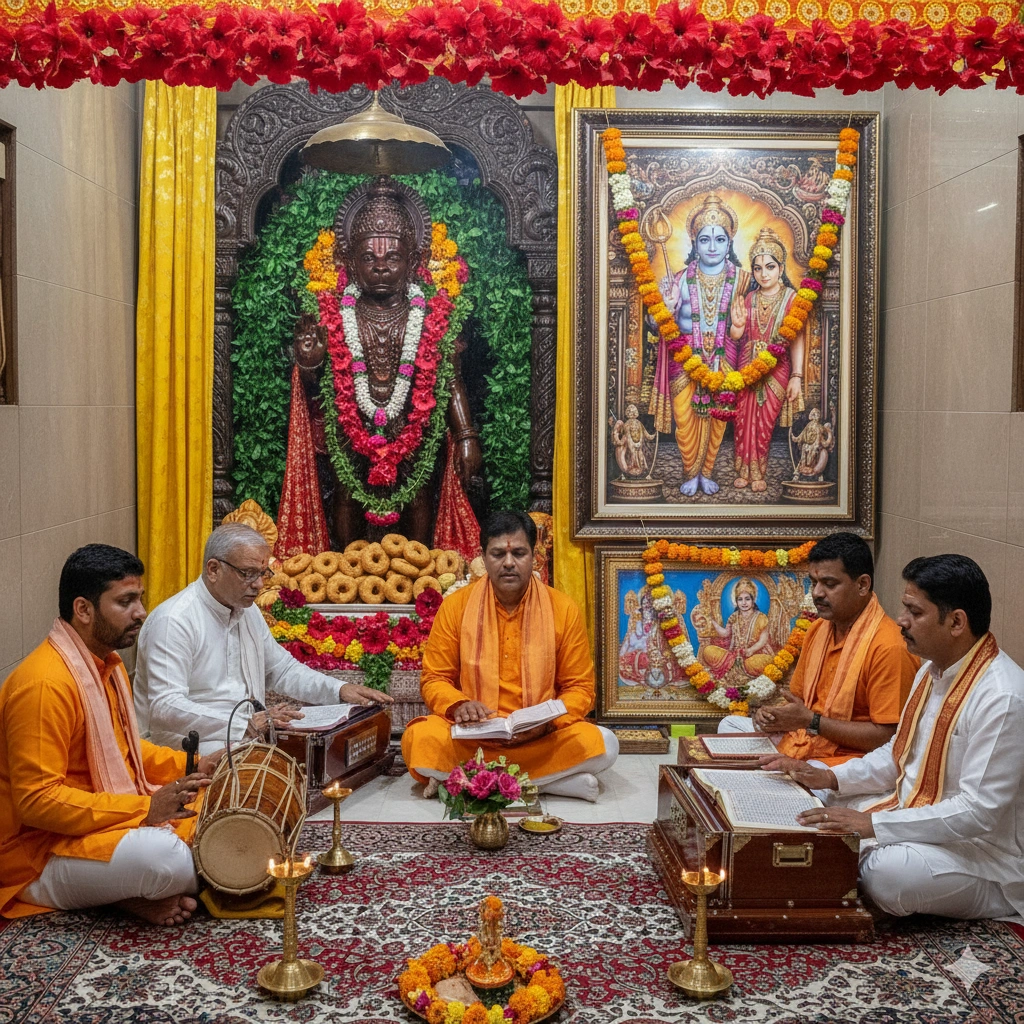
Sunderkand Path
(8 Reviews)
Among the seven chapters (Kands) of the Ramcharitmanas, the Sundar Kand occupies a special place of glory, it is the Kand where Lord Hanuman takes center stage, crossing the ocean, finding Mother Sita in Lanka, and displaying his absolute devotion, courage, and divine power. The word 'Sundar' means beautiful, and this is indeed the most beautiful chapter, describing Hanuman's journey with unparalleled poetic beauty. For devotees of Lord Hanuman across India, and particularly in Maharashtra where the tradition of Hanuman devotion runs extraordinarily deep, the Sundar Kand Path holds a sacred place as the most accessible yet profoundly powerful scripture for invoking Hanuman's blessings. Families in Pune, from the Ram-bhakts of Kothrud to the Maruti mandirs of Hadapsar and the bhajan circles of Viman Nagar, perform Sunderkand Path to overcome fears, remove obstacles, find missing persons or situations, and invite Lord Hanuman's invincible protection.
Why Sundar Kand is Lord Hanuman's Supreme Scripture
The Sundar Kand is unique in the Ramcharitmanas because it is the only Kand where the hero is not Lord Ram, it is Hanuman. And in it, Hanuman demonstrates every quality that devotees aspire to:
- Fearlessness: He flies across the ocean to Lanka without hesitation
- Intelligence: He disguises himself and navigates the enemy stronghold with wisdom
- Devotion: His every action is motivated purely by love for Ram and care for Sita
- Power: He destroys an entire army when necessary, showing that true devotion gives unlimited strength
- Humility: Despite his feats, he presents himself before Mother Sita as simply 'Ram's servant'
When this Kand is recited with devotion, Lord Hanuman's energy manifests powerfully in the listener's life, bringing the same fearlessness, wisdom, and divine protection that he displayed in Lanka.
Occasions for Sunderkand Path
The Sunderkand Path is particularly effective for:
- Overcoming fears and phobias, Lord Hanuman removes all fear without exception
- Medical emergencies and illness recovery, Hanuman is called 'Sankat Mochan' (remover of distress) and 'Roga Nashin' (destroyer of illness)
- Legal and enemy challenges, Hanuman's energy specifically counters adversarial forces
- Before major life events, job interviews, business launches, surgeries, court dates
- Finding lost items, missing people, or stalled situations, Hanuman found what was considered impossible to find (Mother Sita in Lanka)
- Protection of vehicles and journeys, Hanuman is considered the deity of safe travel
- Regular Tuesday devotional practice, Many families organize monthly Sunderkand on Tuesdays
- Hanuman Jayanti, The most powerful day for Sundar Kand recitation
Step-by-Step Sunderkand Path Ritual Process
1. Purification: The puja space is cleaned and the image of Lord Hanuman is installed. Fresh flowers, particularly marigold, red hibiscus, and jasmine, are offered.
2. Sankalp: The Pandit takes the formal Sankalp in the host family's name and declares the specific intention.
3. Ganapati Puja: Lord Ganesha is invoked for an obstacle-free recitation.
4. Hanuman Invocation: Lord Hanuman is formally invoked with the Hanuman Chalisa and the Hanuman Ashtakam. A specific visualization of Hanuman in his flight over the ocean is guided by the Pandit.
5. Complete Sunderkand Recitation: The Pandits begin the Sunderkand, all 60 Chopais (verses) of this chapter of the Ramcharitmanas. In the musical (sangeet) format, each verse is sung to devotional tunes, creating a profoundly moving and joyful atmosphere. The standard Sundar Kand takes approximately 2.5–3 hours to complete.
6. Hanuman Chalisa and Bajrang Baan: After the Sundar Kand, the Hanuman Chalisa is recited 11 times. For situations involving enemies or black magic, the Bajrang Baan, Hanuman's most powerful protection mantra, is also recited.
7. Hanuman Aarti: The famous 'Aarti Kije Hanuman Lala Ki' is performed with great devotion.
8. Prasad: Traditional Sunderkand Prasad, Boondi, Besan Ladoo, and fruits, is distributed.
9. Havan (Standard and Premium): A Havan dedicated to Lord Hanuman, with offerings of sesame, ghee, and red flowers, amplifies the path's protective energy.
Benefits of Sunderkand Path
- Removes fear: One of the most powerful ceremonies for dissolving anxiety and phobias at the root level
- Health recovery: Specifically invokes Hanuman's healing aspect; strongly recommended for those in hospital or recovering from surgery
- Enemy protection: Creates an impenetrable protective field against adversarial human forces
- Obstacle removal: Clears the path for stalled plans, projects, and relationships
- Joyful, devotional atmosphere: Unlike many remedial pujas, the Sundar Kand is celebrated joyfully, it elevates mood and spirit
- Protective for children: Hanuman is especially protective of children; this path creates a shield of divine protection around them
Best Time for Sunderkand Path
- Tuesday, Lord Hanuman's day
- Saturday, Also associated with Hanuman worship in many traditions
- Hanuman Jayanti, The most powerful day of the year
- Ram Navami, Lord Ram's birthday; Hanuman's devotion for Ram makes this equally powerful for Sunderkand
- Any time of personal need, Sunderkand can be organized any day for urgent situations
Why Choose Vedic Pooja for Sunderkand Path in Pune?
Sunderkand is a devotional celebration, it should be joyful, musical, and uplifting. Our Pandits bring not just ritual correctness but genuine devotion to the Sunderkand Path. They have performed this beloved scripture thousands of times and can maintain the devotional momentum for the full duration.
For the musical Sunderkand format, we coordinate experienced Pathakars who sing the verses in the classical bhajan style, an experience that moves even first-time participants to tears of joy.
We serve all Pune localities including Wakad, Baner, Kharadi, Hadapsar, Pashan, and Pimpri-Chinchwad. Call or WhatsApp 8668552465 to book your Sunderkand Path. Jai Bajrangbali!
From
₹7,100
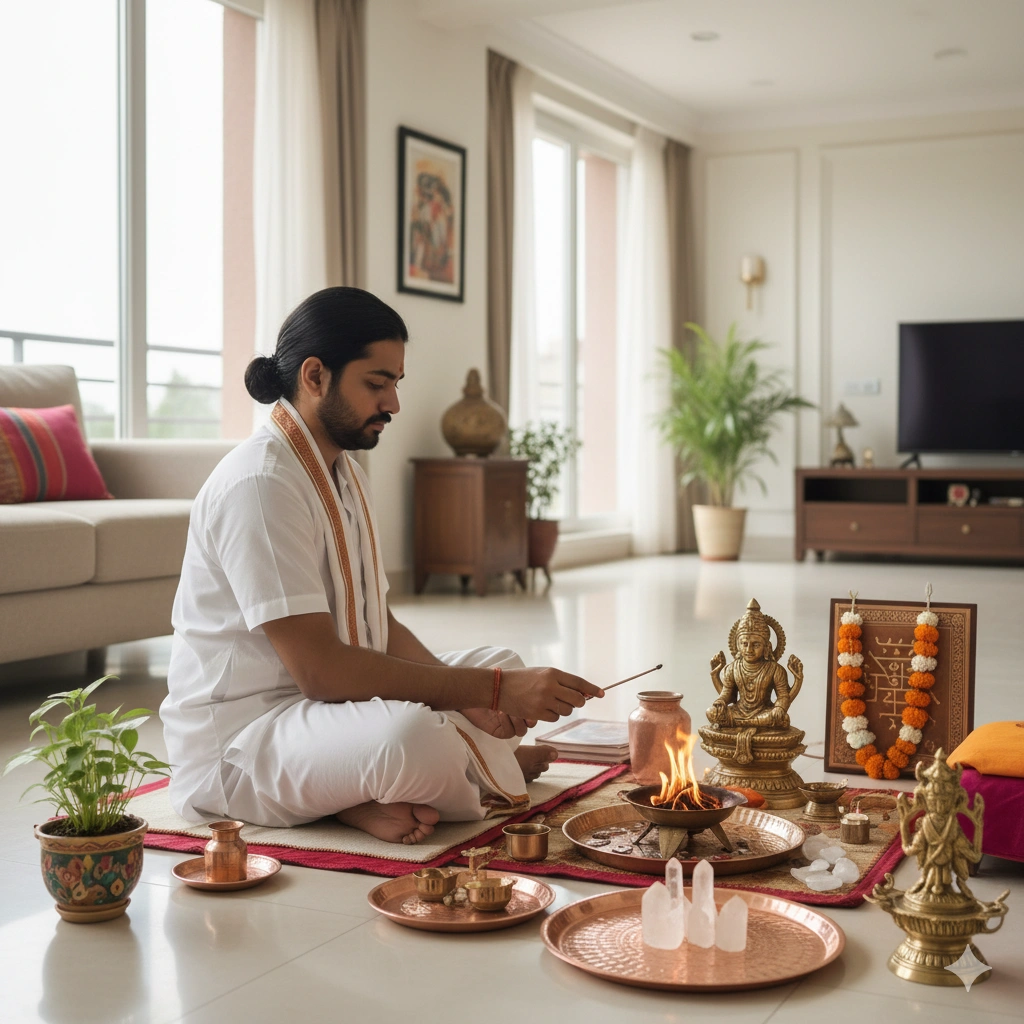
Vastu Dosh Nivaran
(8 Reviews)
Your home should be your sanctuary, a place where energy flows freely, where health is restored, where family bonds strengthen, and where prosperity naturally accumulates. But when the architecture, layout, or energy of a space is misaligned with Vedic Vastu Shastra principles, it creates what is known as Vastu Dosh, a disruption in the subtle energy grid of the structure that can manifest as persistent financial problems, health issues, relationship conflicts, or a generally oppressive atmosphere. If you have noticed that your home or office in Pune, whether in Baner, Kharadi, Wakad, or anywhere else, carries an inexplicable heaviness, that despite your hard work results don't come, or that family members fall sick repeatedly, a Vastu Dosh Nivaran Puja may be the transformative solution you have been seeking.
What is Vastu Dosh and How Does It Affect You?
Vastu Shastra is the ancient Indian science of architecture and spatial arrangement. It teaches that every building is a living energy field, and when the five elements, Earth (Prithvi), Water (Jal), Fire (Agni), Air (Vayu), and Space (Akasha), are balanced within a structure, they support the well-being of its occupants. But when there are structural defects, wrong placements of rooms, incorrect entry directions, or improper orientation, these imbalances create Vastu Doshas.
Common causes of Vastu Dosh:
- Main entrance facing south or southwest without remediation
- Kitchen in the northeast or north (should be in southeast)
- Toilet or bathroom in the northeast corner (most powerful positive direction)
- Master bedroom in the northeast (weakens the head of household)
- Overhead beam directly above the bed or dining table
- Staircase in the center of the house
- Plot with L-shape, T-shape, or cut corners
- Water tank or sump in the wrong direction
- Trees blocking the north or east
Effects of untreated Vastu Dosh range from financial losses and business failures to chronic health issues, legal troubles, marital conflicts, and difficulty conceiving children. In severe cases, occupants report a general sense of misfortune and stagnation that follows them despite sincere efforts to improve.
Who Should Perform Vastu Dosh Nivaran Puja?
- Families moving into a previously occupied home and experiencing ongoing difficulties
- New homeowners who notice that prosperity hasn't come despite a beautiful home
- Business owners in offices that face constant turnover, low sales, or team conflicts
- Anyone who has undergone a structural renovation and noticed subsequent problems
- Those whose astrologer has identified Vastu Dosh in the birth chart
- Families experiencing health problems that are concentrated among specific members
- Anyone in Pune who simply wants to energize and harmonize their living space
What Vastu Dosh Nivaran Puja Accomplishes
This puja does what physical renovation often cannot: it works at the energy level. Even if structural changes are impossible (as is common in apartments in Pune's high-rises), the puja installs divine protective energy, purifies accumulated negative vibrations, and brings the five elements back into balance through mantra, fire, and specific Vastu remedies.
The puja works on three levels:
1. Purification: Removes accumulated negative energy, stagnant chi, and residual vibrations from previous occupants
2. Harmonization: Invokes the Vastu Purusha (the deity that resides in every building) and seeks his blessings for all occupants
3. Protection: Establishes protective energy grids through Yantra placement and specific mantras
Step-by-Step Vastu Dosh Nivaran Ritual Process
1. Vastu Survey and Sankalp: The Pandit briefly surveys the property, noting the main Vastu Doshas. A formal Sankalp is taken in the family's name and gotra.
2. Ganesh Puja: Lord Ganesha is invoked to remove all obstacles from the ritual.
3. Vastu Purusha Mandal Drawing: The Vastu Purusha Mandal, the sacred geometric diagram representing the energy grid of the building, is drawn in the center of the home (usually the main hall). This is the focal point of the entire puja.
4. Navagrah Puja: The nine planetary deities are invoked and appeased. Since many Vastu problems are amplified by planetary afflictions, this step is essential.
5. Panchamahabhuta Puja: The five elements are individually invoked and brought into balance. Each element is worshipped with its corresponding material, earth with soil, water with Gangajal, fire with the lamp, air with incense, and space with a bell.
6. Vastu Homa (Havan): A sacred fire is lit, and 108 offerings are made with the Vastu Purusha mantra. Each offering of ghee, sesame, and herbs into the fire releases specific energetic corrections into the atmosphere of the home.
7. Vastu Yantra Sthapana: A specially energized Vastu Yantra (a geometric copper plate inscribed with sacred geometry) is installed in the auspicious direction, usually the center or northeast of the home, as a permanent positive energy anchor.
8. Room-by-Room Purification: The Pandit walks through each room with smoking incense (Dhoop), ringing a bell, and chanting purification mantras. This clears residual energy from every corner.
9. Aarti and Prasad: The ceremony concludes with an Aarti to the Vastu Purusha and distribution of Prasad.
Benefits of Vastu Dosh Nivaran Puja
Health Benefits:
- Reduction in chronic or unexplained health issues
- Better sleep quality and mental peace
- Positive energy in bedrooms supports recovery and wellbeing
Financial Benefits:
- Clearing of blocked financial energy; new income opportunities emerge
- Business growth and improved cash flow
- Reduction in unexpected expenses and losses
Relationship Benefits:
- Reduction in family conflicts and misunderstandings
- Strengthening of marital bonds
- Improved communication between family members
General Benefits:
- Home feels lighter, more peaceful, and welcoming
- Children perform better academically
- Career opportunities improve for working members
Best Time (Muhurat) for Vastu Dosh Nivaran
- Uttarayana (January 14 to July 14), the northern solar transit period, most auspicious for all Vastu-related work
- Diwali season, especially before Dhanteras
- Navratri, particularly Shukla Paksha (waxing moon phase)
- Before moving into a new home, always perform Vastu Puja before Griha Pravesh
- During Pushya Nakshatra, traditionally the most powerful day for Vastu work
Our Pandits will calculate the best available Muhurat based on your specific situation.
What's Included in Our Vastu Dosh Nivaran Service
- Experienced Vastu-trained Pandit
- Complete Homa Samagri (pure Ghee, Sesame, Rice, Havan herbs)
- Vastu Purusha Mandal drawing materials
- Vastu Yantra (copper, energized) for permanent placement
- Room-by-room purification with Dhoop
- Post-puja Vastu remedies: specific plants, colors, or arrangements to maintain balance
Why Choose Vedic Pooja for Vastu Dosh Nivaran in Pune?
Pune's rapid urban growth has created a generation of high-rise apartments and office complexes where Vastu compliance is often an afterthought. Our Pandits have specialized experience in urban Vastu, performing this puja in apartments, bungalows, and commercial offices across Viman Nagar, Hadapsar, Pimpri-Chinchwad, Pashan, Aundh, and beyond.
We don't just perform a ceremony and leave, we walk you through the specific energy issues in your space and provide practical, non-invasive remedies that complement the puja's effects over time.
Call or WhatsApp 8668552465. Same-day bookings available for urgent situations.
From
₹5,100
.7027b01a.webp)
Engagement Puja (Sagai)
(0 Reviews)
The Engagement Ceremony, known as Sagai, Sakharpuda, Kurmai, Mangni, or Roka depending on regional traditions, marks the beautiful beginning of a couple's journey towards marriage. It is the first official step where two families formally agree to the union and exchange promises of a lifelong bond. While the exchange of rings is a modern highlight, the core of a Hindu engagement is deeply rooted in Vedic rituals meant to seek divine blessings for a hurdle-free wedding and a prosperous life together.
At Vedic Pooja, we provide experienced, verified, and professional Pandits for Engagement Puja across all areas in Pune. Whether you are hosting an intimate Maharashtrian Sakharpuda at your residence in Pashan, a traditional North Indian Roka in Kothrud, or a grand ring ceremony at a banquet hall in Viman Nagar, our Pandits ensure that the rituals are performed with the utmost sanctity and joy. We have helped over 3,000 couples start their marital journey with divine blessings.
The Importance of the Engagement Puja (Sagai / Sakharpuda)
Before any major life event, it is customary in Hindu tradition to seek the blessings of the Almighty to remove potential obstacles and bless the path ahead. The period between the engagement and the wedding is considered crucial, and the Sagai Puja acts as a spiritual shield for the couple.
During the engagement, the families exchange sweets, gifts, and most importantly, respect. It is a formal declaration (Vagdan) to the society and the gods that the bride and groom are committed to each other. Performing this puja aligns planetary positions favorably before the actual Shubh Vivah.
Key Rituals Performed During Sagai
While engagement customs vary vastly across different Indian cultures, our Pune-based Pandits can customize the ceremony based on your specific traditions (Maharashtrian Sakharpuda, North Indian Roka, South Indian Nishchitartham, etc.). The core Vedic rituals generally include:
1. Swasti Vachan & Sankalpam: The ceremony begins with the chanting of peace mantras (Swasti Vachan). A Sankalpa (vow) is taken by the families, stating the date, location, and the names of the bride and groom, officially declaring their intent to marry.
2. Lord Ganesha Puja: No auspicious work begins without worshipping Vighnaharta, Lord Ganesha. A brief Ganesh Puja is performed to ensure that the journey from the engagement to the wedding day is smooth and free of any obstacles.
3. Varun Puja (Kalash Sthapana): A Kalash filled with water, symbolizing Lord Varun, is worshipped. Water represents purity and life, and this ritual invokes peace and harmony for the new relationship.
4. Grah Shanti (Optional): Depending on the couple's horoscope, a brief Navagraha prayer may be included to seek the blessings of the nine planets.
5. Ring Exchange & Ashirvad: The most awaited moment! Our Pandit chants specific Vedic mantras invoking love, trust, and fidelity as the couple exchanges rings. Following the ring ceremony, the parents and elders shower the couple with Akshat (blessed rice and flowers), offering their heartfelt blessings.
Why Book Our Pandits for Engagement in Pune?
Planning an engagement involves coordinating multiple things—decor, catering, guest lists, and photography. You should not have to worry about finding a reliable Pandit or running around to arrange the Puja Samagri.
* Stress-Free Experience: We offer complete packages that include a highly experienced Pandit and 100% authentic Puja Samagri. We bring everything required for the ceremony, from Haldi and Kumkum to specific leaves and fruits.
* Multilingual Pandits: Pune is a cosmopolitan city. We provide Pandits who can fluently conduct the puja and explain the rituals in Marathi, Hindi, English, and Sanskrit, ensuring your guests feel involved in the ceremony.
* Pune-Wide Coverage: From Hinjewadi and Wakad to Hadapsar and Kharadi, our Pandits travel to your chosen venue anywhere in Pune or PCMC.
* Punctuality: We guarantee that our Pandits will arrive at your venue exactly on time, allowing your event schedule to run flawlessly.
* Customizable Packages: Whether you want a short 30-minute blessing ceremony before the ring exchange or a detailed 2-hour traditional Sakharpuda, we tailor the rituals to your family's customs and time constraints.
Make the first step of your marital journey truly divine. Book your Engagement Puja Pandit in Pune with Vedic Pooja today. Contact us via WhatsApp or call to check Muhurat availability and receive a customized quote.
From
₹3,100
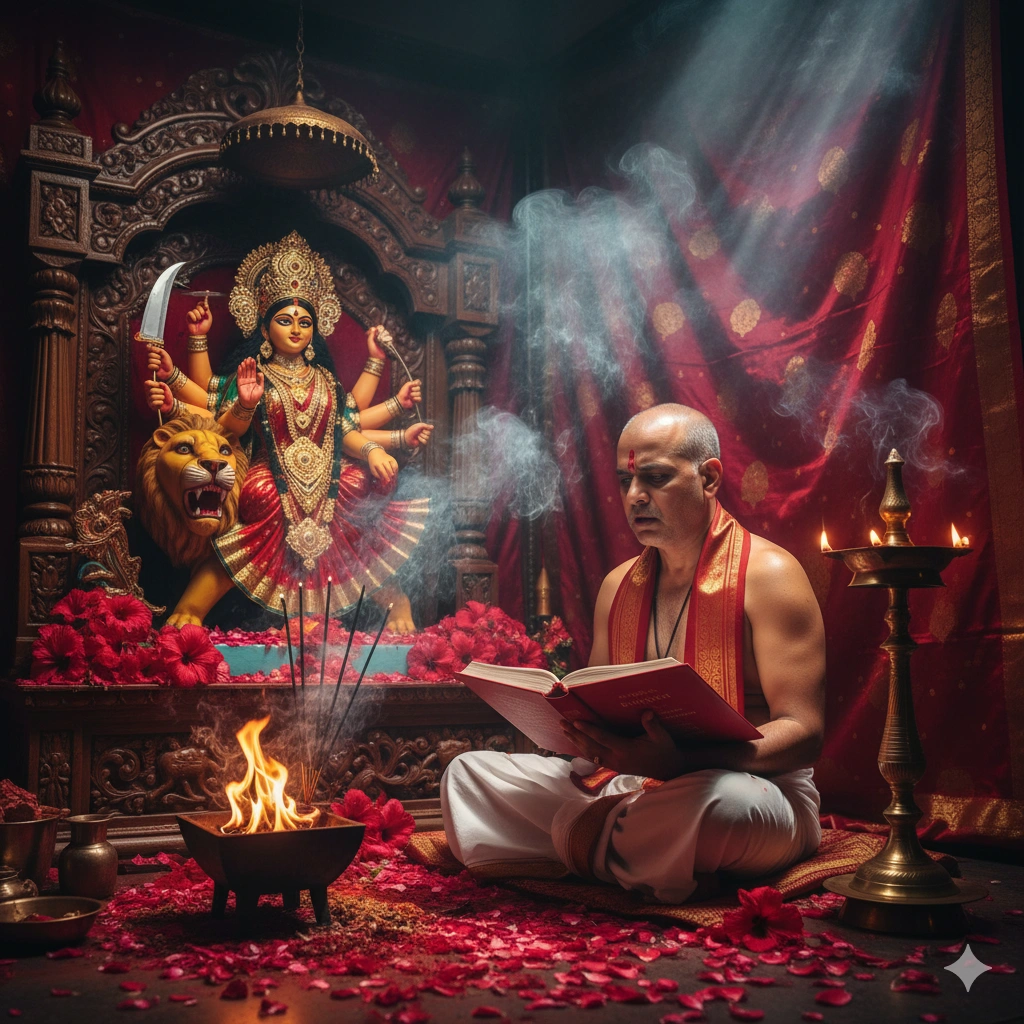
Nav Chandi & Chandi Path
(8 Reviews)
Among all the powerful feminine deities of the Vedic-Tantric tradition, Goddess Chandi, also known as Chandika or Chamunda, stands as one of the most fierce, direct, and instantaneously effective forces. Unlike the gentle Lakshmi or the wisdom-bearing Saraswati, Chandi is the warrior aspect of the Divine Mother, the one who emerges when the universe faces existential threats and when ordinary powers are insufficient. The Chandi Path (also called Navarna Chandi or Navachandi Path based on the number of recitations) is the recitation of the Devi Mahatmyam, with specific additional procedures that maximize its power for the devotee's protection, wish fulfillment, and liberation from adversarial forces. When nine complete readings are performed (Nav Chandi), the energy generated is nine times the standard, creating a vortex of feminine cosmic power that sweeps away obstacles, enemies, illnesses, and negative karma with extraordinary force. Families and individuals across Pune, from those facing business battles in Kharadi to those seeking protection in Hadapsar, from court case challenges in Pimpri-Chinchwad to spiritual seekers in Kothrud, commission Nav Chandi for situations that demand the most powerful available divine intervention.
Understanding the Difference: Chandi Path vs. Nav Chandi
Chandi Path: One complete recitation of the 13-chapter Devi Mahatmyam (700 verses), along with the preamble texts (Devi Kavach, Argala, Kilak, Navarna Jaap). This is a complete, powerful ceremony that takes approximately 4–5 hours.
Nav Chandi (Nine Chandis): Nine complete recitations of the Devi Mahatmyam, performed by 3–5 Pandits over the course of one full day. The nine-fold recitation is associated with the nine forms of the Divine Mother (Navadurga) and creates nine times the spiritual merit and energetic impact.
Both are effective, but Nav Chandi is specifically prescribed for situations requiring extraordinary divine power, court cases nearing verdict, severe black magic attacks, business crises, or as the central ritual of a major Navratri celebration.
The Significance of 'Nava' (Nine)
The number nine in Hindu numerology and Tantra represents completion, power, and the totality of the Divine Mother's energy (9 Navadugas, 9 Planets, 9 Rasas, 9 Chakras). When Chandi is recited nine times, it invokes all nine aspects of the Devi simultaneously, creating a complete cosmic protective umbrella for the devotee.
Who Should Commission Nav Chandi / Chandi Path?
- Active legal battles: Court cases approaching a critical hearing or verdict
- Severe black magic or Tantra attacks: When other remedies have been insufficient
- Business crises: Sudden loss of major clients, fraud, or financial collapse that requires divine reversal
- Health crises: Serious illness, especially when conventional medicine is struggling
- Enemy removal: When adversarial people are causing significant harm despite preventive measures
- Major life obstacles: Career stagnation despite excellence, repeated rejection in important matters
- Navratri celebration: Nav Chandi performed during Navratri is the most powerful Navratri ceremony possible at home
- Wish fulfillment: For important desires that have been long unfulfilled despite sincere effort
Step-by-Step Nav Chandi / Chandi Path Process
1. Sankalp: A detailed Sankalp stating the exact purpose, whether protection, wish fulfillment, legal victory, health, or spiritual growth.
2. Ganesh Puja: Lord Ganesha is invoked.
3. Navarna Mantra Jaap: 108–1,008 recitations of the Navarna Mantra ("Om Aim Hreem Kleem Chamundaye Vichche") to energize the space.
4. Devi Kavach, Argala, and Kilak: These three preamble texts, specifically the Devi Kavach (armor of the Goddess), create a protective field for both the performers and the beneficiary.
5. Complete Devi Mahatmyam Recitation (x1 or x9): All 13 chapters are recited in sequence, with appropriate Nyasa (ritual hand gestures) at each chapter's beginning. For Nav Chandi, all 9 rounds are completed in sequence by the team of Pandits.
6. Havan (Chandi Homa): A grand Havan follows the recitation. For each complete Chandi, 700 Ahutis are offered, one for each verse. For Nav Chandi, 6,300 Ahutis are offered total, creating one of the most powerful fire ceremonies available in home settings.
7. Kanya Puja: Nine young girls representing the nine forms of Durga are worshipped with flower garlands, offered food, and given the Dakshina (gift).
8. Aarti and Visarjan: A grand Devi Aarti concludes the ceremony.
Benefits of Nav Chandi / Chandi Path
- Invokes the most powerful protective force in the Hindu tradition
- Destroys adversarial forces that have resisted simpler remedies
- Creates an impenetrable protective energy field around the devotee and family
- Fulfills long-standing desires with unusual speed
- Grants victory in legal battles and conflicts
- Purifies the most severe black magic and negative energy attacks
- Brings immediate mental peace and courage to the devotee
Best Time for Chandi Path / Nav Chandi
- Navratri (both Chaitra and Sharad), the most powerful period
- Fridays, The Devi's day
- Ashtami, The 8th lunar day, sacred to the fierce aspect of the Goddess
- Masik Durgashtami, Monthly Durgashtami
Why Choose Vedic Pooja for Nav Chandi in Pune?
Nav Chandi is one of the most demanding ceremonies in Vedic practice, requiring Pandits who have not only memorized the Devi Mahatmyam but can maintain the correct phonetics and devotional intensity through nine complete recitations and a large-scale Havan. Our senior Pandits have performed Nav Chandi repeatedly and manage every aspect of this complex ceremony with precision and reverence.
We serve all of Pune including Baner, Aundh, Viman Nagar, Kharadi, Pashan, and Pimpri-Chinchwad. Call or WhatsApp 8668552465 for a confidential consultation and booking.
From
₹9,000
Akhand Ramayan Path
(8 Reviews)
There is a reason that the Ramcharitmanas, the beloved rendition of Lord Ram's life story by the saint-poet Tulsidas, has been recited continuously, without pause, in homes and temples across India for five centuries. It is because the Ramcharitmanas is not merely a poem or a story, it is a living mantra, a complete spiritual universe in verse form, whose continuous recitation (Akhand Path, meaning unbroken recitation) creates a field of divine sound energy so powerful that it transforms the very atmosphere of the space where it is chanted. The Akhand Ramayan Path is a 24-hour non-stop, continuous recitation of the complete Ramcharitmanas by a team of trained Pandits and Pathakars (reciters) who rotate in shifts to ensure that Lord Ram's story, from Bal Kand to Uttar Kand, flows without interruption from beginning to end. Families across Pune, from the devotion-rich localities of Kothrud to the corporate townships of Hinjewadi and Wakad, organize Akhand Ramayan Path for a wide range of auspicious occasions and life situations.
Why is Akhand (Unbroken) Recitation So Powerful?
In the Vedic tradition, continuity of sound has a unique spiritual significance. When a mantra or scripture is recited without stopping, its vibrations build upon each other, creating a resonance that deepens progressively over time, much like how a bell's sound remains present long after it has been struck. The Akhand Ramayan Path creates a continuous sound dome over the home or venue for the entire 24 hours, and devotees, family members, and neighbors who come within this field, even briefly, receive blessings.
The Ramcharitmanas itself states in its Mahatmya (glory section) that even hearing a single verse of this scripture can purify the listener. Imagine what a full 24-hour recitation does for the family hosting it.
Occasions for Akhand Ramayan Path
- Marriage season: Organized before or after a wedding to invite Ram's blessings on the union
- New home blessing: As an alternative or addition to Griha Pravesh, filling the home with divine vibrations before moving in
- Death anniversary (Barsi) or Pitra Paksha: For the peace and liberation of departed souls
- Illness recovery: When a family member is recovering from serious illness, the path creates a healing sound environment
- Business or career difficulties: To invite Lord Ram's blessings for stability and growth
- Community events: Housing societies organize Akhand Path to bring the entire community together in devotion
- Simply as an act of gratitude and devotion: No specific reason is needed, devotion to Lord Ram is itself a complete purpose
The Structure of Akhand Ramayan Path
The Ramcharitmanas consists of seven sections (Kands):
1. Bal Kand: Lord Ram's birth, childhood, and early life
2. Ayodhya Kand: The exile, the tests of dharma
3. Aranya Kand: The forest years, Sita's abduction
4. Kishkindha Kand: The alliance with Sugriva and Hanuman
5. Sundar Kand: Hanuman's journey to Lanka, the most beloved section
6. Lanka Kand: The great battle and Ravan's defeat
7. Uttar Kand: Ram's return to Ayodhya, the ideal kingdom
The complete Akhand Path takes approximately 24 hours when chanted at a devotional pace by a team of 4–7 trained reciters who rotate in shifts of 2–3 hours each.
Step-by-Step Process
1. Kalash Sthapana: A sacred Kalash is established in the puja space before the Path begins. Lord Ram, Goddess Sita, Lord Lakshmana, and Lord Hanuman are invoked.
2. Ganesh Puja: Lord Ganesha is worshipped to bless the uninterrupted flow of the recitation.
3. Sankalpam: The host family takes the Sankalp, the formal declaration of purpose, their name, gotra, and the intention of the Path.
4. Aarti (Start): A beautiful Aarti to Lord Ram is performed as the recitation begins.
5. Continuous Akhand Recitation: The team of Pandits and Pathakars begins the Ramcharitmanas from the beginning (Maṅgalācharan). Reciters rotate in pairs, ensuring no break in the recitation at any point during the 24 hours.
6. Sunderkand Special Aarti (mid-path): When the reciters reach the Sundar Kand, a special mid-path Aarti is performed as this section is especially beloved and potent.
7. Conclusion Puja and Havan: Upon completing the Uttar Kand, a concluding puja is performed. A Havan follows, with offerings made with Ram naam mantras.
8. Bhajan Sandhya (Evening Devotional Music): In the premium package, a bhajan team performs devotional music during the evening portion of the 24-hour period.
9. Maha Prasad: A community meal (Prasad) is served at the conclusion, traditionally including kheer, pooris, and sabzi.
Benefits of Akhand Ramayan Path
- The entire home is filled with the divine vibrations of Lord Ram's story for a complete 24-hour cycle
- Purifies accumulated negative energies and past karma of the household
- Brings peace to ancestral souls (Pitrus) when performed for this purpose
- Creates a powerful protective energy field that remains perceptible for days after the Path
- Strengthens family bonds through collective participation in devotion
- Attracts divine grace for any specific intention the family holds
Best Time for Akhand Ramayan Path
- Ram Navami, Lord Ram's birthday, the most powerful day
- Vivah Panchami, Ram and Sita's marriage anniversary
- Purnima (Full Moon days), especially Kartik and Chaitra
- Any personally auspicious occasion, anniversaries, recovery from illness, new beginnings
Why Choose Vedic Pooja for Akhand Ramayan Path in Pune?
An Akhand Path is a logistical and spiritual event requiring coordination between multiple reciters, a devotional atmosphere, and careful management of the 24-hour timeline. Our team has extensive experience managing Akhand Ramayan Paths in homes and community halls across Pune, from individual family celebrations in Hadapsar to large society events in Baner and Kharadi.
We provide a complete, turnkey service: trained reciters, all samagri, coordinated shift management, and an evening bhajan program in premium packages.
Call or WhatsApp 8668552465 to book your Akhand Ramayan Path in Pune.
From
₹15,000
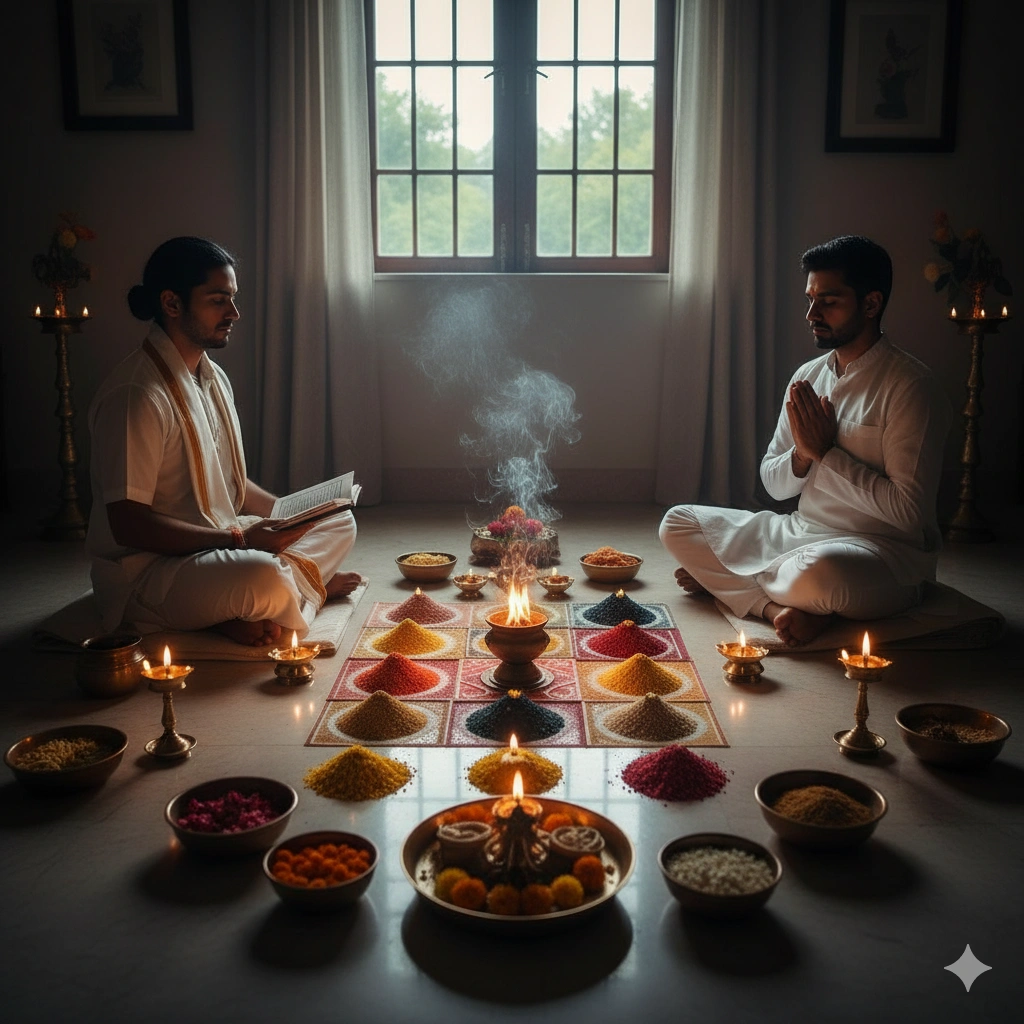
Grah Shanti Puja
(8 Reviews)
Every person's life unfolds within a cosmic framework shaped by nine planetary forces, the Navagrahas. At birth, the positions of these planets in the horoscope create a blueprint of the individual's life tendencies, strengths, challenges, opportunities, and potential struggles. While we cannot choose our birth chart, the Vedic tradition offers a remarkable gift: the ability to actively harmonize our relationship with the planets through dedicated rituals. Grah Shanti Puja, literally 'planetary pacification worship', is the comprehensive Vedic ceremony for strengthening favorable planets, pacifying malefic ones, and ensuring that the cosmic forces of your horoscope work for you rather than against you. This is not superstition, it is the sophisticated practice of aligning personal energy with cosmic cycles, a practice that has been refined over thousands of years by Vedic astrologers and ritual specialists. Families across Pune, from tech professionals in Wakad and Kharadi navigating career transits to families in Kothrud and Hadapsar experiencing health or financial challenges, turn to Grah Shanti Puja for genuine relief and upliftment.
Understanding the Nine Planets and Their Influence
Each of the nine planets governs specific domains of human life:
- Sun (Surya): Authority, father, health, career recognition, government
- Moon (Chandra): Mind, mother, emotions, water, cycles, intuition
- Mars (Mangal): Energy, courage, blood, property, siblings, aggression
- Mercury (Budha): Intelligence, communication, business, education, adaptability
- Jupiter (Guru): Wisdom, expansion, children, marriage, spirituality, abundance
- Venus (Shukra): Love, beauty, luxury, relationships, vehicles, creativity
- Saturn (Shani): Karma, discipline, delay, longevity, service, transformation
- Rahu (North Node): Ambition, foreign elements, technology, illusion, sudden changes
- Ketu (South Node): Spirituality, detachment, past-life karma, moksha, mysterious experiences
When any of these planets is debilitated, afflicted, or placed in a challenging house in the birth chart, or when the current planetary period (Mahadasha or Antardasha) is of a difficult planet, Grah Shanti Puja provides targeted relief.
Which Planet-Specific Puja Do You Need?
Grah Shanti Puja can be performed for all nine planets together (Navagraha Shanti) or for a specific planet:
- Surya Shanti: For career recognition, relationship with authority, and health issues related to heart, eyes, and bones
- Chandra Shanti: For mental peace, emotional stability, maternal health, and memory
- Mangal Shanti: For Mangal Dosh, aggression issues, property disputes, and blood disorders
- Budha Shanti: For communication skills, business success, and nerve-related health issues
- Guru Shanti (Jupiter): For delayed marriage, children issues, and financial expansion
- Shukra Shanti: For relationship harmony, artistic growth, and luxury acquisition
- Shani Shanti: The most frequently requested, for Sade Sati, Shani Dhaiya, Shani Mahadasha challenges
- Rahu Shanti: For sudden losses, confusion, foreign travel issues, and unconventional career paths
- Ketu Shanti: For spiritual confusion, health mysteries, and breaking free from limiting past-life patterns
Step-by-Step Grah Shanti Puja Process
1. Kundali Review: The Pandit reviews the birth chart and identifies the specific planet(s) needing pacification based on current Dasha, transit, and natal placement.
2. Sankalp: Formal Sankalp taken in the person's name, birth Nakshatra, and gotra.
3. Ganapati Puja: Lord Ganesha is invoked first.
4. Navagraha Sthapana: Nine sacred vessels or nine-sided diagrams representing each planet are established in the puja space. Specific items are placed for each planet, red flowers for Mars, white flowers for Moon, yellow flowers for Jupiter, blue flowers for Saturn, etc.
5. Planet-Specific Mantras: For each planet (or the targeted planet), specific beeja mantras are chanted. The number of repetitions corresponds to the planet's cosmic number (Sun = 7000, Moon = 11000, Mars = 10000, Mercury = 17000, Jupiter = 19000, Venus = 16000, Saturn = 23000, Rahu = 18000, Ketu = 17000).
6. Navagraha Stotra: The complete Navagraha Stotra, a 9-verse hymn praising each planet, is recited.
7. Havan: Specific herbs and offerings for each planet are offered into the sacred fire:
, Sun: Red sandalwood, wheat grains
, Moon: White rice, milk
, Mars: Red sesame, masoor dal
, Mercury: Green grass, moong dal
, Jupiter: Yellow sesame, gram dal
, Venus: White sesame, white rice
, Saturn: Black sesame, sesame oil
, Rahu: Multi-color sesame mixture
, Ketu: Mixed sesame and grains
8. Gemstone Energization (optional): If the devotee wears a planetary gemstone, it is placed before the respective planet's image during the puja and formally energized with mantras.
9. Post-Puja Remedies: Specific dietary recommendations, charitable acts, and gemstone or rudraksha suggestions are provided.
Benefits of Grah Shanti Puja
- Direct pacification of the specific planetary energies creating disturbances
- Relief from ongoing Mahadasha/Antardasha challenges
- Strengthening of favorable planetary periods
- Improved mental peace, career clarity, and relationship harmony
- Physical health improvements in areas governed by the troubled planet
- Astrological protection for the entire family during challenging transits
Best Time for Grah Shanti Puja
- Planet-specific days: Each planet has a specific day, Sun on Sunday, Moon on Monday, Mars on Tuesday, Mercury on Wednesday, Jupiter on Thursday, Venus on Friday, Saturn on Saturday
- During the planet's Hora (specific hour of the day when the planet is most powerful)
- Pushya Nakshatra, universally auspicious for all remedial pujas
- During challenging transit periods, e.g., Saturn transit into a new sign, Rahu-Ketu shift
Why Choose Vedic Pooja for Grah Shanti Puja in Pune?
Grah Shanti Puja is highly personalized, the specific mantras, counts, colors, and materials depend entirely on the individual's birth chart. Our Pandits are trained in both Jyotish (Vedic astrology) and the corresponding ritual procedures, ensuring that your Grah Shanti Puja is tailored to your specific planetary situation.
We serve all Pune localities including Baner, Aundh, Pashan, Pimpri-Chinchwad, Viman Nagar, and Hinjewadi. Call or WhatsApp 8668552465 for a free astrological consultation before booking.
From
₹5,000
.8002cc94.webp)
Mangal Dosh Puja (Manglik Dosh)
(0 Reviews)
If you or a family member has been told by an astrologer that 'you are Manglik', you have likely encountered a term that carries both fear and misunderstanding. Mangal Dosh, also known as Manglik Dosh or Kuja Dosh, is one of the most commonly discussed astrological conditions in the context of Hindu marriage, and one of the most misunderstood. While it can create real challenges, particularly in marriage, relationships, and temperament, it is absolutely remediable through the Mangal Dosh Puja, a precisely targeted Vedic ritual that appeases Mars (Mangal) and transforms its destructive energy into courage, vitality, and determination. Families in Pune, from Kothrud to Kharadi, Viman Nagar to Wakad, have seen this remedy transform seemingly impossible matrimonial situations and bring lasting harmony.
Understanding Mangal Dosh
Mangal Dosh occurs when Mars (Mangal) is placed in the 1st, 2nd, 4th, 7th, 8th, or 12th house of a birth chart. (Different regional traditions count slightly different houses, which is why consulting an experienced astrologer for your specific chart is essential.)
Mars is the planet of energy, aggression, passion, and will. In the right position, Mars makes a person courageous, decisive, and energetic. But in the houses related to partnership, marriage, and shared life (the 7th and 8th especially), Mars creates friction, dominance, conflict, and, in severe cases, disruption to the marital relationship.
Degrees of Mangal Dosh:
- Mild Manglik: Mars in these houses without major affliction, manageable with simple remedies
- Moderate Manglik: Mars conjunct or aspected by malefics, requires dedicated Puja
- Severe Manglik: Mars in the 7th or 8th house, heavily afflicted, comprehensive remediation recommended
Importantly, if both partners in a marriage are Manglik, the doshas cancel out. If only one is Manglik, the remedies below become essential before marriage.
Common Effects of Mangal Dosh
- Delays in marriage despite eligible candidates
- Conflicts and power struggles with romantic partners
- Difficulty maintaining long-term relationships
- Aggression, impulsiveness, and temperamental challenges
- In extreme cases, repeated relationship failures
- Physical health issues related to blood, muscles, or injuries
Who Should Perform Mangal Dosh Puja?
- Young men and women whose kundali analysis confirms Mangal Dosh before marriage
- Anyone experiencing repeated failures in relationships or broken engagements
- Married individuals experiencing ongoing marital conflict
- Those with health issues related to Mars, blood disorders, accidents, surgeries
- Anyone in a strong Mars Mahadasha or Antardasha experiencing turbulence
Step-by-Step Mangal Dosh Puja Ritual Process
1. Kundali Review and Sankalp: The ceremony begins with the Pandit reviewing the birth chart. A formal Sankalp is taken in the individual's name, gotra, birth Nakshatra, and the specific Dosh being remedied.
2. Ganesh Puja: Lord Ganesha is invoked first to bless and remove obstacles from the ritual.
3. Navagrah Sthapana: The nine planets are established and worshipped, with special emphasis on Mars (Mangal).
4. Mangal Shanti Puja: Lord Mangal is worshipped with red flowers (red lotus, red roses), red cloth, copper items, and his specific beeja mantra: "Om Kraam Kreem Kraum Sah Bhaumaya Namah."
5. Hanuman Puja: Lord Hanuman is invoked, he is the deity who governs and controls the fierce energy of Mars. Hanuman Chalisa is recited along with Sundar Kand Path for powerful Mars pacification.
6. Mangal Jaap: The Mangal beeja mantra is chanted 10,000 times (basic), 28,000 times (standard), or 40,000 times (premium). This Purashcharana directly addresses the Mars energy in the birth chart.
7. Havan: A sacred fire ceremony with red sandalwood, sesame, ghee, and specific Mars-pacifying herbs. The Havan seals and amplifies the Jaap's energy.
8. Mangal Stotra Path: The Mangal Stotra, specific hymns to Mars, is recited for final purification.
9. Kumbha Vivah or Vishnu Vivah (if recommended): In certain severe cases, our Pandit may recommend a symbolic marriage to a Peepal tree or Lord Vishnu idol before the actual marriage, a traditional Vedic remedy for intense Mangal Dosh. We facilitate this with complete protocol.
10. Post-Puja Remedies: Wearing a Red Coral (Moonga) in gold, Tuesday fasting, visiting a Hanuman temple on Tuesdays, and offering red lentils (Masoor Dal) are recommended by our Pandits as ongoing remedies.
Benefits of Mangal Dosh Puja
- Reduces the aggressive, conflict-prone energy of Mars in personal relationships
- Removes or significantly reduces delays in marriage
- Brings harmony between Manglik and non-Manglik partners
- Transforms Mars energy from destructive to constructive, courage without aggression
- Improves physical health related to Mars (blood, muscles, vitality)
- Pacifies ongoing Mars Mahadasha/Antardasha challenges
Best Time for Mangal Dosh Puja
- Tuesday (Mangalvar), Mars's day, most auspicious
- Amavasya (New Moon), powerful for planetary remedies
- Scorpio or Aries Lagna, Mars's own signs, strongest for Mangal Puja
- Pushya Nakshatra, universally auspicious for remedial pujas
Why Choose Vedic Pooja for Mangal Dosh Puja in Pune?
Mangal Dosh Puja requires specific expertise in both Vedic astrology and ritual procedure. Our Pandits accurately assess the type and severity of Mangal Dosh from the actual birth chart before recommending the appropriate package. We serve all Pune localities including Aundh, Pashan, Baner, Hinjewadi, Pimpri-Chinchwad, and Hadapsar.
Call or WhatsApp 8668552465 for a free initial consultation and same-day booking.
From
₹5,100
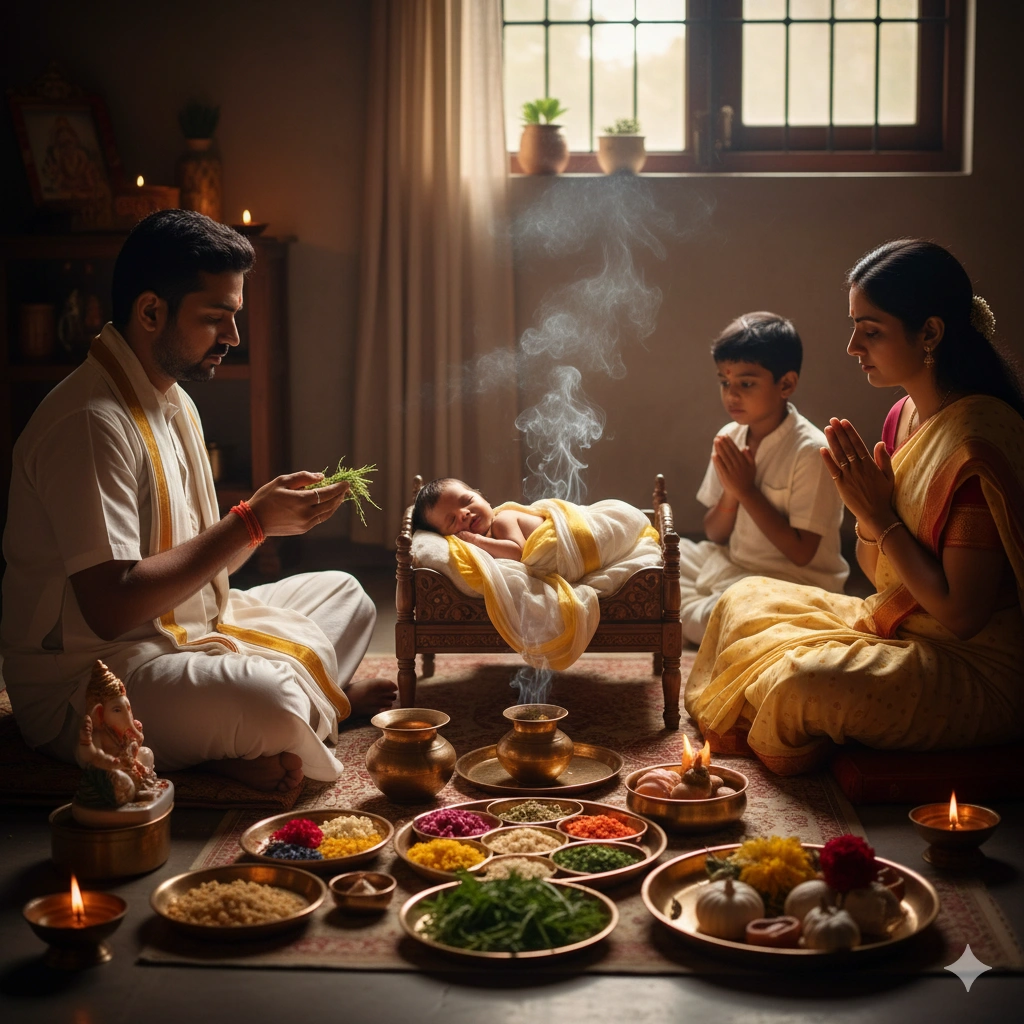
Gand Mool Shanti Puja
(8 Reviews)
The birth of a child is among the most joyful moments in any family's life. Yet when the newborn arrives during one of the six Gand Mool Nakshatras, Ashwini, Ashlesha, Magha, Jyeshtha, Moola, or Revati, traditional Vedic astrology prescribes a specific protective ceremony called Gand Mool Shanti Puja. This puja is not a cause for alarm, it is a cause for informed action. In the Vedic tradition, children born in these Nakshatras are considered to be powerful souls who carry significant karmic potential, and the Gand Mool Shanti ceremony is designed to carefully manage and redirect this intense energy toward the child's highest good, and protect both the child and the family from the heightened sensitivity of this birth configuration. Families across Pune, in Hadapsar, Kothrud, Kharadi, Viman Nagar, and beyond, perform this puja within 27 days of the child's birth to ensure that the newborn begins life fully protected and blessed.
Understanding Gand Mool Nakshatras
In Vedic astrology, the 27 Nakshatras (lunar constellations) are grouped into different energy qualities. The term 'Gand' refers to a 'knot' or 'junction', these Nakshatras fall at the junctions between the water and fire signs of the zodiac, creating a specific energetic quality that is intense, transformative, and sensitive:
- Ashwini (Aries), The healing Nakshatra; powerful but intense at the Pisces-Aries junction
- Ashlesha (Cancer), The serpent Nakshatra; deeply karmic at the Gemini-Cancer junction
- Magha (Leo), The ancestral Nakshatra; connected to Pitru (ancestral) energies
- Jyeshtha (Scorpio), The elder Nakshatra; intense and leadership-oriented
- Moola (Sagittarius), The root Nakshatra; most widely cited in Gand Mool discussions
- Revati (Pisces), The closing Nakshatra; sensitive and spiritually oriented
The concern in traditional texts is that children born in these Nakshatras carry intensified karmic patterns that, without proper ritual management, can create challenges for the child's development or for the family. The Gand Mool Shanti Puja addresses this with precise ritual procedures.
When Should Gand Mool Shanti Puja Be Performed?
The scriptures prescribe the following timing:
- Ideally on the 27th day after birth, when the Moon returns to the same Nakshatra as the birth
- Or within the first year of life, on any day when the Moon transits the same Nakshatra
- The 27th, 54th, or 81st day are all considered appropriate
Our Pandits identify the exact dates when the Moon will transit the child's birth Nakshatra and schedule the puja for maximum effectiveness.
Step-by-Step Gand Mool Shanti Puja Process
1. Kundali Analysis: The Pandit reviews the child's precise birth details to confirm the Gand Mool Nakshatra and identify its pada (quarter), which determines the exact nature of the Shanti required.
2. Sankalp: The Sankalp is taken in both the child's name and the father's name, as the ceremony involves blessings flowing from the family lineage to the newborn.
3. Ganapati Puja: Lord Ganesha is invoked for the success of the Shanti ritual.
4. Nakshatra Devata Puja: The presiding deity of the specific Nakshatra is worshipped:
, Ashwini: The Ashwini Kumaras (divine healers)
, Ashlesha: The Nagas (serpent deities)
, Magha: The Pitrus (ancestral divine beings)
, Jyeshtha: Indra (king of gods)
, Moola: Nirriti (goddess of dissolution)
, Revati: Pushan (the nourishing solar deity)
5. Navagraha Puja: The nine planets are invoked and appeased, with special attention to the planet governing the birth Nakshatra.
6. 27 Paani Vidhi (Standard and Premium): In the traditional format, the Pandit performs a ritual using 27 separate water vessels, each representing one of the 27 Nakshatras. Each vessel receives specific herbs and mantras before being used for a symbolic purification of the child. This ritual comprehensively harmonizes the child with all Nakshatra energies.
7. Nakshatra Jaap: The specific Nakshatra mantra is chanted, typically 108 to 1,008 times depending on the package.
8. Havan with Abhishek: A sacred fire is lit and offerings are made for the child's protection and purification. The child may be gently bathed with specially prepared water (Abhishek) as part of the ceremony.
9. Blessings and Aarti: The child is dressed in new clothes, adorned with auspicious marks, and blessed by the Pandit with mantras for health, intelligence, and long life. An Aarti is performed.
Benefits of Gand Mool Shanti Puja
For the Child:
- Releases and redirects the intense karmic energy of the Gand Mool birth configuration
- Establishes a protective field of divine blessing around the child from the earliest stage of life
- Activates the positive potential of the Gand Mool Nakshatra, these children often have exceptional talents and leadership qualities
- Promotes good health, strong immunity, and bright intellect
For the Family:
- Releases the family from the traditional apprehensions about Gand Mool births
- Invokes ancestral blessings for the new addition to the lineage
- Fulfills the Vedic obligation of properly managing this important birth configuration
Astrological Benefits:
- Pacifies the specific planets and deities whose Nakshatra the child has occupied
- Creates a favorable planetary environment for the child's Dasha periods
What's Included
- Experienced Pandit trained in Nakshatra Shanti procedures
- Complete Gand Mool Shanti Samagri: 27 water vessels (for 27 Paani Vidhi), specific herbs for each Nakshatra, flowers, Gangajal, new cloth for child
- Nakshatra Devata Puja
- Navagraha Puja
- Nakshatra Mantra Jaap
- Havan and Abhishek
- Post-puja guidance and ongoing remedies
Why Choose Vedic Pooja for Gand Mool Shanti in Pune?
Gand Mool Shanti requires a Pandit who understands both Vedic astrology and ritual procedures deeply, because the ceremony is precisely calibrated to the child's specific Nakshatra and birth configuration. Our Pandits have performed hundreds of Gand Mool Shanti pujas across Pune and bring genuine care, ritual expertise, and warm reassurance to anxious parents.
We serve all Pune localities. Call or WhatsApp 8668552465 to schedule your child's Gand Mool Shanti Puja with free Nakshatra date calculation.
From
₹7,000
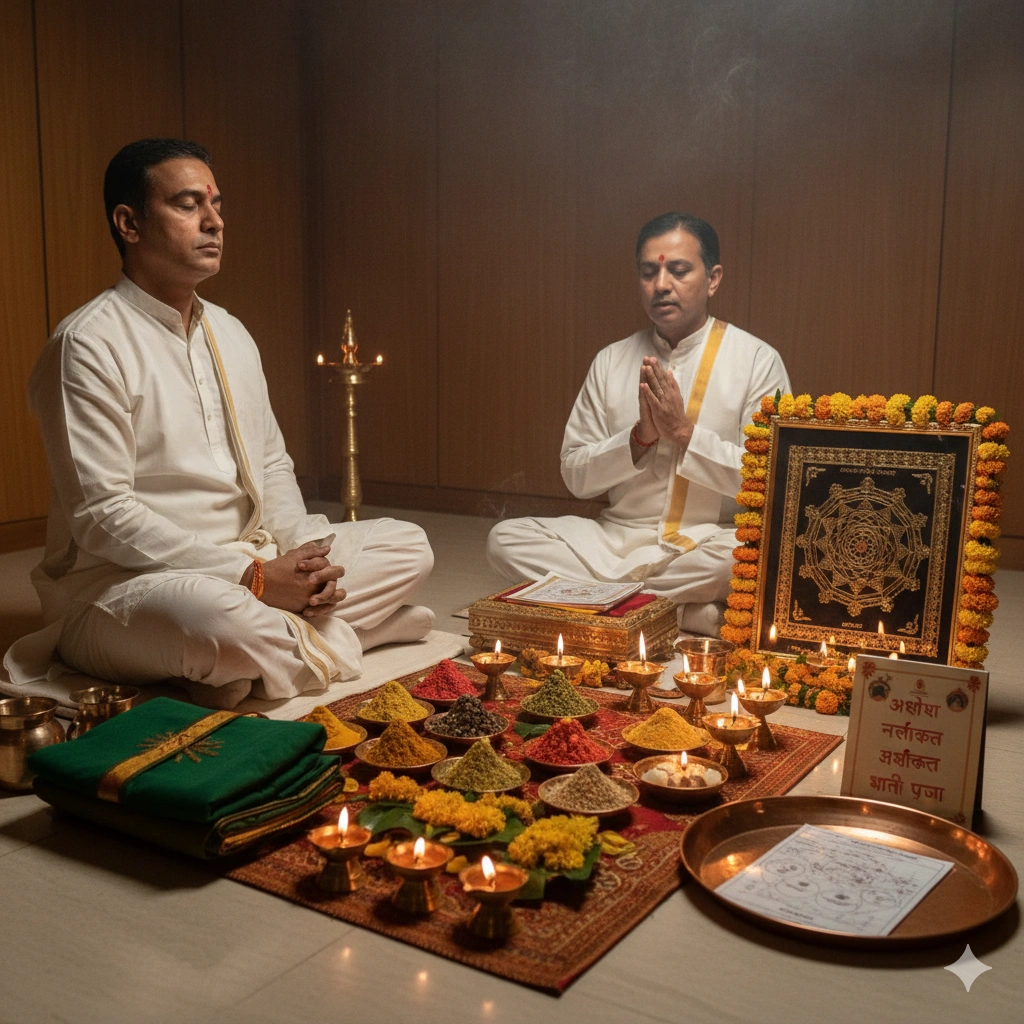
Nakshatra Shanti Puja
(8 Reviews)
In Vedic astrology, the Nakshatra (lunar constellation) you were born in is not a passive symbol, it is the most intimate cosmic fingerprint of your soul in this life. The Moon's position in one of the 27 Nakshatras at the moment of birth determines your deepest emotional nature, your subconscious patterns, your instinctive responses, your spiritual proclivities, and, crucially, the quality of your first planetary Dasha (life period). When the birth Nakshatra is afflicted, either by its inherent qualities, by the placement of malefic planets near it in the chart, or by challenging current transits, it can manifest as persistent emotional difficulties, recurring health patterns, mental restlessness, or obstacles in relationships. The Nakshatra Shanti Puja is a personalized, targeted Vedic ceremony designed to pacify these birth-Nakshatra afflictions and enhance the positive, supportive qualities of your Janma Nakshatra. Unlike generic remedial pujas, this ceremony is completely tailored to the individual's specific Nakshatra, its presiding deity (Nakshatra Devata), its ruling planet (Nakshatra Swami), and the specific challenges arising from it. Families in Pune, from individuals in IT careers navigating career and mental health challenges in Hinjewadi and Kharadi, to families managing health and relationship issues in Kothrud and Hadapsar, find genuine relief through this personalized remedy.
The 27 Nakshatras and Their Presiding Deities
Each of the 27 Nakshatras has a specific ruling deity, a ruling planet, a symbol, and an associated element of human psychology:
- Ashwini (Ketu), Ashwini Kumaras: Healing, new beginnings
- Bharani (Venus), Yama: Discipline, karma, transformation
- Krittika (Sun), Agni: Purification, leadership
- Rohini (Moon), Brahma: Growth, beauty, material abundance
- Mrigashira (Mars), Soma: Curiosity, searching, creativity
- Ardra (Rahu), Rudra: Storms, transformation, grief
- Punarvasu (Jupiter), Aditi: Return, renewal, abundance
- Pushya (Saturn), Brihaspati: Nourishment, wisdom, spirituality
- Ashlesha (Mercury), Nagas: Serpent wisdom, kundalini, hidden knowledge
- Magha (Ketu), Pitrus: Ancestral power, royalty
- Purva Phalguni (Venus), Bhaga: Pleasure, creativity, abundance
- Uttara Phalguni (Sun), Aryaman: Service, generosity
- Hasta (Moon), Savitri: Skill, manifestation, dexterity
- Chitra (Mars), Vishwakarma: Creativity, design, brilliance
- Swati (Rahu), Vayu: Independence, flexibility, movement
- Vishakha (Jupiter), Indra-Agni: Purpose, determination, ambition
- Anuradha (Saturn), Mitra: Friendship, devotion, balance
- Jyeshtha (Mercury), Indra: Elder wisdom, leadership, protection
- Moola (Ketu), Nirriti: Dissolution, roots, foundation
- Purva Ashadha (Venus), Apas: Water, purification, invincibility
- Uttara Ashadha (Sun), Vishvadevas: Universal dharma, victory
- Shravana (Moon), Vishnu: Learning, listening, connection
- Dhanishtha (Mars), Ashta Vasus: Wealth, music, abundance
- Shatabhisha (Rahu), Varuna: Healing, mystery, cosmic law
- Purva Bhadrapada (Jupiter), Aja Ekapad: Fire, purification, intensity
- Uttara Bhadrapada (Saturn), Ahirbudhnya: Depth, wisdom, cosmic ocean
- Revati (Mercury), Pushan: Nourishment, guidance, safe passage
Who Should Perform Nakshatra Shanti Puja?
- Those experiencing recurring mental health challenges, anxiety, depression, emotional instability
- Individuals with chronic health patterns that correspond to their birth Nakshatra's body area
- People whose Nakshatra lord (ruling planet) is significantly afflicted in their birth chart
- Those born in Gand Mool Nakshatras as a complement to or alternative to Gand Mool Shanti
- Anyone experiencing difficult Dasha periods governed by their birth Nakshatra's ruling planet
- Those whose Moon is seriously afflicted in the birth chart
- Individuals seeking to enhance the positive gifts of their Nakshatra, a skilled person with Hasta Nakshatra can amplify their dexterity and manifestation ability through this puja
Step-by-Step Nakshatra Shanti Puja Process
1. Detailed Kundali Review: The Pandit carefully analyzes the birth chart, identifying the Janma Nakshatra, its Pada (quarter), the Nakshatra lord's position, and any specific afflictions.
2. Sankalp: Formal Sankalp taken in the individual's name, birth Nakshatra, and gotra.
3. Ganapati Puja: Lord Ganesha is invoked.
4. Nakshatra Devata Avahana: The presiding deity of the birth Nakshatra is formally invoked with their specific mantras and offerings.
5. Nakshatra Swami Puja: The ruling planet of the Nakshatra is specifically worshipped with its beeja mantra and associated colors, flowers, and materials.
6. Nakshatra Mantra Jaap: The specific Nakshatra mantra is chanted, typically 54 times for each of the 27 Nakshatras in the basic format, or the specific Nakshatra's count (108 x the Nakshatra number in sequence) in the advanced format.
7. Havan: A fire ceremony with the Nakshatra Devata's specific herbs and offerings. The Havan's fire purifies the subtle body at the level of the Nakshatra's energy frequency.
8. Moon (Chandra) Puja: Since the Moon governs Nakshatra experience, a separate Moon puja with white flowers, white rice, and Chandra mantras is often included for complete effect.
9. Remedial Guidance: Post-puja, the Pandit provides specific ongoing remedies, foods, colors, directions, and simple mantras to maintain the Nakshatra's positive activation.
Benefits of Nakshatra Shanti Puja
- Stabilizes emotional patterns rooted in Nakshatra afflictions
- Reduces recurring health issues connected to the Nakshatra's body areas
- Enhances the natural gifts and talents of the birth Nakshatra
- Pacifies the challenging aspects of malefic placements near the birth Moon
- Creates a deep sense of inner peace and alignment with one's cosmic identity
- Activates favorable planetary influences from the Nakshatra lord
Best Time for Nakshatra Shanti Puja
- On the day the Moon transits the birth Nakshatra, the most powerful moment, occurring once a month
- Full Moon (Purnima), when the Moon is at maximum strength
- Pushya Nakshatra, universally auspicious for remedial pujas
- Monday, the Moon's day
Our Pandits calculate the ideal monthly Nakshatra day for each individual.
Why Choose Vedic Pooja for Nakshatra Shanti in Pune?
This is the most personalized puja we offer, it requires genuine Jyotish knowledge to correctly identify and address the Nakshatra afflictions. Our Pandits bring both astrological expertise and ritual precision to this ceremony, ensuring it addresses your specific Nakshatra pattern rather than following a one-size-fits-all procedure.
We serve all Pune localities including Aundh, Pashan, Baner, Wakad, Viman Nagar, and Pimpri-Chinchwad. Call or WhatsApp 8668552465 for a free Nakshatra consultation before booking.
From
₹5,100
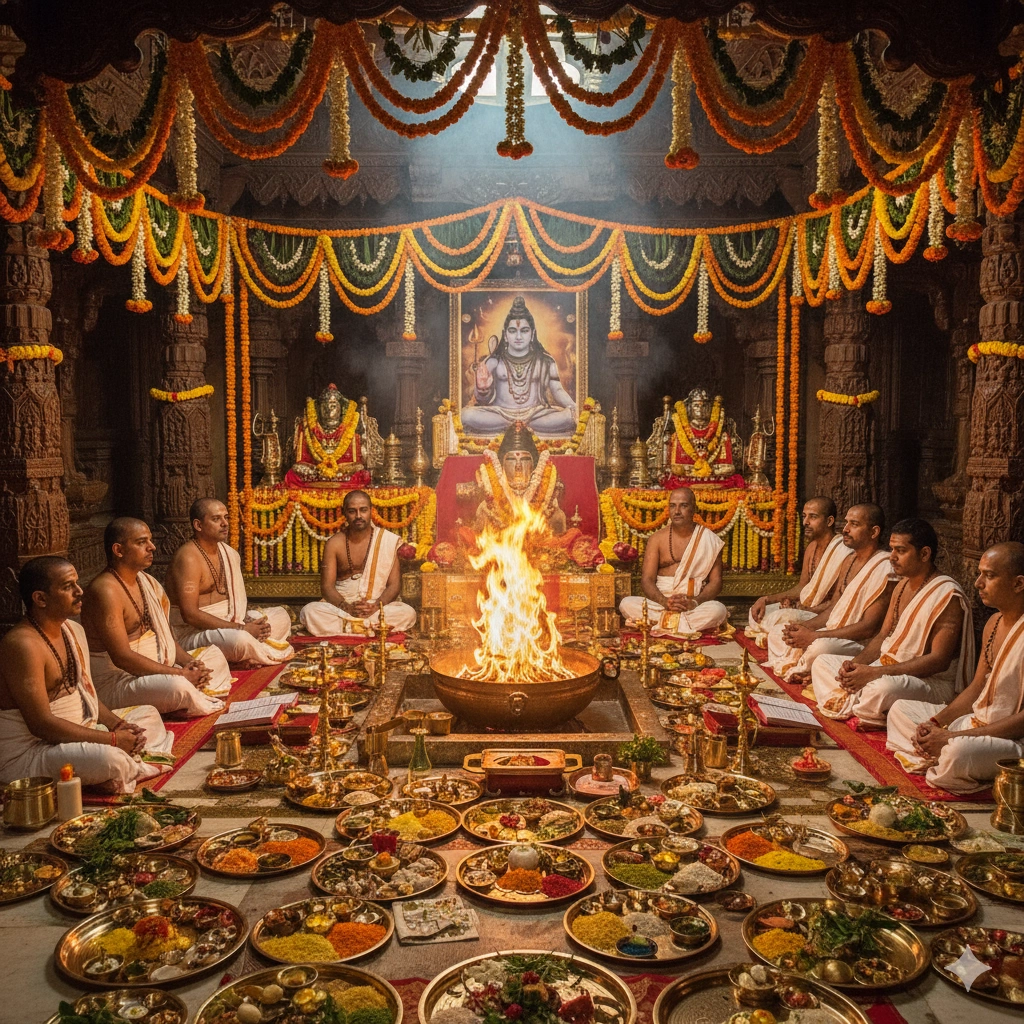
Rudra Yagna
(8 Reviews)
If Rudrabhishek is the daily prayer and Rudrabhishek with multiple cycles is the dedicated practice, then Rudra Yagna is the supreme offering, a grand, multi-Pandit, multi-day fire ceremony dedicated entirely to Lord Shiva in his Rudra form, featuring hundreds of recitations of the complete Sri Rudram. This is the Maha Yajna of Shaivism, performed when extraordinary blessings are sought, when serious collective or personal calamities must be averted, when a family or community wishes to express the highest degree of gratitude and devotion, or when a powerful karmic reset is needed at the level of the entire family lineage. Rudra Yagna with 11, 121, or even 1,331 Rudram recitations creates a vortex of Shiva's energy so powerful that its effects are felt for years. Organized by temples, large families, communities, and devotees across Pune, from the ancient religious localities of Deccan and Shivaji Nagar to the new developments of Wakad and Baner, the Rudra Yagna is Pune's most powerful Shaiva ceremony.
The Vedic Basis of Rudra Yagna
The tradition of Rudra Yagna is rooted in the Vedic concept of collective Vedic fire offerings (Yajna) as a means of connecting with and propitiating cosmic powers. The Sri Rudram, divided into Namakam (the first 8 anuvaks calling out to Rudra) and Chamakam (the final 11 anuvaks requesting boons), is the oldest and most comprehensive hymn to Lord Shiva, dating to the Krishna Yajurveda.
The specific numerical multiples of Rudram recitations in a Rudra Yagna have precise meanings:
- 11 Rudrams: A single Laghu Rudrabhishek cycle. Performed by 1–2 Pandits.
- 121 Rudrams: An Ekadasha Rudri, 11 Pandits each chanting 11 Rudrams simultaneously. Creates a 11x amplification of energy.
- 1,331 Rudrams: A Maha Rudra, 11 Pandits each performing 121 Rudrams. One of the most powerful ceremonies in Vedic tradition.
Our basic package covers 121 Rudrams (5 Pandits, completing over the course of one day). Our premium package covers a full Maha Rudra configuration.
Who Should Organize a Rudra Yagna?
- Families facing repeated serious illness, especially health crises that seem to repeat across generations (indicating family karma)
- Communities experiencing collective distress, natural disasters, recurring accidents, epidemics
- Business organizations seeking a powerful reset after sustained losses or disruptions
- Housing societies wishing to consecrate the collective energy of the residential community
- Individuals in severe Saturn, Rahu, or Ketu periods who need a high-powered spiritual intervention
- Those performing a Shata Chandi or Navagraha Maha Yagna for whom Rudra Yagna is the crown ceremony
- Devotees of Lord Shiva seeking the highest available form of devotional offering
Step-by-Step Rudra Yagna Process
1. Yagna Shala Setup: A dedicated fire altar (Kunda) is constructed, typically a square pit lined with bricks, with specific geometric proportions corresponding to the type of Yagna.
2. Sankalp by Host: The hosting family or organization takes the formal Sankalp, declaring the purpose and dedicating the merit to the welfare of all.
3. Ganesh Puja, Navagrah Puja: All planetary deities are invoked. Special attention to Saturn and Rahu.
4. Shivalinga Abhishek: The Shivalinga is bathed with Panchamrit, Gangajal, and Bilva leaves as a preliminary act of devotion.
5. Yagna Diksha: All participating Pandits take a formal dedication to Lord Shiva for the duration of the Yagna.
6. Sri Rudram Recitation with Yagna: The participating Pandits begin the continuous Rudram recitation. With each verse of the Namakam, corresponding Ahutis (offerings) of ghee, sesame, rice, and specific herbs are poured into the sacred fire by the Yagna team.
7. Chamakam Offerings: Each recitation of the Chamakam is accompanied by special offerings for the 33 specific boons requested, from cows to gold to spiritual liberation.
8. Musical Component: The premium package includes a traditional Vedic musical team, Veena or Sarangi and Mridangam, whose music elevates the atmosphere to a concert of devotion.
9. Purnahuti: The grand final offering, the Purnahuti, marks the conclusion of the Yagna. This is a large offering of coconut, cloth, flowers, and all remaining samagri into the fire, representing the total surrender of all offerings to Lord Shiva.
10. Maha Prasad: A community meal is served. For large Yagnas, hundreds of participants join in the Prasad distribution.
Benefits of Rudra Yagna
- Creates a massive upward surge of Shiva energy that purifies the environment for miles around the Yagna site
- Neutralizes collective karma, particularly powerful for families, organizations, or communities
- Grants extraordinary blessings for health, prosperity, and spiritual advancement
- Counters the most intense planetary afflictions including Saturn, Rahu-Ketu, and 8th house transits
- The Yagna's merit is infinite, it benefits not just the host but all participants, neighbors, and even the broader community
- A Rudra Yagna performed at home consecrates the space for decades
Best Time for Rudra Yagna
- Maha Shivaratri, the most powerful occasion
- Shravan Maas (the entire month of Shravan), Lord Shiva's special month
- Pradosh Vrata (13th Tithi), Shiva's most auspicious time
- Monday mornings, for ongoing smaller Rudra Yagnas
Why Choose Vedic Pooja for Rudra Yagna in Pune?
A Rudra Yagna requires coordination between multiple Pandits with expert Rudram knowledge, a properly constructed Yagna Shala, and precise ritual management. We have organized Rudra Yagnas in homes, temples, and community halls across Pune, from intimate family Yagnas in Kothrud and Hadapsar to large community events in Hinjewadi and Pimpri-Chinchwad.
Our senior Pandit personally supervises all Rudra Yagnas to ensure procedural integrity.
Call or WhatsApp 8668552465 for a consultation and custom quote for your Rudra Yagna in Pune.
From
₹11,000
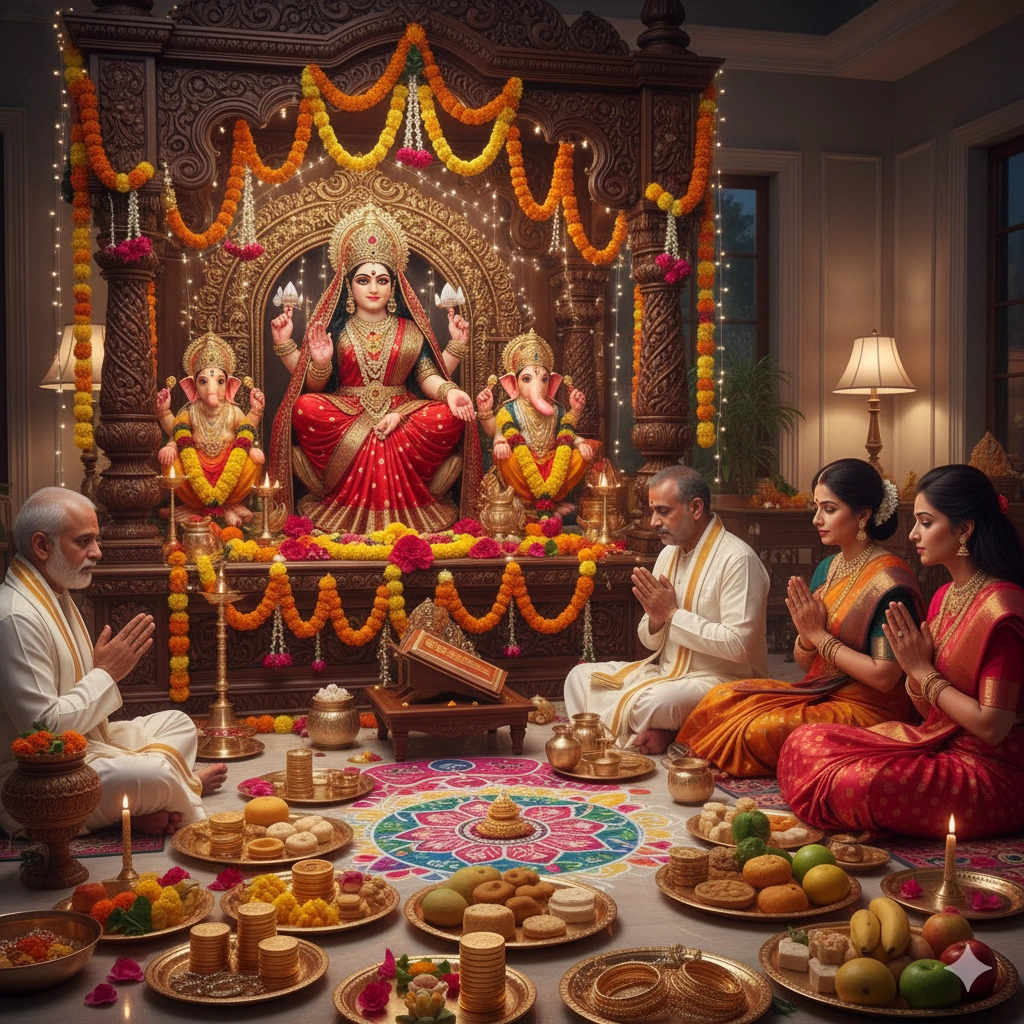
Maha Lakshmi Puja
(8 Reviews)
Wealth is not merely the accumulation of money. In the Vedic tradition, true wealth, Lakshmi, encompasses prosperity in relationships, health, knowledge, beauty, food, power, and liberation. Goddess Maha Lakshmi is the divine embodiment of all eight of these forms of abundance (Ashta Lakshmi), and invoking her through a properly conducted Maha Lakshmi Puja is one of the most direct and powerful ways to invite comprehensive prosperity into your life and home. Across Pune, from the thriving business districts of Kharadi and Viman Nagar to the family neighborhoods of Kothrud and Hadapsar, Maha Lakshmi Puja is performed to remove financial blockages, attract new wealth, and establish lasting abundance.
The Eight Forms of Lakshmi
Maha Lakshmi is not a one-dimensional deity of money. Her eight manifestations address the full spectrum of human prosperity:
1. Adi Lakshmi, the primordial form, source of all abundance
2. Dhana Lakshmi, material wealth, gold, silver, and financial prosperity
3. Dhanya Lakshmi, grain, food, nourishment, and abundance of provisions
4. Gaja Lakshmi, power, authority, and elephants (symbols of royal prosperity)
5. Santana Lakshmi, blessings of children and lineage
6. Veera Lakshmi, courage, strength, and victory
7. Vijaya Lakshmi, success in all endeavors
8. Vidya Lakshmi, knowledge, wisdom, and education
When you perform Maha Lakshmi Puja with complete devotion, you are invoking all these eight dimensions of abundance, not just financial wealth, but the totality of a blessed life.
Who Should Perform Maha Lakshmi Puja?
- Families experiencing financial stagnation or unexpected losses
- Business owners in Pune seeking growth and new clients
- Individuals who work hard but cannot retain or grow their savings
- Those with a Lakshmi Dosh or weak Venus (Shukra) in their birth chart
- Families seeking harmony and abundance in their new home
- Anyone who feels that prosperity has been elusive despite sincere effort
- Regular devotees of Goddess Lakshmi, especially during Diwali, Navratri, and Fridays (Shukravar)
Step-by-Step Maha Lakshmi Puja Ritual Process
1. Sankalp and Purification: The puja space is purified with Gangajal and the Pandit takes the formal Sankalp in the family's name.
2. Kalash Sthapana: A golden or silver Kalash filled with water, a coin, and a coconut is established. The Kalash represents the divine vessel of abundance.
3. Gauri-Ganesh Puja: Lord Ganesha and Goddess Gauri are invoked first as the gateway deities.
4. Maha Lakshmi Avahana: Goddess Maha Lakshmi is formally invoked into the idol or yantra with specific Beeja Mantras (Shri Vidya).
5. Shodashopachara: Sixteen offerings including lotus flowers (Lakshmi's most beloved flower), red hibiscus, Bilva leaves, sandalwood paste, gold or silver jewelry, silk cloth, saffron-infused water, and sweets made from coconut and sugar.
6. Shri Sukta Recitation: The Shri Sukta, 16 hymns from the Rig Veda dedicated to Goddess Lakshmi, is chanted. Each verse is accompanied by an Ahuti (offering) of lotus seeds, sesame, and pure ghee into a small fire.
7. Lakshmi Sahasranama Archana: 1,000 names of Goddess Lakshmi are chanted, each accompanied by a flower offering. This is one of the most powerful forms of Archana for attracting abundance.
8. Havan: A fire ritual with Shri Sukta mantras and specific herbs (Shatavari, Ashwagandha, and lotus seeds) to multiply the puja's financial benefits.
9. Aarti and Prasad: The Maha Lakshmi Aarti is sung. Prasad of kheer (sweet rice pudding), coconut, and lotus seeds is distributed.
Benefits of Maha Lakshmi Puja
Financial Benefits:
- Removal of Daridra (poverty) Dosh from the home and horoscope
- Attracts new income streams and business opportunities
- Improves cash flow and reduces unnecessary expenditure
- Brings good fortune to investments and financial decisions
Relationship Benefits:
- Strengthens marital bonds (Goddess Lakshmi governs marital happiness)
- Brings harmony and reduces conflict in the home
- Attracts supportive and prosperous relationships
Career and Business Benefits:
- Opens new professional opportunities
- Attracts clients, contracts, and recognition
- Supports business growth and brand building
Spiritual Benefits:
- Deepens devotion to the Divine Feminine
- Removes spiritual blocks that prevent prosperity
- Aligns the individual with the universe's abundant nature
Best Time (Muhurat) for Maha Lakshmi Puja
- Diwali (Lakshmi Puja), the most powerful night of the year for Lakshmi invocation
- Friday (Shukravar), Goddess Lakshmi's day of the week
- Navratri, especially the 8th day (Maha Ashtami)
- Sharad Purnima, the night when the moon is at maximum brightness; Goddess Lakshmi descends to earth on this night according to tradition
- Rohini, Pushya, and Revati Nakshatras, most auspicious for Lakshmi puja
- Shukla Paksha (waxing moon), always preferred for prosperity rituals
What's Included
- Trained Pandit experienced in Shri Vidya tradition
- Complete Lakshmi Puja Samagri: Lotus flowers, Red Hibiscus, Chandan, Kumkum, Saffron, Coconut, Gold/Silver Yantra, Silk cloth, Kheer ingredients, Ghee
- Shri Sukta chanting
- Lakshmi Sahasranama Archana
- Havan with specific herbs
- Aarti and Prasad
Why Choose Vedic Pooja for Maha Lakshmi Puja in Pune?
Goddess Lakshmi is known to be subtle and specific, she does not respond to hurried or procedurally incorrect worship. Our Pandits have specific training in the Shri Vidya tradition and perform Maha Lakshmi Puja with the devotion, correctness, and care that this powerful deity deserves.
We bring fresh lotus flowers (her favorite), pure ghee, and all required samagri directly to your home in Pune, whether in Wakad, Baner, Aundh, or Pashan. For business premises in IT hubs like Hinjewadi or Pimpri-Chinchwad, we offer dedicated corporate Lakshmi Puja packages.
Call or WhatsApp 8668552465 to book your Maha Lakshmi Puja in Pune today.
From
₹5,100
Navratri Pooja
(12 Reviews)
Nine nights. Nine forms of the Divine Mother. One extraordinary festival that transforms homes, hearts, and consciousness. Navratri, literally meaning 'nine nights', is celebrated twice a year with unmatched devotion across India and especially in Pune, the cultural heart of Maharashtra. During Chaitra Navratri (March–April) and Sharad Navratri (September–October), the Divine Feminine energy reaches its peak intensity on earth, making this the most powerful period of the year for invoking Goddess Durga, Goddess Lakshmi, and Goddess Saraswati. Whether you are celebrating Navratri in your home, organizing a community celebration in your housing society, or seeking a complete nine-day puja setup, our expert Pandits at Vedic Pooja bring the full authentic glory of Navratri to your doorstep anywhere in Pune, from the family neighborhoods of Kothrud to the IT townships of Hinjewadi and Wakad.
The Spiritual Significance of Navratri
Navratri is not merely a festival, it is a nine-day intensive spiritual practice (Sadhana). The Devi Bhagavat Purana and Markandeya Purana describe in detail how the Divine Mother in her form as Durga defeated the demonic forces of Mahishasura, Shumbha, Nishumbha, and Raktabija over nine nights, not just as a mythological event, but as a cosmic recurrence that happens within every devotee's consciousness.
Each of the nine nights is dedicated to one of the Navadurga, the nine forms of the Divine Mother:
1. Shailaputri, Daughter of the mountains, base energy, root chakra
2. Brahmacharini, The ascetic, tapas, self-discipline
3. Chandraghanta, Courage, beauty, grace
4. Kushmanda, The cosmic creator, solar energy
5. Skandamata, Mother of Kartikeya, nurturing energy
6. Katyayani, The warrior form, destruction of ego
7. Kalaratri, The fierce destroyer of darkness
8. Mahagauri, Peace, purity, wisdom
9. Siddhidatri, Bestower of spiritual powers
Worshipping each form in sequence creates a progressive spiritual awakening that mirrors the journey from base existence to liberation.
Key Navratri Rituals We Perform
Day 1, Kalash Sthapana (Ghatasthapana):
The ceremony begins with the installation of the sacred Kalash, a pot filled with water, herbs, and a coconut, representing the Divine Mother. The Pandit chants specific mantras while establishing the Kalash in the northeast corner of the puja space. Barley seeds (Jau) are sown in fertile soil at this time, their sprouting over nine days symbolizes growth and abundance.
Days 1–9, Daily Durga Aarti and Puja:
Each evening, a beautiful and detailed Aarti is performed with multiple lamps and offerings of flowers, fruits, and sweets. The specific form of the Divine Mother for that day is worshipped with her corresponding color, flower, and offering.
Durga Saptashati Path:
The recitation of the 700 verses of the Devi Mahatmyam (Durga Saptashati), the primary scripture of Navratri, forms the devotional backbone of the entire nine-day period. Our Pandits recite this in its authentic Sanskrit form.
Ashtami/Navami, Kanya Puja (Kumari Puja):
One of the most beloved Navratri traditions, nine young girls (representing the nine forms of Durga) are invited, worshipped with flower garlands, and offered food. This act of worshipping the living Goddess in young girls is considered one of the most merit-generating acts of Navratri.
Navami, Havan:
On the ninth day, a grand fire ceremony (Havan) is performed. 108 to 1,008 Ahutis are offered into the sacred fire with the Durga Saptashati mantras and the Navarna Mantra. This Havan purifies the home, destroys accumulated negative energies, and seals the nine days' worth of divine grace.
Dashami, Visarjan:
The Kalash is formally bid farewell on Vijaya Dashami (Dussehra). In some traditions, Sindoor Khela (exchange of sindoor among women) is performed as a joyful community celebration.
Benefits of Navratri Puja
Spiritual Benefits:
- Direct invocation of the Divine Mother's energy at its annual peak
- Accelerated spiritual growth through nine days of continuous worship
- Destruction of inner negativity (ego, fear, anger), mirroring the Devi's victory over demons
- Activation of all nine chakras through the nine nights' progressive worship
Material Benefits:
- Attracts wealth and prosperity, Goddess Lakshmi is invoked on the final days
- Protects against enemies, legal troubles, and competitive challenges
- Brings harmony and peace to family relationships
- Supports career growth and recognition (especially through Saraswati's blessings)
Health Benefits:
- The vibrations of the Durga Saptashati are specifically known to support healing
- Fasting during Navratri purifies the body and sharpens the mind
- The Havan's sacred smoke purifies the atmosphere, reducing illness-causing bacteria
Best Muhurat for Navratri Puja
Navratri occurs on specific dates each year according to the Hindu Panchang:
- Chaitra Navratri: Starts on Pratipada of Chaitra Shukla Paksha (March–April)
- Sharad Navratri: Starts on Pratipada of Ashwin Shukla Paksha (September–October)
The Ghatasthapana (Kalash installation) must be performed during the most auspicious Muhurat on Day 1, our Pandits calculate this precisely for your location in Pune.
What's Included
- 1–3 experienced Pandits (based on package)
- Complete Navratri Samagri for all 9 days
- Kalash Sthapana setup including fertile soil and barley seeds
- Durga Saptashati recitation (1 to 3 complete readings based on package)
- Daily Aarti materials, flowers, and fruits
- Kanya Puja on Ashtami/Navami
- Havan on Navami with 108 to 1,008 Ahutis
- Prasad distribution
Why Choose Vedic Pooja for Navratri in Pune?
Navratri is Pune's most celebrated festival alongside Ganesh Chaturthi. Our Pandits have performed community and home Navratri celebrations across hundreds of societies in Kharadi, Viman Nagar, Hadapsar, Pimpri-Chinchwad, Pashan, and beyond. We understand how to manage the logistics of a nine-day puja, coordinate with families for daily schedules, and ensure that the devotional quality is maintained through all nine nights.
For community Navratri celebrations in housing societies, we offer complete event management, including setup, sound system coordination, and catering guidance.
Call or WhatsApp 8668552465 to book your Navratri Puja in Pune.
From
₹5,100
Vehicle Puja (New Car Puja / Bike Puja / Vahana Puja)
(8 Reviews)
The moment you bring home a new car or bike, time seems to pause. Before the first key turn, before the first rev of the engine, Hindu tradition calls for a sacred pause — a moment of gratitude, of surrender, of blessing. This is the essence of the Vahana Puja, also spelled Vahan Puja or Wahana Puja, a Vedic ceremony performed to invoke divine protection upon your vehicle and all who travel in it.
Whether it is a New Car Puja for a gleaming sedan, a New Bike Puja for your first motorcycle, a scooter puja for your daily two-wheeler, or a Truck Puja for your new commercial fleet, the underlying spirit is the same: a vehicle is not merely a machine. It carries your family through every school run, every weekend road trip, every late-night medical emergency. The Vedic tradition honours this and prescribes a formal blessing before the first journey begins.
What Is Vehicle Puja?
Vehicle Puja, known in Sanskrit as Vahana Puja or Vahana Poojan, is a Vedic ritual performed to consecrate a new or existing vehicle with divine energy. The Car Puja — popularly called Gaadi ki Puja or Nai Gaadi Puja in Hindi — is one of the most widely observed traditions in Maharashtra, Uttar Pradesh, Rajasthan, Gujarat, and across India. It is performed by families purchasing a new car, bike, truck, auto-rickshaw, bus, delivery vehicle, or even an electric vehicle (EV car puja).
The ceremony formally places the vehicle under the protection of Lord Ganesha (remover of obstacles), Lord Vishwakarma (the divine engineer who blesses all tools and machines), and Lord Hanuman (who guards travellers on the road). Together, these deities are invoked to ensure that every journey in the vehicle is safe, prosperous, and free from accidents.
The Deep Significance of Vahana Puja
In ancient India, warriors worshipped their horses and war chariots before battle. Farmers honoured their bullock carts at the start of harvest. The Vedic worldview sees a divine presence in everything that enables human movement and livelihood. By performing Vahana Puja, you acknowledge this truth and formally invite divine grace into your vehicle.
Beyond the spiritual dimension, there is a powerful practical impact: a family that has performed the Car Puja or Bike Puja drives with greater reverence and mindfulness. The vehicle is no longer just an object — it becomes a responsibility held in trust. Accidents are often caused by recklessness and inattention; the puja instils a spirit of care that naturally promotes safer driving.
Auspicious Occasions for Vehicle Puja
Some of the most auspicious days for Vehicle Puja include:
- Dhanteras Car Puja: The day before Diwali is traditionally the single most auspicious day in India for purchasing and worshipping vehicles. Families across India buy new cars and bikes on Dhanteras and perform the Gaadi ki Puja right at the dealership or at home.
- Dussehra Vehicle Puja (Vijayadashami Puja for vehicle): On this legendary day, Lord Rama defeated Ravana, and the tradition of Ayudha Puja — the worship of tools, weapons, and vehicles — is observed across India. Performing Vehicle Puja on Vijayadashami is considered supremely auspicious.
- Vishwakarma Puja for vehicle / Vishwakarma Jayanti vehicle puja: The birthday of Lord Vishwakarma, the divine craftsman, is a mandatory occasion for worshipping all machinery, vehicles, and tools of trade. Factories, garages, and truck owners across Pune observe this day with great devotion.
- Day of Vehicle Purchase: Any Shubh Muhurat identified from the Panchang can be selected for the puja, avoiding Rahu Kaal, Yamaghanta, and Gulika Kaal.
- Akshaya Tritiya: Brings lasting prosperity to new possessions.
Our Pandits provide personalised Muhurat guidance based on the owner's Rashi (moon sign) and the day's Panchang.
Key Rituals in a Traditional Vehicle Puja
1. Cleaning and Decoration
The vehicle is washed clean and decorated with a fresh marigold garland draped across the front. A Swastika is drawn in Kumkum on the hood or bonnet — an auspicious symbol of prosperity and divine presence.
2. Sankalp (Sacred Intent)
The Pandit formally states the Sankalp — the owner's full name, Gotra, the vehicle details, and the prayer intention: for safe journeys, protection of all passengers, and long life for the vehicle.
3. Ganesh Puja
Lord Ganesha is always invoked first. As the remover of obstacles, his blessings ensure that every journey in the vehicle begins and ends safely.
4. Vishwakarma Puja
Lord Vishwakarma, the cosmic engineer, is worshipped to bless the vehicle's mechanical integrity. This is especially important for commercial vehicles — Truck Puja, Bus Puja, Auto Rickshaw Puja, Commercial Vehicle Puja, delivery vehicle puja — where the vehicle is the primary source of livelihood.
5. Nazar Utarna (Evil Eye Removal)
One of the most important parts of the ceremony is Nazar Utarna for car — the removal of the evil eye (buri nazar) from the vehicle. This is done by rotating a camphor flame around the vehicle and scattering black mustard seeds to neutralise jealous energies. The ritual of evil eye removal for a new vehicle (buri nazar se bachao) is especially critical when the vehicle is brand new and attracts many admiring — and sometimes envious — eyes.
6. Coconut Breaking (Narial Todna)
A coconut (narial) is broken at the front wheel of the vehicle in a traditional ritual of coconut breaking for new vehicle. This act drives away negative energy, marks an auspicious commencement, and is one of the oldest traditions in Indian car and bike inauguration ceremonies.
7. Lemon and Chilli Kavach (Nimbu Mirchi for Vehicle)
A string of seven green chillies and one lemon — the famous nimbu mirchi for vehicle — is tied beneath the vehicle or hung at the front. This lemon chilli for car (also called kavach) is a time-honoured Indian protection charm against the evil eye. Many families hang this both at vehicle inauguration and regularly thereafter as an ongoing protective measure.
8. Mantra Jaap and Circumambulation
The Pandit chants specific Vedic protective mantras while walking around the vehicle. The Hanuman Chalisa is recited for road protection, especially for vehicles that travel long distances.
9. Aarti and New Vehicle Blessing Ceremony
Aarti is performed for the vehicle, completing the new vehicle blessing ceremony. The owner then starts the engine — often for the very first time — under the Pandit's guidance, while a blessing mantra is chanted.
10. Car Inauguration Puja and First Journey
The car inauguration puja concludes with the owner driving a short auspicious first journey in an eastward or northward direction, symbolising the beginning of a blessed and protected chapter.
Vehicle Puja for Every Type of Vehicle
Our Pandits perform Vahana Puja for all vehicle types:
- New Car Puja and Car Puja (sedan, SUV, hatchback)
- New Bike Puja, Motorcycle Puja, and Two-wheeler Puja (bike, scooter, new scooter puja)
- Truck Puja and Bus Puja for commercial operators
- Auto Rickshaw Puja for three-wheeler owners
- Commercial Vehicle Puja for fleets and delivery businesses
- Delivery vehicle puja for e-commerce and logistics companies
- Electric Vehicle Puja and EV car puja — because even a zero-emission vehicle deserves divine blessing!
Vehicle Puja in Pune — We Come to You
We provide pandit for vehicle puja Pune across all major localities. Whether you need a car puja pandit Pune for a celebration in your building's parking lot, or a puja at your home or office, we are available throughout the city.
We serve: Vehicle Puja in Wakad, Baner, Kharadi, Hinjewadi, Kothrud, Viman Nagar, Hadapsar, PCMC, Pimpri Chinchwad, and all surrounding areas of Pune.
नई गाड़ी पूजा, वाहन पूजा, गाड़ी की पूजा, नई बाइक पूजा, कार पूजा — हम सभी प्रकार की वाहन पूजाओं के लिए उपलब्ध हैं।
नवीन गाडी पूजा, वाहन पूजन, नवीन कार पूजा, बाईक पूजा पुणे — पुण्यातील सर्व भागांत आमचे पंडित उपलब्ध आहेत.
Why Choose Vedic Pooja?
We understand the pride and joy of a new vehicle. Our Pandits arrive punctually, perform the complete traditional ceremony without shortcuts, and bring all required samagri. We have conducted Vehicle Puja ceremonies for hundreds of families, commercial fleet owners, and corporate clients across Pune.
Call or WhatsApp 8668552465 to book your Vahana Puja today. Let your vehicle begin its journey with the blessings of the divine.
From
₹2,500
Pitru Dosh Shanti Puja
(0 Reviews)
There are moments in a family's life when despite doing everything right, things keep going wrong. Careers stagnate inexplicably. Marriages face repeated hurdles. Health problems recur without clear cause. Children are late in arriving. Debts accumulate without reason. When these patterns persist across generations, the Vedic tradition points to one potential cause: Pitru Dosh, the unfulfilled karmic debt owed to deceased ancestors who may not have received proper last rites, who died under unfortunate circumstances, or whose souls remain unsettled.
Pitru Dosh Shanti Puja is the powerful Vedic remedy prescribed in the Garuda Purana, the Vishnu Purana, and the ancient texts of Shraddha Vidhi to settle these ancestral debts. It brings peace to the departed souls, clears the karmic ledger, and releases the family from the shadow of ancestral suffering. Families in Kothrud, Hadapsar, Viman Nagar, and Baner who have performed this puja report a remarkable shift in family fortune and harmony within months.
Understanding Pitru Dosh
In Vedic astrology, Pitru Dosh occurs in the birth chart when Rahu is placed in conjunction with or aspects the Sun, Moon, or the 9th house (the house of ancestors and father). It can also arise from:
- Ancestors who died without proper last rites (Antyeshti Samskara)
- Family members who died in accidents, suicides, or untimely deaths
- Ancestors who suffered from unfulfilled desires or unresolved conflicts
- Generations of the family that neglected the Shraddha and Tarpan rituals
- Those whose property was wrongfully taken or whose injustices were never addressed
The effects of Pitru Dosh manifest differently in different families: some face financial ruin, others face childlessness, others face repeated illness, and some face disharmony that seems to come from nowhere.
The Vedic Solution: Pitru Dosh Shanti Puja
The puja directly addresses the root cause by:
1. Tarpan: Offering sacred water, sesame, and barley to the departed souls, providing them the spiritual nourishment they need to move forward peacefully
2. Pind Daan: Offering rice balls (Pindas) representing the subtle bodies of the ancestors, helping them transition to higher realms
3. Narayan Bali: A formal ceremony of offering to departed souls who died untimely or abnormal deaths
4. Brahmin Bhojan: Feeding Brahmins in the name of ancestors, which directly transfers merit to them
5. Vishnu Puja: Invoking Lord Vishnu, the protector, to grant peace to the ancestors
Ideal Time for Pitru Dosh Shanti Puja
- Pitru Paksha (15-day period before Navratri): The most powerful period for ancestral rites, when the veil between worlds is thinnest
- Amavasya (New Moon day): Every month is auspicious for Tarpan and Pitru Puja
- Guru Pushya Nakshatra: Especially powerful for ancestral ceremonies
- Gaya Pilgrimage timing: If you cannot travel to Gaya, our Pandits perform the equivalent ritual at home
- Solar or Lunar eclipses: Extremely powerful for Pitru Tarpan
Step-by-Step Ritual Process
1. Sankalp: A detailed Sankalp is taken naming as many known ancestors as possible, their relationship to the family, and the specific relief being sought.
2. Ganapati Puja: Lord Ganesha is invoked first for the removal of obstacles and smooth conduct of the ceremony.
3. Kalash Sthapana: A sacred water vessel is established, representing the presence of Varuna, the god of cosmic waters who carries offerings to the ancestral realm.
4. Navagraha Puja: The nine planets are propitiated, with special emphasis on the Sun (Surya, the lord of ancestors) and Rahu (the planet most associated with Pitru Dosh).
5. Pitru Tarpan: Water mixed with sesame seeds (til) and barley (jau) is offered in both hands (Anjali) toward the south (the direction of ancestors), with specific mantras naming each known ancestor. Three Anjalis are offered per ancestor.
6. Pind Daan: Rice balls mixed with sesame, honey, and milk are prepared and offered on banana leaves with specific Pitru mantras. This nourishes the subtle bodies of the departed.
7. Vishnu Sahasranama or Narayan Stotra: Lord Vishnu's thousand names are chanted, invoking his power to liberate the ancestors from any karmic bondage.
8. Havan: A sacred fire ritual with Pitru-specific offerings (sesame, barley, and specific herbs) is performed to transform the offerings and deliver them to the ancestral realm.
9. Brahmin Dana: Clothes, food, or money are donated in the name of specific ancestors as a final act of merit transfer.
10. Aarti and Visarjan: The ceremony concludes with Aarti and the offering's immersion in flowing water.
Benefits
- Settles generational karmic debt and breaks cycles of ancestral suffering
- Removes Pitru Dosh from the birth chart over time
- Brings harmony and peace to family relationships
- Opens blocked paths in career, marriage, and financial growth
- Brings the protection and active blessings of satisfied ancestors
- Helps couples facing difficulty conceiving
- Reduces recurring, unexplained health issues in the family
What's Included
- Experienced Pandit trained in Pitru Vidhi and Shraddha rituals
- Complete Samagri: Sesame, barley, rice, banana leaves, Gangajal, til oil, black cloth, flowers, honey, milk
- Navagraha Puja and Pitru Tarpan
- Pind Daan and Havan
- Vishnu Stotra recitation
- All travel and setup
Why Choose Vedic Pooja for Pitru Dosh Shanti Puja in Pune?
Pitru Dosh Shanti requires precision. The correct identification of ancestors, the right mantras for specific cases, and the proper sequence of rituals matter deeply. Our Pandits are trained in the complete Shraddha Vidhi, understand the nuances of this sacred ceremony, and approach it with the compassion and care that this profound ritual deserves.
We serve all of Pune including Hadapsar, Kharadi, Wakad, Aundh, and Pimpri-Chinchwad. Call or WhatsApp 8668552465.
From
₹5,100
Tripindi Shradh Puja
(3 Reviews)
Tripindi Shradh is one of the most specialized and rarely performed ancestral rituals in the Vedic tradition, and that rarity itself speaks to its importance. It is prescribed specifically when three or more consecutive generations of a family have passed away without receiving proper Shradh rites, or when Shradh has been neglected for three or more years. In such cases, the ordinary Pitru Tarpan or annual Shradh is no longer sufficient. The accumulated spiritual debt requires the complete Tripindi ceremony.
The word Tripindi literally means three Pindas, the sacred rice balls offered to three generations of ancestors simultaneously. When families in Kothrud, Hadapsar, or Wakad come to us with reports of persistent misfortune spanning multiple generations, recurring illness across family branches, or difficulty with progeny, Tripindi Shradh is often the ritual that brings lasting relief.
When Is Tripindi Shradh Required?
The Garuda Purana and Dharmasindhu texts specifically prescribe Tripindi Shradh in these situations:
- Three or more generations have passed without receiving Pind Daan
- A family member died an untimely, violent, or accidental death and proper rites were not performed
- Ancestors died far from home and no Shradh was possible
- The family has broken ancestral traditions for three or more generations
- Multiple generations of the same family suffer from the same recurring problems
- Dreams of deceased ancestors appearing distressed or seeking food
The Three Tiers of Tripindi Shradh
Tripindi Shradh addresses three specific tiers of ancestral suffering:
1. Pretayoni: Souls stuck in the in-between state who have not crossed over
2. Pitru Loka residents: Souls who are in the ancestral realm but unfed and uncomfortable
3. Those awaiting rebirth: Souls whose forward journey is blocked by unresolved karmic accounts
The ritual simultaneously addresses all three through three separate Pind offerings, three sets of Tarpan, and a three-part Havan.
Ideal Time for Tripindi Shradh
- Trimbakeshwar near Nashik: The traditional and most powerful location for Tripindi Shradh
- Pitru Paksha (Shradh Paksha): The 15-day period dedicated to ancestral rites
- Gaya Pind Daan equivalent: Our Pandits perform the equivalent at home when travel is not possible
- Amavasya: Every new moon day is auspicious for ancestral rites
- Any day recommended by the Jyotishi based on the family's Kundali
Step-by-Step Ritual Process
1. Sankalp: A detailed declaration naming all known ancestors across three generations, their relationship, and the specific karmic accounts being addressed.
2. Ganesh Puja: Lord Ganesha is invoked to ensure the offering reaches its intended recipients without obstruction.
3. Navagraha Puja: All nine planets are propitiated, with emphasis on the Sun (representing the father line) and the Moon (representing the mother line).
4. Kalash Sthapana: Three Kalashas representing the three generations are established with specific mantras.
5. First Pind Offering (Pitamaha): A rice ball is prepared with sesame, honey, and milk and offered with specific mantras to the grandparents (Pitamaha and Pitamahi).
6. Second Pind Offering (Prapitamaha): A Pinda is offered to the great-grandparents with their specific mantras and Gotra declaration.
7. Third Pind Offering (Vriddhaprapitamaha): The third Pinda completes the three-generation cycle, offered to the great-great-grandparents.
8. Tripindi Tarpan: Three rounds of sacred water offering with sesame seeds are performed in the south direction, one for each generation.
9. Havan with Pitru-Specific Samagri: Sesame, barley, rice, black til, and Pitru Samidha are offered into the sacred fire with Pitru Sukta mantras.
10. Brahmin Bhojan Dana: Food and clothing are offered to Brahmins representing the ancestors.
11. Visarjan: Pindas are immersed in flowing water, symbolically releasing the ancestors to continue their journey.
Benefits
- Resolves deep multi-generational ancestral debt in one ceremony
- Frees souls of ancestors stuck in transit between worlds
- Removes recurring generational patterns of suffering, illness, and financial loss
- Brings the powerful blessing of satisfied ancestors from three generations
- Opens blocked paths in marriage, career, and health within the family
- Provides lasting peace to the entire family lineage
What's Included
- Pandit trained in Tripindi Shradh Vidhi
- Three Pindas preparation with all ingredients
- Complete Samagri: Sesame, barley, Gangajal, rice, honey, black cloth, banana leaves
- Navagraha Puja and Pitru Tarpan
- Three-part Havan
- Brahmin Dana arrangement (Standard and Premium)
Why Choose Vedic Pooja in Pune?
Tripindi Shradh is one of the most technically precise ancestral rituals. The correct identification of generations, the specific Gotra declarations, and the three-part structure require a Pandit with specialized training. Our team brings this expertise to your home across all areas of Pune including Viman Nagar, Baner, Kharadi, and Aundh. Call or WhatsApp 8668552465.
From
₹7,100
Narayan Nagbali Puja
(3 Reviews)
Narayan Nagbali is a two-part combined ceremony that is among the most powerful ancestral liberation rituals in the entire Vedic tradition. It is prescribed for very specific and serious situations — situations where ordinary Shradh or Tarpan will not suffice. When a family member has died an untimely or unnatural death, when a sacred promise made by an ancestor was never fulfilled, or when a snake was accidentally killed by someone in the family lineage, the consequences according to the Vedic tradition can be severe and generational. Narayan Nagbali is the designated remedy.
The ceremony has two distinct parts performed together: Narayan Bali for the liberation of souls who died untimely deaths, and Nag Bali for the atonement of accidentally killing a serpent (which in Vedic tradition carries significant spiritual consequence). Families from Kharadi, Viman Nagar, Hadapsar, and Baner come to our Pandits for this ceremony when conventional remedies have not brought the expected relief.
Understanding the Two Parts
Narayan Bali: This part addresses the souls of family members who died untimely deaths — through accidents, suicides, sudden illness, snake bites, lightning, drowning, or other violent circumstances. According to the Vedic texts, these souls do not naturally transition to the ancestral realm. They remain in a liminal state, unable to move forward, and their unresolved energy affects the living members of the family. Narayan Bali performs a symbolic secondary funeral for these souls, using a symbolic body (a dough effigy) and complete last rites, providing them the farewell they never received.
Nag Bali: This part addresses the karmic consequence of a serpent being killed within the family — either knowingly or accidentally. The Nag (serpent) in Hindu tradition is sacred, associated with Lord Shiva, Lord Vishnu (as Ananta Shesha), and the Navagraha system (Rahu and Ketu are serpent energies). Accidentally killing a serpent, especially a cobra, is considered to attract Sarpa Dosh or Nag Dosh upon the family line. Nag Bali performs a symbolic funeral and last rites for the killed serpent, releasing the family from this specific karmic debt.
Conditions That Require Narayan Nagbali
- Suicide or accidental death of a young family member
- Drowning, snakebite, or lightning death in the family history
- Serpent accidentally killed during construction or land clearing
- Recurring childlessness across multiple family members
- Dreams of snakes or deceased family members appearing distressed
- Persistent Kaal Sarp Dosh that does not respond to regular remedies
- Family suffering from Sarpa Dosh effects (skin diseases, fear, repeated miscarriage)
Ideal Time and Location
- Trimbakeshwar (Nashik) is the traditionally prescribed location for Narayan Nagbali
- Our certified Pandits perform this ceremony at home in Pune with equal Vedic precision when travel is not possible
- Pitru Paksha: The most auspicious period
- Amavasya: Monthly option
- Shravana month: Especially powerful for Nag Bali
Step-by-Step Ritual Process
1. Sankalp: A detailed Sankalp naming the deceased whose soul is being liberated and the specific nature of the karmic debt being addressed.
2. Narayan Puja: Lord Narayan (Vishnu) is invoked as the divine liberator of souls from all forms of bondage.
3. Dough Effigy Preparation (Narayan Bali): A human effigy made from dough or clay is prepared, representing the body of the soul whose last rites are being symbolically performed.
4. Complete Last Rites for the Effigy: The Pandit performs the complete Antyeshti (funeral) rituals over the effigy including Mukhagni (symbolic fire offering at the mouth) and final prayers.
5. Nag Effigy Preparation (Nag Bali): A serpent effigy of silver, clay, or dough is prepared representing the killed serpent.
6. Nag Puja and Last Rites: Complete ritual worship and last rites are performed for the serpent effigy, appeasing the serpent energy and releasing the family from Sarpa Dosh.
7. Pitru Tarpan: Sacred water offering with sesame for all known ancestors.
8. Havan: A powerful fire ceremony with Pitru-specific and serpent-related offerings.
9. Navagraha Puja: Special emphasis on Rahu and Ketu (the serpent nodes) for complete Sarpa Dosh resolution.
10. Brahmin Dana: Food, clothing, and money donated to Brahmins in the name of the ancestors.
11. Visarjan: Both effigies are immersed in flowing water to complete the liberation.
Benefits
- Liberation of family members who died untimely deaths from their trapped state
- Complete resolution of Sarpa Dosh and Nag Dosh affecting the family
- Removal of Kaal Sarp Dosh effects when combined with appropriate puja
- Restoration of fertility and resolution of repeated miscarriage issues
- End of nightmares, skin diseases, and fear-based anxiety linked to Nag Dosh
- Peace, harmony, and forward movement in family life after generations of stagnation
What's Included
- Pandit trained in Narayan Bali and Nag Bali Vidhi
- Dough and clay effigy preparation
- Complete Samagri for both ceremonies
- Narayan Puja and Nag Puja
- Havan and Tarpan
- Navagraha Puja with Rahu-Ketu focus
Why Choose Vedic Pooja in Pune?
Narayan Nagbali requires a Pandit who understands both ceremonies in their complete depth. Our Pandits are trained in both the Narayan Bali Vidhi and the Nag Bali procedure and perform this combined ceremony with the solemnity and precision it demands. We serve all of Pune. Call or WhatsApp 8668552465.
From
₹9,100
Hanuman Puja
(12 Reviews)
There is a particular kind of courage that does not come from wealth, status, or intellect. It comes from devotion. And in the entire Vedic pantheon, no deity embodies pure, selfless, fearless devotion more completely than Lord Hanuman. He is Sankat Mochan, the remover of all crises. He is Bajrang Bali, whose body is as strong as vajra. He is the son of Vayu (wind), capable of crossing oceans, moving mountains, and standing firm in the face of any adversity. When you are facing a situation that feels impossible, when the enemy seems too powerful, when fear has entered your house, when black magic seems to be at work, this is when Lord Hanuman's grace is most urgently needed.
Hanuman Puja and the complete recitation of the Hanuman Chalisa Path are among the most potent Vedic remedies available to the ordinary devotee. Across Pune, from the working-class neighborhoods of Hadapsar and Pimpri-Chinchwad to the corporate towers of Hinjewadi and the residential societies of Baner, families have been invoking Lord Hanuman for generations to bring courage, protection, health, and resolution of the impossible.
Who Is Lord Hanuman and Why Is His Puja So Powerful?
Lord Hanuman is simultaneously the greatest devotee (Bhakta) and the greatest warrior (Vira) in the Hindu tradition. His puja is accessible to everyone, regardless of caste, class, or educational background. He responds to sincere devotion with immediate and tangible grace.
In astrology, Lord Hanuman governs the planet Shani (Saturn) and is also the antidote to Rahu's malefic effects. Performing regular Hanuman Puja reduces the suffering caused by Shani Sade Sati, Shani Dhaiya, Rahu Mahadasha, and Ketu Mahadasha. This makes the Hanuman Puja one of the most universally effective remedies for the most common forms of astrological suffering.
When Should You Perform Hanuman Puja?
- Tuesdays and Saturdays: The two days specially dedicated to Lord Hanuman
- During Shani Sade Sati or Shani Dhaiya: The most recommended antidote
- During Rahu or Ketu Mahadasha: For protection and mental peace
- Before court cases or legal battles: For the strength and clarity to fight and win
- When facing black magic, evil eye, or spiritual attacks: For immediate protection
- Hanuman Jayanti: Lord Hanuman's birthday, the most powerful day for his worship
- Before any major life challenge: Job interviews, business negotiations, health surgeries
Step-by-Step Hanuman Puja Ritual Process
1. Preparation: The puja area is purified and an image or idol of Lord Hanuman, preferably in his active, standing form with Gada (mace), is placed facing east or south.
2. Sankalp: The intention is declared: the specific crisis, the specific protection needed, or the specific obstacle to be removed.
3. Ganesh Puja: Lord Ganesha is worshipped first, even in a Hanuman ceremony, as he is the gateway to all auspicious rituals.
4. Hanuman Sthapana and Pranapratishtha: Lord Hanuman is invoked into the puja space with specific Vedic mantras. Sindoor (red lead) and jasmine oil are applied to the image, which is Lord Hanuman's favorite offering.
5. Panchamrit Snan: The deity is bathed in Panchamrit (milk, curd, honey, ghee, sugar).
6. Shodashopachara Puja: Sixteen sacred offerings including a garland of red flowers, sindoor, jasmine oil, sesame oil lamps, and betel leaves are made.
7. Hanuman Chalisa Path: The Hanuman Chalisa (40 verses by Tulsidas) is recited. For the Standard and Premium packages, it is chanted 7 or 108 times respectively, creating an immensely powerful protective field.
8. Bajrang Baan Recitation: The powerful Bajrang Baan, the arrow of Bajrang Bali, is recited for protection from enemies and negative forces.
9. Mantra Jaap: The Panchamukhi Hanuman mantra and the Moola mantra are chanted for specific protection.
10. Havan: Offerings of sesame, sampat, and specific herbs are made into the sacred fire while chanting Hanuman's Vedic mantras.
11. Aarti and Prasad: The famous Aarti is performed and prasad of jaggery, banana, and roasted wheat is distributed.
Benefits
- Protection from enemies, black magic, evil eye, and negative energies
- Courage, strength, and mental fortitude in challenging situations
- Relief from Shani Sade Sati, Rahu, and Ketu doshas
- Victory in legal battles and conflicts
- Resolution of long-standing problems that seem impossible
- Physical health and vitality
- Spiritual purification of the home
What's Included
- Experienced Pandit trained in Hanuman Vidhi
- Samagri: Sindoor, jasmine oil, red flowers, sesame, betel leaves, jaggery, banana, ghee, camphor
- Hanuman Chalisa Path (7 or 108 times based on package)
- Bajrang Baan recitation
- Havan with Hanuman-specific offerings
- Prasad distribution
Why Choose Vedic Pooja in Pune?
Our Pandits understand that someone who calls for Hanuman Puja is often in a moment of real crisis or genuine spiritual need. We respond with urgency, compassion, and ritual precision. We serve Wakad, Kharadi, Viman Nagar, Kothrud, Aundh, and all of Pune. Emergency bookings accepted on WhatsApp at 8668552465.
From
₹2,500
Nazar Dosh Nivaran Puja
(8 Reviews)
Every culture in the world has a version of the evil eye. The Vedic tradition calls it Nazar or Drishti Dosh. And unlike skeptics who dismiss it, anyone who has watched a thriving business suddenly collapse, a healthy child fall inexplicably ill, or a harmonious family begin to fight without reason, has likely encountered its effects. The Vedic understanding of Nazar is precise: intense, concentrated emotion, whether jealousy, envy, or even excessive admiration, creates a psychic wave of energy that can attach to a person, child, home, or business and disrupt its natural positive flow.
Nazar Dosh Nivaran Puja is the sacred remedy, practiced in the Vedic tradition for thousands of years, to identify, sever, and neutralize this negative energy. It combines mantra shakti, fire purification, sacred herbs, and energized Yantra to completely cleanse the affected person or space. Families in Pune, from those in the high-rises of Kharadi to the traditional households of Kothrud, know the difference a proper Nazar Nivaran can make.
Recognizing Nazar Dosh
The signs of Nazar Dosh include:
- A child who was healthy suddenly develops unexplained fever, crying spells, or lethargy
- A business that was growing suddenly loses customers or faces unexpected losses
- A couple who was happy begins fighting constantly without clear cause
- A house that felt peaceful suddenly feels heavy, stressful, or uncomfortable
- A person who was confident and productive becomes anxious, lethargic, or unclear
- Plants in the home wither unexpectedly
- Milk curdles quickly or food goes bad faster than usual
If multiple symptoms appear simultaneously, especially after a period of visible success or after receiving many compliments or visitors, Nazar Dosh is a strong possibility.
How Nazar Dosh Nivaran Puja Works
The puja works on multiple levels:
1. Mantra Shakti: Specific Vedic mantras create a frequency of protection that repels negative psychic energy
2. Agni Shuddhi: The sacred fire burns away the negative etheric attachments
3. Herb Purification: Specific herbs like Neem leaves, Guggul, and Loban (frankincense) purify the aura of the affected person or space
4. Yantra Kavach: An energized protection Yantra is installed in the home or given to the individual to maintain ongoing protection
5. Nimbu-Mirchi and Camphor: Traditional protective rituals using lemon, green chillies, and camphor create an energetic shield
Step-by-Step Nazar Dosh Nivaran Puja Process
1. Sankalp: The Pandit takes the Sankalp specifically identifying the affected person or space and the nature of the disturbance being experienced.
2. Ganesh Puja: Lord Ganesha is invoked to clear the path for complete and effective purification.
3. Space Purification: The home or business is circumambulated with burning camphor mixed with Guggul, creating a smoke purification of the entire premises.
4. Nazar Nivaran Mantra Jaap: Powerful Atharva Vedic mantras specifically prescribed for Drishti Dosh removal are chanted. These include the Netra Suktam and specific Chakshushmati mantras.
5. Kalash Sthapana: A sacred vessel is established representing divine protection entering the space.
6. Salt and Red Chilli Treatment: Rock salt and red chillies are moved over the affected person or around the premises in a specific pattern, absorbing negative energy.
7. Havan with Nazar-Specific Samagri: Neem leaves, Guggul, Loban, camphor, and black sesame are offered into the fire with specific purifying mantras.
8. Yantra Installation: An energized Suraksha Yantra (protection diagram) is installed at the main entrance of the home or business.
9. Nimbu-Mirchi Kavach: A protective charm of lemons and chillies is prepared and hung at the entrance by the Pandit with specific mantras.
10. Aarti and Blessing: The ceremony concludes with Aarti and a specific blessings chant for continued protection.
Benefits
- Complete removal of evil eye (Nazar) from person, child, home, or business
- Restoration of natural positive energy flow in the affected space
- Protection of children from frequent, unexplained illness
- Reversal of sudden business decline caused by Nazar
- Restoration of harmony in relationships disrupted by negative energy
- Ongoing protection through energized Yantra installation
What's Included
- Experienced Pandit trained in Atharva Vedic remedies
- Complete Samagri: Salt, camphor, Guggul, Loban, Neem leaves, chillies, lemons, black sesame
- Nazar Nivaran Mantra Jaap and Havan
- Space purification walk-through
- Yantra (Standard and Premium)
- Nimbu-Mirchi Kavach
Why Choose Vedic Pooja in Pune?
Nazar Dosh Nivaran requires a Pandit who has practical experience with these remedies, not just theoretical knowledge. Our Pandits have handled hundreds of such cases across Pune including Baner, Wakad, Hadapsar, and Hinjewadi and bring genuine expertise and sensitivity to this work. Call or WhatsApp 8668552465.
From
₹2,500
Kubera Lakshmi Puja (Ganesh Lakshmi Puja / Dhan Puja)
(8 Reviews)
If Goddess Lakshmi is the divine force of wealth, then Lord Kubera is her cosmic treasurer. He is Dhanpati, the lord of riches, the keeper of the universe's material abundance, the divine being entrusted by the gods with the management of all precious metals, jewels, and earthly wealth. When Lakshmi and Kubera are worshipped together in the Kubera Lakshmi Puja, the combination creates one of the most potent financial blessings available in the entire Vedic tradition. This is not a puja for those who are merely curious about wealth. It is for those who are serious about it.
Business owners in Hinjewadi, shop owners in Hadapsar, startup founders in Kharadi, and trading families in Pimpri-Chinchwad have all discovered that consistent worship of Kubera Lakshmi creates a remarkable shift in financial energy. Debts begin to clear. New income streams appear. Investments that were stuck begin to move. Customers return. The stagnation that felt permanent starts to lift.
Who Are Lord Kubera and Goddess Lakshmi?
Lord Kubera rules the north direction (Uttara), which is considered the direction of prosperity in Vastu Shastra. His primary abode is Lanka and later Alaka, both described as cities of unimaginable wealth. He is a Yaksha, one of the divine guardians of earthly riches, and his blessings specifically address the storage and protection of wealth (not just its arrival).
Goddess Lakshmi represents the flowing energy of prosperity, the kind that moves, multiplies, and sustains life. Together, Kubera provides the vault and Lakshmi fills it.
The Kubera Lakshmi Puja is specifically recommended when:
- A business is profitable but wealth does not accumulate (money leaks)
- Income is irregular or unreliable
- Debts are persistent despite good income
- Investments consistently underperform or lose value
- A new business or shop is being established
- A family wants to establish a dedicated wealth corner in their home
The Kubera Yantra: Heart of the Puja
Central to this puja is the energization of the Kubera Yantra, a sacred geometric diagram that acts as a magnetic field for wealth energy. When properly consecrated with specific mantras, Gangajal, and Kumkum, the Yantra becomes a permanent wealth attractor that continues to work long after the ceremony is over. Our Pandits place and energize the Yantra in the Kubera corner (north direction) of your home or office.
Ideal Time for Kubera Lakshmi Puja
- Dhanteras: The single most powerful day for Kubera Lakshmi worship
- Akshaya Tritiya: The day of inexhaustible abundance
- Purnima (Full Moon): Especially auspicious for Lakshmi worship
- Diwali: When the puja combines both Diwali Lakshmi Puja and Kubera worship
- Wednesday and Friday: Kubera's and Lakshmi's favored days respectively
- Shubh Muhurat during Mercury's strong placement: For financial intelligence and growth
Step-by-Step Ritual Process
1. Sankalp: The family head declares the specific financial goals, debts to be cleared, or abundance being sought.
2. Ganesh Puja: Lord Ganesha is invoked to open all channels of abundance.
3. Kalash Sthapana: A sacred vessel filled with Gangajal, coins, and a coconut is established, representing the arrival of abundance.
4. Lakshmi Sthapana: Goddess Lakshmi's idol or image is installed and worshipped with specific Vedic hymns including the Sri Suktam from the Rigveda.
5. Kubera Sthapana and Yantra Puja: Lord Kubera's image and the Kubera Yantra are installed and energized. The Kubera Moola Mantra is chanted 108 times.
6. Sri Suktam and Lakshmi Ashtakam: These powerful Rigvedic hymns are chanted to invoke the flowing energy of prosperity.
7. Kubera Mantra Jaap: The Kubera Beej Mantra is chanted 1,008 times during the Standard and Premium ceremonies.
8. Havan: Offerings of lotus seeds, bilva leaves, saffron, and gold-colored flowers are made into the sacred fire with Kubera and Lakshmi mantras.
9. Gold or Silver Coin Puja: The family's savings, gold, or silver items are brought to the altar and consecrated during the havan.
10. Yantra Installation: The energized Kubera Yantra is placed permanently in the north wall of the home or office.
11. Aarti and Prasad: The ceremony concludes with Aarti and the distribution of Prasad of sweets and coins.
Benefits
- Resolves persistent financial stagnation and wealth leakage
- Activates the north direction as a permanent wealth magnet
- Brings new income streams and business opportunities
- Helps clear debts and accumulated financial burdens
- Protects existing wealth from loss, theft, or bad investments
- Deepens the family's relationship with abundance consciousness
What's Included
- Experienced Pandit trained in Lakshmi and Kubera Vidhi
- Samagri: Lotus seeds, bilva, saffron, coins, Gangajal, flowers, Kumkum, gold-colored items
- Sri Suktam and Kubera Mantra Jaap
- Kubera Yantra (energized and ready to install)
- Complete Havan
- Aarti and Prasad
Why Choose Vedic Pooja in Pune?
Money is a sensitive subject. We approach the Kubera Lakshmi Puja with both ritual precision and genuine care for your family's prosperity. Our Pandits are experienced in this specific puja and have performed it for business owners and families across Baner, Wakad, Kharadi, Viman Nagar, and all of Pune. Call or WhatsApp 8668552465.
From
₹3,100
Shop Opening Puja
(8 Reviews)
Opening a new shop is an act of courage and hope. You have invested your savings, your family's trust, and months of hard work into a space that you are now ready to offer to the world. In the Vedic tradition, this moment deserves far more than a ribbon cutting. It deserves an invocation of the divine forces of prosperity, obstacle removal, and auspicious beginning that will carry your shop through years of honest business.
Shop Opening Puja is distinct from Office Opening Puja in its specific invocations. Where an office calls for corporate blessings, intellectual prosperity, and professional growth, a shop calls for customer footfall, smooth daily transactions, good inventory flow, loyal supplier relationships, and the specific grace of Goddess Lakshmi's constant presence at the cash counter. Shop owners across Hadapsar's busy market lanes, Wakad's commercial complexes, Kharadi's retail hubs, and Pimpri-Chinchwad's trading areas have used this puja to begin their businesses on an unshakeably auspicious foundation.
The Spiritual Logic Behind Shop Opening Puja
Every commercial space has its own Vastu energy field. A new shop carries the neutral energy of an uninhabited space. The Shop Opening Puja does three things simultaneously:
1. Purifies the space of any residual negative energy from construction workers, previous occupants, or the land itself
2. Invokes the specific deities of commerce, prosperity, and obstacle removal
3. Establishes a permanent energetic foundation of abundance through the Yantra installation and consecrated objects
The cash counter is specially consecrated, as it is the literal point through which money enters your business. The main entrance is blessed, as it is the gateway through which customers enter. The entire shop is circumambulated with sacred smoke to clear all negative energy.
Key Deities Invoked in Shop Opening Puja
- Lord Ganesha: First and always, for obstacle removal and smooth operations
- Goddess Lakshmi: For constant flow of customers and money through the shop
- Lord Vishwakarma: Blessing of the shop's structure, shelving, tools, and equipment
- Lord Kubera: For accumulation and protection of the day's earnings
- Goddess Saraswati: For wisdom in pricing, accounting, and business decisions
Ideal Time for Shop Opening Puja
- Akshaya Tritiya: The most auspicious day for starting any new commercial venture
- Dhanteras: Blessed by Lakshmi and Kubera simultaneously
- Any Shubh Muhurat in Shukla Paksha: Calculated from the Panchang avoiding Rahu Kaal
- Wednesday or Friday: Auspicious for Mercury (commerce) and Venus (luxury goods)
- The date you received the shop's keys: Many families prefer this symbolically significant day
Step-by-Step Shop Opening Puja Process
1. Space Purification: The shop is swept and cleaned. Rangoli is drawn at the entrance. The Pandit purifies the entire space with Gangajal and camphor smoke.
2. Sankalp: The shop owner declares their name, the nature of the business, and the specific blessings sought: customer flow, financial growth, and divine protection.
3. Ganesh Sthapana at Entrance: A Ganesha idol or image is installed at the main entrance or counter with Vedic mantras, becoming the permanent guardian of the shop.
4. Lakshmi Puja at Cash Counter: Goddess Lakshmi is specifically invoked at the main cash counter or billing area. Sri Suktam is chanted to draw prosperity to this central point.
5. Vishwakarma Puja: The shop's equipment, shelving, billing machines, computers, and tools are all blessed with Vishwakarma mantras.
6. Kubera Yantra Installation: An energized Kubera Yantra is placed in the north direction of the shop for permanent wealth accumulation.
7. Havan: A sacred fire ceremony is performed with offerings of prosperity-attracting herbs, lotus seeds, and Bilva leaves.
8. Cash Counter Ritual: Coins and currency notes are consecrated in the havan fire and placed in the cash drawer as the first sacred money in the shop.
9. First Customer Blessing: A ritual is performed to attract an auspicious first customer, often involving placing turmeric-touched coins at the entrance.
10. Aarti and Sweet Distribution: The shop is aarti-ed and sweets are distributed to well-wishers and neighbors as an act of community goodwill.
Benefits
- Powerful auspicious beginning that sets the tone for years of business success
- Removal of all Vastu defects and negative energy from the commercial space
- Permanent divine protection through consecrated Ganesha and Kubera installations
- Increased customer flow and footfall through spiritual magnetism
- Protection of daily earnings through Kubera Yantra
- Community goodwill through the sweet distribution tradition
What's Included
- Experienced Pandit with commercial puja expertise
- Samagri: Rangoli materials, Gangajal, camphor, ghee lamps, coins, lotus seeds, Bilva, flowers, sweets
- Ganesha and Lakshmi Sthapana materials
- Kubera Yantra (Standard and Premium)
- Havan setup and conduction
- Cash counter consecration ritual
Why Choose Vedic Pooja for Shop Opening in Pune?
Your shop's opening day happens only once. We bring the complete traditional ceremony, arrive early, set up beautifully, and ensure every ritual is performed with care. We serve all commercial areas of Pune including Hadapsar market, Wakad commercial zones, Kharadi, Viman Nagar, and Pimpri-Chinchwad. Call or WhatsApp 8668552465.
From
₹2,500
Dhanteras Puja
(8 Reviews)
Dhanteras marks the first day of Diwali and is the single most auspicious day in the Hindu calendar for wealth, prosperity, and the acquisition of gold, silver, and new possessions. The name itself reveals the purpose: Dhan means wealth, Teras means the 13th day of Krishna Paksha in the month of Kartik. On this day, Lord Kubera, the cosmic treasurer, and Goddess Lakshmi together bless all new acquisitions with permanence, prosperity, and growth. Lord Dhanvantari, the divine physician, also emerged from the cosmic ocean on this day, making Dhanteras equally auspicious for health and healing.
Families across Pune, from the trading communities of Hadapsar and Pimpri-Chinchwad to the professional households of Baner and Kharadi, mark Dhanteras with a complete puja that goes well beyond lighting a lamp. A properly conducted Dhanteras Puja consecrates your new purchases, activates your home's wealth energy for the entire coming year, and formally invites Goddess Lakshmi and Lord Kubera to reside in your home.
The Significance of Dhanteras
According to the Bhavishya Purana, performing Dhanteras Puja on this night protects the family from untimely death (Akal Mrityu). Lord Yama, the god of death, is also propitiated on this day through a specific lamp ritual (Yama Deepam) that protects the family's health for the coming year. This dual blessing of wealth AND health makes Dhanteras Puja one of the most complete and powerful pujas in the entire Vedic calendar.
Step-by-Step Dhanteras Puja Process
1. Sankalp: The family head declares the intention: blessings of wealth, health, and divine protection for the coming year.
2. Ganesh Puja: Lord Ganesha is invoked for auspicious beginning.
3. Lakshmi Sthapana: Goddess Lakshmi's idol is ceremonially installed with specific Dhanteras mantras and the Sri Suktam is chanted.
4. Kubera Puja: Lord Kubera is invoked with the Kubera Gayatri and Moola mantra. New coins and notes are placed at the altar.
5. Dhanvantari Puja: Lord Dhanvantari is worshipped for family health and protection from illness.
6. New Purchase Consecration: All new items purchased on Dhanteras, gold ornaments, silver, utensils, vehicles, are brought to the altar and consecrated with specific mantras.
7. Yama Deepam: A specific lamp ritual performed at the main entrance facing south (Yama's direction) with the prayer for long life for all family members.
8. Havan: Offerings of lotus seeds, saffron, ghee, and prosperity herbs are made into the sacred fire.
9. Cash and Locker Puja: The family's safe, locker, or savings box is opened and consecrated, inviting Lakshmi's permanent residence.
10. Aarti and Prasad: The festival Aarti is performed and prasad is distributed.
Benefits
- Permanent activation of home's wealth energy for the coming year
- Consecration of all new purchases with divine blessing
- Protection of family from illness through Dhanvantari worship
- Long-life blessing through Yama Deepam ritual
- Invitation of Lakshmi's permanent residence in the home
- Spiritual foundation for the entire Diwali festival celebration
What's Included
- Experienced Pandit trained in Dhanteras Vidhi
- Samagri: Lotus seeds, saffron, ghee, coins, lamps, flowers, Gangajal, incense
- Sri Suktam, Kubera Mantra and Dhanvantari Puja
- Yama Deepam setup
- Havan and Aarti
- New purchase consecration ritual
Why Choose Vedic Pooja in Pune?
Dhanteras Puja is time-sensitive as it must be performed during the specific Pradosh Kaal (evening period after sunset) on the 13th lunar day. Our Pandits arrive on time, perform the complete ceremony within the correct window, and ensure your Dhanteras is truly auspicious. Serving all of Pune including Wakad, Kothrud, Viman Nagar, and Hadapsar. Call 8668552465.
From
₹2,500
Shani Shanti Puja
(10 Reviews)
Of all the nine planetary deities, Lord Shani (Saturn) is the one most feared, most misunderstood, and most powerfully transformative. Shani is not a punisher by nature. He is a teacher, the strictest and most impartial of all cosmic judges, who administers the precise consequences of past actions without favoritism. When Shani's grace is with you, his transit brings discipline, hard work, and ultimately profound success. When his grace is absent, the same transit brings obstacles, delays, health issues, job losses, and isolation that can last for years.
The Shani Sade Sati, Saturn's 7.5-year transit over three consecutive Rashis, affects one in nine people at any given time. The Shani Dhaiya, Saturn's 2.5-year partial transit, affects even more. Families in Baner, Wakad, Kharadi, and Viman Nagar who are undergoing these transits often report career stagnation, unexplained relationship tensions, and persistent financial difficulty that seems to resolve the moment Shani's transit ends.
Shani Shanti Puja is the prescribed Vedic remedy to reduce these effects, earn Shani's grace through devotion, and transform his transit from a period of suffering into a period of disciplined spiritual growth.
Understanding Shani's Energy
Shani rules the signs Capricorn and Aquarius and is exalted in Libra. He governs the 10th house (career), the 11th house (gains), and the 12th house (losses). His transit through these houses, as well as through the Moon sign, creates the effects felt during Sade Sati and Dhaiya. Lord Hanuman is the antidote energy to Shani, which is why Hanuman Puja is often combined with Shani Shanti.
Ideal Time for Shani Shanti Puja
- Shani Jayanti: Lord Shani's birthday, the most powerful day
- Saturdays: Shani's sacred day, especially Saturdays during Shani Sade Sati
- Shani Amavasya: New moon falling on Saturday
- During Shani Mahadasha or Antardasha: The most critical period for this puja
- Shani Trayodashi: The 13th lunar day, sacred to Shani
Step-by-Step Shani Shanti Puja Process
1. Sankalp: Declaration of the person's Rashi, their Shani Sade Sati or Dhaiya status, and specific relief sought.
2. Ganesh Puja: Lord Ganesha is worshipped first for obstacle removal during the ceremony.
3. Shani Sthapana: Lord Shani's image is installed, dressed in black cloth (Shani's color), and worshipped with sesame oil, black sesame, and blue flowers.
4. Shani Mantra Jaap: The Shani Beej Mantra ("Om Pram Prim Praum Sah Shanaischaraya Namah") is chanted 23,000 times in the complete package, or a significant portion in basic packages.
5. Shani Ashtakam and Stotra Recitation: Powerful devotional hymns to Lord Shani are chanted that describe his nature and invoke his grace.
6. Shani Havan: Offerings of sesame oil, black sesame, iron pieces, blue flowers, and specific herbs into the sacred fire with Shani mantras.
7. Hanuman Chalisa: Since Lord Hanuman is the natural remedy for Shani's malefic effects, his Chalisa is chanted as part of the ceremony.
8. Shani Til Abhishek: Lord Shani's image or Shiv Linga is bathed with sesame oil, his most beloved offering.
9. Dana (Donation): Specific donations are made in Shani's name: black urad dal, sesame, iron vessels, black cloth, or oil to workers and laborers (Shani's people).
10. Aarti and Prasad: Aarti with blue flowers and prasad of sesame ladoo is distributed.
Benefits
- Significant reduction of Shani Sade Sati and Dhaiya suffering
- Restoration of career momentum and professional growth
- Resolution of legal issues and pending court matters
- Improved health for chronic conditions often linked to Shani
- Mental clarity and end of confusion during difficult Saturn transits
- Earned grace of Shani, transforming his transit into growth
What's Included
- Experienced Pandit trained in Shani Vidhi and Navagraha puja
- Samagri: Black sesame, sesame oil, blue flowers, black cloth, iron items, urad dal
- Shani Mantra Jaap and Stotra
- Shani Havan with specific offerings
- Hanuman Chalisa recitation
- Dana arrangement
Why Choose Vedic Pooja in Pune?
Shani Shanti is not a puja to be taken lightly or rushed. Our Pandits understand the depth of Shani's energy and approach this puja with the reverence and precision it demands. We serve all of Pune and offer Saturday morning slots specially for Shani worship. Call or WhatsApp 8668552465.
From
₹11,000
Rahu Ketu Shanti Puja
(8 Reviews)
Among the nine celestial forces in Vedic astrology, Rahu and Ketu are the most mysterious, the most powerful, and the most misunderstood. Unlike the seven visible planets, Rahu and Ketu are shadow planets, the lunar nodes, the points where the Moon's orbit crosses the ecliptic. They are not physical bodies but points of immense cosmic power. In Hindu mythology, they represent the severed head and tail of the demon Svarbhanu who swallowed the nectar of immortality. Lord Vishnu severed him with his Sudarshana Chakra, but not before the nectar had passed through his throat, making both head (Rahu) and tail (Ketu) immortal.
The placement of Rahu and Ketu in a birth chart determines some of the deepest patterns of a person's life: their obsessions, their fears, their karmic missions, and their most profound spiritual lessons. When Rahu or Ketu are afflicting the Moon, Sun, or ascendant, or when they transit sensitive points in the chart, they create a range of effects that include confusion, sudden reversals, spiritual crises, addictions, fear, and inexplicable life disruptions that rational analysis cannot explain.
Families in Wakad, Hinjewadi, Hadapsar, and Viman Nagar who discover Rahu or Ketu affliction in their Kundali often feel immediate recognition: that explains the years of unexplained turmoil, the bad decisions that seemed to come from nowhere, the persistent anxiety that therapy cannot resolve.
Rahu's Effects When Afflicted
Rahu creates: Sudden, dramatic reversals of fortune, addictions to substances or obsessive patterns, fear of the unknown, deception by others or tendency to deceive, chronic anxiety and mental unrest, skin diseases and unusual physical ailments, and attraction to foreign cultures while losing roots.
Ketu's Effects When Afflicted
Ketu creates: Detachment from worldly life that borders on purposelessness, spiritual confusion, inability to focus or complete tasks, mysterious health issues, disconnection from family, and a persistent sense of loss or incompleteness.
Rahu Ketu Shanti Puja: The Remedy
The Rahu Ketu Shanti Puja simultaneously addresses both nodes through specific deity invocations, beej mantra jaap, Havan with node-specific offerings, and protective Yantra installation. It does not eliminate Rahu and Ketu's influence (which would eliminate their karmic lessons too), but it transforms their expression from chaotic and destructive to purposeful and growth-oriented.
Step-by-Step Ritual Process
1. Sankalp: Detailed declaration of the person's birth chart situation, the specific Rahu-Ketu placement, and the issues being addressed.
2. Ganesh Puja: Lord Ganesha is worshipped first for obstacle removal.
3. Navagraha Sthapana: All nine planets are established together with special emphasis on Rahu and Ketu positions.
4. Rahu Puja: Lord Rahu is propitiated with blue and black offerings, gomed (hessonite) stone energization, and the Rahu Beej Mantra ("Om Bhram Bhrim Bhraum Sah Rahave Namah") chanted in multiples of 18,000.
5. Ketu Puja: Lord Ketu is propitiated with grey and smoky offerings, cat's eye stone energization, and the Ketu Beej Mantra ("Om Stram Strim Straum Sah Ketave Namah") chanted in multiples of 17,000.
6. Sarpa Suktam Recitation: The Vedic hymn to serpent energies is chanted, directly addressing the serpentine nature of both nodes.
7. Rahu-Ketu Havan: Specific offerings of blue flowers, black sesame, coconut, camphor, and Guggul are made into the sacred fire.
8. Kaal Sarp Dosh Ritual (if present): If the birth chart shows Kaal Sarp Dosh (all planets between Rahu and Ketu), a specific additional ritual addresses this.
9. Yantra Installation: Rahu and Ketu Yantras are energized and installed in the home.
10. Aarti and Protective Blessing: The ceremony concludes with aarti and a specific protective mantra chanted over the individual.
Benefits
- Reduction of Rahu's chaos, obsession, and deceptive influences
- Resolution of Ketu's detachment, confusion, and purposelessness
- Transformation of Rahu-Ketu transits from destructive to spiritually purposeful
- Relief from unexplained anxiety and mental unrest
- Clarity on life direction and karmic mission
- Protection from deception by others and self-destructive patterns
What's Included
- Pandit trained in Navagraha and Rahu-Ketu Vidhi
- Samagri: Blue and grey offerings, sesame, Guggul, camphor, coconut, flowers
- Rahu and Ketu Mantra Jaap
- Havan with node-specific offerings
- Rahu-Ketu Yantra installation
- Kaal Sarp Dosh check and remedy (Premium)
Why Choose Vedic Pooja in Pune?
Rahu and Ketu represent complex karmic energies that require a Pandit with deep astrological knowledge to address properly. Our Pandits review the birth chart before the ceremony, ensuring that the puja is precisely calibrated to the person's specific situation. We serve all of Pune. Call or WhatsApp 8668552465.
From
₹11,000
Chandra Shanti Puja
(8 Reviews)
The Moon, Chandra Dev, is the celestial body closest to the Earth and the one that most directly governs human emotions, mental health, subconscious patterns, and the rhythm of daily life. In Vedic astrology, the Moon is the most important planet after the Sun, governing the Janma Rashi (birth sign), the mental constitution, the mother relationship, and the fluctuating tides of emotional experience. When the Moon is well-placed and strong in the birth chart, the person enjoys emotional stability, clear intuition, good relationship with the mother, and a nurturing, adaptable nature. When the Moon is afflicted, weakened, or under the influence of Rahu, Ketu, or Shani, the effects on mental and emotional health can be profound.
Afflicted Moon in the birth chart or under adverse transit manifests as: persistent anxiety and mood swings, depression that cycles with the lunar phases, troubled sleep and vivid nightmares, strained relationships with the mother or maternal family, difficulty in marriage and relationships (Moon governs emotional bonding), digestive issues and hormonal imbalances, and a pervasive sense of emotional insecurity despite external stability.
Chandra Shanti Puja directly addresses these issues by strengthening the Moon's energy in the person's life through specific mantras, white offerings, pearl energization, and Shiva worship (Lord Shiva carries the moon on his head, making him the divine protector of lunar energy).
Families and individuals across Pune, from the tech professionals of Hinjewadi dealing with anxiety to the homemakers of Kothrud facing unexplained emotional distress, find remarkable relief through this focused ceremony.
Ideal Time for Chandra Shanti Puja
- Purnima (Full Moon): The most powerful day for Chandra worship
- Monday (Somvar): Chandra's sacred day of the week
- Shravana month: Entire month is blessed by Moon energy
- During Chandra Mahadasha or Antardasha: Critical period for this puja
- Rohini, Hasta, or Shravana Nakshatra days: Moon's own nakshatras
Step-by-Step Ritual Process
1. Sankalp: Declaration of the person's Moon sign, current planetary period, and specific emotional or health issues.
2. Ganesh Puja: Obstacle-removing worship.
3. Shiva Abhishek: Since Shiva holds the Moon, offering milk, Gangajal, honey, curd, and white flowers to the Shiva Linga directly strengthens the Moon's energy.
4. Chandra Sthapana: The Moon's yantra or image is installed with white flowers and white cloth.
5. Chandra Mantra Jaap: The Chandra Beej Mantra ("Om Shram Shrim Shraum Sah Chandraya Namah") is chanted 11,000 or more times.
6. Chandra Kavach Recitation: The protective hymn of the Moon is chanted for mental protection.
7. Pearl Energization: A pearl or moonstone is energized in the puja and given to the person to wear for ongoing lunar strength.
8. Havan: White sesame, rice, white flowers, milk, and silver are offered into the sacred fire.
9. Kheer Offering: Sweet rice porridge, the Moon's favorite food, is prepared and offered.
10. Aarti and Prasad: Moon-white prasad of kheer and sugar is distributed.
Benefits
- Significant reduction of anxiety, mood swings, and emotional instability
- Improved sleep quality and reduction of nightmares
- Strengthened relationship with mother and maternal figures
- Improved hormonal balance and digestive health
- Greater emotional resilience and stability in relationships
- Strengthened intuition and creative sensitivity
What's Included
- Pandit trained in Chandra and Shiva worship
- Samagri: White flowers, white sesame, milk, Gangajal, kheer ingredients, pearl or moonstone
- Chandra Mantra Jaap and Kavach
- Shiva Abhishek
- Havan with white offerings
- Energized pearl/moonstone (Standard and Premium)
Why Choose Vedic Pooja in Pune?
Mental health has a spiritual dimension that modern medicine often cannot address alone. Our Pandits approach Chandra Shanti with deep sensitivity and expertise, serving all areas of Pune including Baner, Wakad, Kharadi, and Aundh. Call or WhatsApp 8668552465.
From
₹11,000
Surya Shanti Puja
(6 Reviews)
The Sun, Surya Dev, is the source of all life on Earth and the king of all nine planets in Vedic astrology. In the birth chart, the Sun represents the self, the ego, the father, authority, government, health and vitality, career recognition, and the fundamental will to live and succeed. A strong Sun in the horoscope gives a person natural charisma, leadership ability, good health, recognition in their field, and a clear, powerful sense of identity. A weak or afflicted Sun creates exactly the opposite: low self-confidence, chronic health issues particularly heart and eye problems, strained relationship with the father or authority figures, lack of recognition despite hard work, and a persistent feeling of being unseen and undervalued.
Surya Shanti Puja is the prescribed remedy to strengthen the Sun's energy in the birth chart, heal the Surya Dosha, and invoke the direct blessings of Surya Dev for health, success, and recognition. It is especially beneficial for those in leadership roles, government jobs, politics, medicine, and management who need the Sun's full support to succeed.
Professionals in Hinjewadi's IT companies, doctors in Kharadi's hospitals, and government officials in Hadapsar and Kothrud have used this puja to break through career plateaus and reclaim the recognition their hard work deserves.
When Is Surya Shanti Puja Most Needed?
- Sun placed in the 6th, 8th, or 12th house in the birth chart
- Sun afflicted by Shani, Rahu, or Ketu
- During Sun Mahadasha or Antardasha periods
- Consistent lack of career recognition despite hard work
- Strained relationship with father or authority figures
- Chronic heart, spine, or eye health issues
- During Makar Sankranti for additional annual solar blessing
Step-by-Step Surya Shanti Puja Process
1. Sankalp: Declaration of the person's Sun sign, ascendant, and specific Sun-related issues.
2. Dawn Worship: Ideally begun at sunrise facing east, the direction of the Sun.
3. Surya Namaskar (Vedic): 12 rounds of Vedic Surya Namaskar with complete mantras, not the physical exercise version but the ritual invocation.
4. Surya Sthapana: The Sun's image or yantra is installed with red flowers, copper vessel, and red cloth.
5. Aditya Hridayam Recitation: This powerful hymn from the Ramayana, chanted by Sage Agastya to Lord Rama before battle with Ravana, is the most potent Surya stotra in existence.
6. Surya Mantra Jaap: The Surya Beej Mantra ("Om Hram Hrim Hraum Sah Suryaya Namah") is chanted 7,000 or more times.
7. Copper Vessel Offering: Water mixed with red sandalwood, red flowers, and a copper coin is offered to the rising sun.
8. Havan: Red flowers, ghee, sandalwood, saffron, and wheat are offered into the sacred fire with Surya mantras.
9. Ruby or Sunstone Energization: A ruby or red stone is energized and given for ongoing solar strength.
10. Aarti and Wheat Prasad: Aarti is performed and prasad of wheat-based sweets is distributed.
Benefits
- Strengthened self-confidence and natural leadership presence
- Career recognition and promotion in professional life
- Improved heart health, vitality, and eye strength
- Healing of relationship with father and authority figures
- Success in government dealings, legal matters, and public life
- Enhanced fame, reputation, and public recognition
What's Included
- Pandit trained in Surya Vidhi
- Samagri: Red flowers, copper vessel, saffron, red sandalwood, wheat, ghee
- Aditya Hridayam and Surya Mantra Jaap
- Havan with solar offerings
- Ruby or sunstone energization (Standard and Premium)
- Dawn worship setup
Why Choose Vedic Pooja in Pune?
Our Pandits perform Surya Shanti at the auspicious dawn hour, arriving early to complete the ceremony at the correct time. We serve all of Pune including Baner, Viman Nagar, Aundh, and Kothrud. Call or WhatsApp 8668552465.
From
₹7,100
Guru Shanti Puja
(6 Reviews)
Jupiter, Brihaspati or Guru Dev, is the most benefic planet in the Vedic astrological system. He is the divine teacher, the cosmic guru, the planet that governs wisdom, higher education, spirituality, law, children, marriage, abundance, and the overall expansion of life in all its dimensions. When Jupiter is strong in the birth chart, the person is naturally wise, fortunate, spiritually inclined, respected in their community, and blessed with good children, a happy marriage, and a life that continually expands in positive directions.
When Jupiter is weak, debilitated, or afflicted, the consequences touch every area of life that Jupiter governs: difficulty in higher education and academic achievement, late or troubled marriages, challenges in conceiving children, legal troubles, lack of respect from peers, financial instability despite intelligence, and a spiritual vacuum that leaves the person feeling that life lacks deeper meaning.
Guru Shanti Puja directly strengthens Jupiter's energy in the birth chart and invokes the specific grace of Brihaspati Dev for wisdom, abundance, and the resolution of Jupiter-related doshas. It is especially relevant for students, teachers, lawyers, judges, financial advisors, parents struggling with fertility, and couples facing delayed marriage.
Families in Baner's educational institutions, Kharadi's legal and financial firms, and across Pune's residential areas who discover Jupiter affliction in their or their children's charts find this puja to be among the most transformative remedies available.
When Is Guru Shanti Puja Required?
- Jupiter debilitated in Capricorn in the birth chart
- Jupiter in the 6th, 8th, or 12th house
- Guru Chandal Yoga (Jupiter with Rahu)
- During Guru Mahadasha or Antardasha showing negative results
- Repeated educational failures or inability to complete higher studies
- Delayed marriage beyond expected age
- Difficulty conceiving children
- Legal troubles or judgments going against despite righteous standing
Step-by-Step Guru Shanti Puja Process
1. Sankalp: Declaration of Jupiter's position in the chart and specific areas of life needing Jupiter's grace.
2. Thursday Morning Beginning: Jupiter's puja is most powerful on Thursday mornings.
3. Ganesh Puja: Obstacle removal worship.
4. Brihaspati Sthapana: Jupiter's image or yantra is installed with yellow flowers, yellow cloth, and turmeric.
5. Vishnu Sahasranama: Since Jupiter is the teacher of the gods and closely associated with Lord Vishnu, the thousand names of Vishnu are chanted.
6. Guru Mantra Jaap: The Jupiter Beej Mantra ("Om Gram Grim Graum Sah Guruve Namah") is chanted 19,000 times in complete packages.
7. Banana Offering: Yellow bananas, Jupiter's favorite fruit, are offered in multiples of 21.
8. Havan: Yellow flowers, turmeric, banana, ghee, and sandalwood are offered into the sacred fire.
9. Guru Kavach Recitation: The protective hymn of Jupiter is chanted for ongoing educational and marital protection.
10. Yellow Sapphire or Topaz Energization: A yellow sapphire or topaz is energized for ongoing Jupiter strength.
11. Dana: Yellow cloth, gold, books, and food are donated to teachers or Brahmins in Jupiter's name.
Benefits
- Resolution of educational obstacles and academic success
- Removal of delays in marriage and improved marital harmony
- Enhanced fertility and blessings for conception of children
- Legal success and favorable judgments
- Wisdom, sound judgment, and respect from peers
- Financial abundance through righteous means
- Spiritual growth and connection to higher purpose
What's Included
- Pandit trained in Brihaspati and Navagraha worship
- Samagri: Yellow flowers, turmeric, bananas, yellow cloth, gold items, ghee
- Vishnu Sahasranama and Guru Mantra Jaap
- Havan with Jupiter-specific offerings
- Yellow sapphire or topaz energization (Standard and Premium)
- Dana arrangement
Why Choose Vedic Pooja in Pune?
Guru Shanti Puja requires timing on Thursday mornings, which our Pandits specifically accommodate. We serve all of Pune including Wakad, Hinjewadi, Viman Nagar, and Kothrud. Call or WhatsApp 8668552465.
From
₹7,100
Budh Shanti Puja
(6 Reviews)
Mercury, Budha Dev, is the planet of intelligence, communication, commerce, learning, wit, analysis, and all forms of exchange. In Vedic astrology, Mercury governs the 3rd house (communication and siblings), the 6th house (health routines), and the signs Gemini and Virgo. A strong Mercury bestows sharp intellect, excellent communication skills, quick thinking, success in business and trade, and facility with languages and writing. A weak or afflicted Mercury creates learning difficulties, speech problems, poor decision-making, business losses from miscommunication, nervous system disorders, skin problems, and a restless, scattered mind that cannot focus.
Budha Dev is the divine child of the Moon, born from Chandra's union with Tara (the wife of Brihaspati, a story that itself speaks to Mercury's complex nature as a planet of paradoxes). He is young, quick, adaptable, and perpetually curious. His worship improves all forms of mental activity and communication.
Professionals in Pune's IT sector in Hinjewadi, writers, teachers, traders in Hadapsar's markets, and students across Baner and Kothrud benefit significantly from Budh Shanti Puja. Anyone whose livelihood depends on sharp thinking, clear communication, or successful business negotiation should consider this puja.
Signs of Afflicted Mercury
- Persistent learning difficulties, especially reading and writing
- Speech impediments or chronic misunderstandings in communication
- Business losses attributed to miscommunication or contract errors
- Scattered thinking, inability to complete projects
- Skin diseases, particularly on the hands
- Nervous system disorders, anxiety related to overthinking
- Sibling conflicts
Step-by-Step Budh Shanti Puja Process
1. Wednesday Morning Start: Mercury's puja is most powerful on Wednesday mornings.
2. Sankalp: Declaration of Mercury's position and the specific issues being addressed.
3. Ganesh Puja: Mercury is closely associated with Ganesha (both govern intelligence).
4. Budha Sthapana: Mercury's yantra or image is installed with green flowers and green cloth.
5. Budha Mantra Jaap: The Mercury Beej Mantra ("Om Bram Brim Braum Sah Budhaya Namah") chanted 17,000 times.
6. Vishnu Puja: Mercury is the son of the Moon and associated with Vishnu; Vishnu mantras strengthen Mercury.
7. Green Offerings: Green moong dal, green leafy vegetables, green cloth offered as Dana.
8. Havan: Green flowers, moong dal, ghee, and sandalwood offered into the fire.
9. Emerald Energization: Emerald or green tourmaline energized for ongoing Mercury strength.
10. Aarti and Prasad: Green-colored prasad of moong ladoo distributed.
Benefits
- Sharpened intellect and improved academic performance
- Fluent, persuasive communication in professional and personal life
- Business success through better negotiation and contract clarity
- Improved nervous system health and reduced anxiety
- Healing of sibling relationships
- Enhanced writing, teaching, and analytical abilities
What's Included
- Pandit trained in Budha worship
- Samagri: Green flowers, moong dal, green cloth, emerald, ghee, sandalwood
- Budha Mantra Jaap and Vishnu Puja
- Havan with Mercury-specific offerings
- Emerald energization (Standard and Premium)
Why Choose Vedic Pooja in Pune?
Wednesday morning bookings are specifically offered by our Pandits for maximum Mercury benefit. Serving all of Pune including Baner, Wakad, Kharadi, and Viman Nagar. Call or WhatsApp 8668552465.
From
₹7,100
Shukra Shanti Puja
(6 Reviews)
Venus, Shukra Dev, is the planet of beauty, love, luxury, marriage, pleasure, creativity, and the enjoyment of life's finest gifts. In Vedic astrology, Shukra governs the 2nd house (wealth and family) and the 7th house (marriage and partnerships), as well as the signs Taurus and Libra. A strong Venus in the birth chart blesses the person with natural charm and charisma, a happy and harmonious marriage, appreciation for beauty and the arts, a comfortable and luxurious lifestyle, and a talent for creative expression in any form.
When Venus is weakened, debilitated, or afflicted, the effects touch the most tender areas of human life. Marital disharmony and repeated relationship failures, inability to attract or maintain a romantic partnership, financial instability despite effort, kidney and reproductive health issues, lack of aesthetic sense or creative blockage, and a persistent emptiness in the enjoyment of life — these are the markers of Venus affliction.
Shukra Shanti Puja directly invokes the grace of Shukra Dev and Goddess Lakshmi (who shares Venus's domain of beauty and prosperity) to restore harmony, love, and abundance to the person's life. It is particularly recommended for couples experiencing marital tension, young professionals facing repeated relationship failures, creative artists facing blocks, and anyone whose 7th house is heavily afflicted.
Families across Pune, from the young IT professionals of Hinjewadi navigating relationship challenges to the newly married couples in Baner's residential societies, find Shukra Shanti to be among the most personally transformative of all planetary remedies.
Step-by-Step Shukra Shanti Puja Process
1. Friday Beginning: Venus's puja is most powerful on Friday mornings.
2. Sankalp: Declaration of Venus's position and the specific relationship or creative issues being addressed.
3. Ganesh Puja: Obstacle removal worship.
4. Lakshmi Puja: Since Lakshmi and Venus share similar domains, Sri Suktam is chanted.
5. Shukra Sthapana: Venus's yantra or image installed with white and pink flowers, white silk.
6. Shukra Mantra Jaap: The Venus Beej Mantra ("Om Dram Drim Draum Sah Shukraya Namah") chanted 16,000 times.
7. Mahalakshmi Ashtakam: The eight-verse hymn to Mahalakshmi for beauty and prosperity.
8. Havan: White flowers, white sesame, ghee, cardamom, and rose petals offered into the fire.
9. Diamond or White Sapphire Energization: A white stone energized for ongoing Venus strength.
10. Cow Donation: White cow or its equivalent in value donated in Venus's name.
11. Aarti and Sweet Prasad: White sweets like barfi and sugar distributed as prasad.
Benefits
- Restoration of marital harmony and deepened romantic connection
- Resolution of repeated relationship failures
- Improved financial flow and appreciation for abundance
- Enhanced creative expression in art, music, writing, or design
- Improved kidney health and reproductive wellbeing
- Natural charm and social grace in all interactions
What's Included
- Pandit trained in Shukra and Lakshmi worship
- Samagri: White and pink flowers, white silk, cardamom, rose, ghee, white sweets
- Sri Suktam, Shukra Mantra Jaap and Mahalakshmi Ashtakam
- Havan with Venus-specific offerings
- Diamond or white sapphire energization (Standard and Premium)
Why Choose Vedic Pooja in Pune?
We accommodate Friday morning puja slots specifically for Venus worship. Serving all areas of Pune including Kothrud, Kharadi, Hadapsar, and Viman Nagar. Call or WhatsApp 8668552465.
From
₹7,100
Annaprashan Sanskar
(8 Reviews)
The first time solid food touches a baby's lips is not merely a feeding milestone. In the Vedic tradition, it is a sacred threshold. The child moves from the purely sattvic nourishment of mother's milk to the world of earth's food, a transition that is simultaneously physical, spiritual, and cosmic. Annaprashan Sanskar, the ceremony of the first solid feeding, is the sixth of the sixteen Samskaras and is performed with deep intention: to invoke the blessings of the Earth, the food deities, and the family's ancestors upon the child's digestive health, physical growth, and long life.
The word Annaprashna means the introduction of Anna (food). The first morsel fed in this ceremony is not ordinary food. It is a sacred preparation, usually rice cooked with milk, jaggery, ghee, and honey, offered first to the family deity, then to the child's lips by the father or maternal uncle in the specific traditional manner prescribed by the family's gotra and tradition.
Families across Pune, from the traditional joint families of Kothrud to the nuclear families of Baner's modern apartments, celebrate Annaprashan with both ritual precision and loving joy. It is one of the most heartwarming ceremonies our Pandits perform.
The Significance of Annaprashan
The Grihya Sutras specify that Annaprashan should be performed before the child's first teeth emerge, while the digestive system is still forming, to ensure that the child's relationship with food begins on an auspicious note. The puja specifically invokes:
- Anna Devata: The deity of food, for digestive health and nourishment
- Prithvi (Earth): The source of all food, for physical strength and growth
- Surya Dev: For the vital energy that digests and transforms food
- Family Kuldevi: The ancestral deity's blessing for healthy development
One beloved tradition in many Maharashtrian and North Indian families is the Prophecy Game: after the feeding, various objects are placed before the child (a pen, soil, coins, a book) and whichever the child reaches for first is taken as a playful prediction of their career or life inclination.
Ideal Time for Annaprashan Sanskar
- Between 6th and 8th month for boys, 5th or 7th month for girls (some traditions)
- Even month (6th or 8th) for girls, odd month (5th or 7th) for boys in some regional traditions
- Auspicious Tithi: Dwitiya, Tritiya, Panchami, Saptami, Dashami, Dwadashi
- Shubh Nakshatra: Any of the 15 auspicious Nakshatras
- Shukla Paksha (waxing moon): Preferred for growth ceremonies
Step-by-Step Annaprashan Ritual Process
1. Purification: The ceremony space is decorated with flowers and rangoli. The baby is dressed in new clothes.
2. Sankalp: The Pandit takes Sankalp with the baby's birth details, stating the auspicious intention of the feeding ceremony.
3. Ganesh Puja: Lord Ganesha is worshipped for obstacle-free digestive health.
4. Navagraha Puja: Nine planets are propitiated for the baby's overall health and development.
5. Anna Devata Puja: The sacred rice preparation is placed on the altar and offered to the food deity with specific Annaprashan mantras.
6. Surya Puja: Invoking solar energy for strong digestion.
7. Sacred Rice Preparation: Rice cooked in milk and sweetened with jaggery and honey is prepared and blessed by the Pandit.
8. First Feeding Ritual: The father places a small amount of the sacred rice on the tip of his finger or a silver spoon and feeds it to the baby while the Pandit chants "Annaprashan Mantra."
9. Prophecy Game (optional): Various objects are placed before the child after the feeding.
10. Ayushya Suktam: Long-life Vedic hymns are chanted over the child.
11. Aarti and Blessings: The baby is blessed by all elders present and Aarti is performed.
Benefits
- Auspicious beginning of the child's relationship with solid food
- Invocation of digestive health and physical growth blessings
- Ancestral and planetary blessings for the child's long and healthy life
- Beautiful family ceremony that creates lasting memories
- Traditional Prophecy Game adds joy and fun to the occasion
What's Included
- Pandit trained in Annaprashan and Samskara rituals
- Sacred rice preparation (kheer) ingredients
- Samagri: Flowers, Gangajal, incense, silver spoon, altar setup
- Navagraha Puja and Ayushya Suktam
- Prophecy Game objects (Standard and Premium)
- Aarti and Prasad
Why Choose Vedic Pooja in Pune?
Annaprashan is a ceremony of pure joy and love. Our Pandits approach it with warmth, patience, and a genuine affection for the little one at the center of it all. We serve all areas of Pune including Viman Nagar, Baner, Hadapsar, Wakad, and Kothrud. Call or WhatsApp 8668552465.
From
₹3,100
Upanayanam (Janeu Ceremony)
(0 Reviews)
Upanayanam, the sacred thread ceremony, is among the most significant and transformative of all sixteen Vedic Samskaras. The word Upanayana means bringing near, specifically bringing the young boy near to his guru and near to the divine knowledge of the Vedas. Through this ceremony, the boy crosses a threshold that marks the transition from childhood innocence to the conscious, disciplined pursuit of knowledge, duty, and spiritual responsibility. He is reborn as a Dvija, a twice-born, with his first birth being physical and his second birth being spiritual through the Upanayanam.
The sacred thread (Yajnopavita or Janeu) that is placed on the boy's left shoulder during this ceremony is not merely symbolic. It is a living reminder, worn every day, of three debts: Deva Rina (debt to the gods, repaid through daily worship), Rishi Rina (debt to the sages who preserved knowledge, repaid through study), and Pitru Rina (debt to the ancestors, repaid through continuing the family line and performing Shraddha). The thread has three strands representing these three obligations.
Families across Pune, from the traditional Brahmin households of Kothrud and Sadashiv Peth to the forward-looking families of Baner and Kharadi who wish to preserve this beautiful tradition for their sons, perform Upanayanam with great ceremony and pride.
The Deep Significance of Janeu
The three-stranded Yajnopavita represents:
1. The three Gunas: Satva, Rajas, Tamas
2. The three Vedas: Rig, Yajur, Sama
3. The three debts: Deva, Rishi, Pitru
4. The three stages of time: Past, Present, Future
5. The Pranava (Om): Brahma, Vishnu, Shiva
The Munja grass used in certain parts of the ceremony represents the boy's new simplicity and readiness to learn. The Danda (walking stick) given to him represents the guru's authority. The Bhiksha (alms gathering) he performs after the ceremony symbolizes his beginning as a student of life.
Ideal Time for Upanayanam
- Between ages 7 and 16: Traditional window, with age 8 considered most auspicious for Brahmins
- Uttarayan period (January to June): Preferred half of the year
- Chaitra to Jyeshtha months: Especially auspicious
- Auspicious Tithi and Nakshatra: Calculated from the boy's birth chart
- Avoiding Ashubh Nakshatras: Our Pandit calculates the best available date
Step-by-Step Upanayanam Ritual Process
1. Pre-ceremony Preparation: The boy's head is shaved (Chuda Karma) if not already done. He is given a ritual bath with specific herbal waters.
2. Punyahavachanam: Purification ceremony with Vedic chants.
3. Sankalp: Detailed declaration of the boy's name, gotra, birth details, and the spiritual intention of the ceremony.
4. Matruka Puja: The divine mothers are invoked for the boy's protection.
5. Navagraha Puja: Nine planets propitiated for the boy's life journey.
6. Ganesh Puja: Obstacle removal and auspicious beginning.
7. Yajnopavita Samskar: The sacred thread is purified, energized with mantras, and placed on the boy by the father while the Gayatri Mantra is chanted.
8. Gayatri Mantra Upadesha: The father (representing the guru) whispers the Gayatri Mantra into the boy's right ear for the first time, a deeply moving moment.
9. Havan: The boy makes his first independent offering into the sacred fire, marking his entry into ritual responsibility.
10. Bhiksha: The boy goes around the assembled family members asking for Bhiksha (alms), practicing humility before his first meal as a student.
11. Guru Dakshina: Symbolic offering to the Pandit representing gratitude to the guru lineage.
12. Aarti and Blessings: Blessings from all elders.
Benefits
- Child's formal spiritual initiation and connection to Vedic wisdom
- Powerful protective energy of the sacred thread throughout life
- Invocation of ancestral and divine blessings at the threshold of young adulthood
- Beginning of daily Sandhyavandan practice for mental discipline and focus
- Cultural continuity and connection to family's Vedic heritage
What's Included
- Pandit trained in Upanayanam Vidhi
- Complete Yajnopavita (sacred thread) of appropriate quality
- Samagri: Munja grass, Danda, Gangajal, flowers, ghee, havan materials
- Gayatri Mantra Upadesha
- Complete Havan with the boy's first Ahuti
- Bhiksha pot and materials
Why Choose Vedic Pooja in Pune?
Upanayanam is a ceremony that spans several hours and involves the active participation of the boy and the entire family. Our Pandits guide the family through every step with clarity, patience, and warmth, ensuring that the ceremony is both ritually correct and emotionally memorable. We serve all of Pune. Call or WhatsApp 8668552465.
From
₹5,100
Vidyarambh Sanskar
(6 Reviews)
Every child's first step into the world of learning deserves more than just a new school bag and a new uniform. In the Vedic tradition, the beginning of formal education is itself a sacred act. Vidyarambh Sanskar, the ceremony of the commencement of learning, is the sacred rite in which the child is formally initiated into the world of knowledge, letters, and wisdom. It is performed before the child begins school, before they learn to write their first alphabet, or before any new field of study begins in earnest.
The ceremony has profound psychological wisdom behind it. When a child begins learning with a ceremony that invokes divine blessings, the child's relationship with knowledge begins with reverence rather than compulsion. The act of writing the first letters with the parent's hand guiding theirs, in sacred turmeric paste or rice on a plate, while mantras flow around them, creates a deep imprint that learning is holy, that knowledge is a gift from the divine, and that every word written is an act of worship.
Families in Pune, from Hadapsar to Baner, from Kharadi to Wakad, perform Vidyarambh before their children's first day of school, before important competitive examinations, or before the child learns a new art like music or dance.
Who Is Vidyarambh For?
- Children aged 3 to 6 years before starting formal schooling
- Any child beginning a new subject, art, or skill (music, dance, martial arts)
- Students before critical examinations (Board exams, NEET, JEE, UPSC)
- Adults returning to education after a gap
- Anyone beginning a new course of professional study
Deities Invoked in Vidyarambh
- Goddess Saraswati: The divine mother of knowledge, learning, music, and all arts
- Lord Ganesha: The lord of intellect and the remover of learning obstacles
- Lord Hayagriva: The horse-headed form of Vishnu specifically governing learning and the Vedas
- Brihaspati: The divine teacher of the gods, for academic wisdom
Step-by-Step Vidyarambh Ritual Process
1. Sankalp: The child's name, birth details, and specific field of study are declared.
2. Saraswati Puja: Goddess Saraswati is worshipped with white flowers, books, musical instruments, and a veena or pen placed at her feet.
3. Ganesh Puja: Lord Ganesha invoked for obstacle-free learning.
4. Hayagriva Puja: The learning deity Hayagriva is invoked with specific mantras from the Vedas.
5. Puja of Books and Writing Instruments: The child's new books, pens, and school supplies are placed on the altar and consecrated with Saraswati mantras.
6. First Writing Ritual (Vidyarambh Likhana): The father or Pandit guides the child's finger or hand to write specific sacred syllables in turmeric paste or rice on a silver plate: "Om Haim Saraswatyai Namah" or the first letter of their own name.
7. Panchamrit Abhishek of Saraswati: The deity's image is bathed in Panchamrit.
8. Havan: Offerings of sesame, ghee, and Saraswati-specific herbs are made into the fire for the child's intellectual growth.
9. Saraswati Stotram Recitation: Powerful hymns to Saraswati for sharp memory, clear expression, and love of learning.
10. Aarti and Prasad: Prasad of sweets and sugar is distributed.
Benefits
- Divine beginning to the child's academic journey
- Invocation of Saraswati's grace for sharp memory and learning ability
- Psychological imprinting of learning as a sacred, joyful activity
- Removal of academic obstacles and learning difficulties
- Consecration of the child's books and study materials
- Blessings for success in examinations and creative pursuits
What's Included
- Pandit trained in Vidyarambh and Saraswati worship
- Silver plate and turmeric for first writing ritual
- Samagri: White flowers, books, Panchamrit, ghee, sesame
- Saraswati Puja, Ganesh Puja and Hayagriva Puja
- Havan and Prasad
Why Choose Vedic Pooja in Pune?
We specifically offer Vidyarambh bookings before school admission season and around Vijaya Dashami (Saraswati Puja day). Our Pandits make the ceremony beautiful and memorable for the child. Serving all of Pune. Call or WhatsApp 8668552465.
From
₹2,500
Jatakarma Sanskar
(5 Reviews)
Before the newborn takes its first full breath of the outside world, before the umbilical cord is cut, before the grandmother reaches out to hold the baby, the Vedic tradition prescribes a sacred ceremony: Jatakarma Sanskar. This is the very first of the sixteen Samskaras (life-cycle rites), performed in the delivery room or immediately after birth, to welcome the new soul into the world with mantras, to cleanse the child of the karmic impressions of the womb, and to begin its life journey on an auspicious, divinely protected note.
In the age of hospital deliveries, Jatakarma cannot always be performed at the exact moment of birth. Our Pandits perform it within the first 24 hours of birth or during the first visit to the home, maintaining the essential spiritual purpose of the ceremony while adapting to modern realities with wisdom and compassion.
The ceremony involves three specific rituals that correspond to the child's three bodies: physical, mental, and spiritual.
The Three Rituals of Jatakarma
1. Medhajanan (Medha Stimulation): Pure honey mixed with pure cow's ghee is placed on the newborn's tongue in the shape of the sacred Aum (ॐ) symbol using a golden ring or clean finger, while the father chants the Medhajanan mantra. This invokes intelligence, sharp memory, and wisdom into the child's nascent mind.
2. Balakar (Strength Invocation): The father chants mantras over the newborn invoking physical strength, immunity, and long life. Specific Vedic hymns from the Atharva Veda are chanted to fill the child's physical body with vital force (Prana).
3. Ayushya (Longevity Blessing): The Ayushya Suktam, the Vedic hymns dedicated specifically to long life, are chanted in full over the newborn. The names of the long-lived sages (Markandeya, Ashwatthama, Bali, Vyasa, Hanuman, Vibhishana, Kripa, Parashurama, and Vyas) are invoked to transfer their longevity blessings to the child.
Why Jatakarma Matters
The Vedic sages understood that the first hours of life are the most sensitive and receptive. The newborn's nervous system is completely open, receiving every vibration from the environment with complete absorption. Filling this space with Vedic mantras, with the father's loving voice, with the sacred frequency of specific hymns, creates an irreversible foundation of positive impressions in the child's subconscious that stays with them through their entire life.
Ideal Timing
- Immediately after birth: Traditional prescription
- Within 24 hours: Modern adaptation if birth occurs in a hospital
- Before the 10th day: The latest window prescribed by the texts
- Any time during the first month: If earlier timing was not possible
Step-by-Step Jatakarma Ritual Process
1. Father's Purification: The father performs Aachaman (self-purification) and Pranayama.
2. Sankalp: The child's birth date, time, and place are declared along with the family's gotra and names.
3. Ganesh Puja: Lord Ganesha is invoked for auspicious welcome of the child.
4. Surya Puja: Surya Dev is invoked for the child's vitality and health.
5. Medhajanan: Honey and ghee mixture applied to the baby's tongue with Medhajanan mantra.
6. Balakar Mantra: Strength-invoking mantras chanted over the child.
7. Ayushya Suktam: Long-life hymns chanted in full.
8. Nakshatra Determination: The Pandit identifies the child's Janma Nakshatra (birth star) based on the birth time and begins the process of Nakshatra-appropriate name syllable calculation.
9. Mother's Blessing: The Pandit chants a specific mantra of protection for the mother's recovery.
10. Prasad: Sacred honey and ghee shared among family members.
Benefits
- First sacred protection for the newborn before the world's vibrations fully enter
- Invocation of lifelong intelligence, memory, and learning ability
- Long-life blessing from the Vedic longevity hymns
- Nakshatra identification to prepare for the Naamkaran Sanskar
- Deep bonding between father and child through the sacred rituals
- Mother's recovery blessing
What's Included
- Pandit trained in Jatakarma and infant Samskara rituals
- Sacred honey and pure cow's ghee for Medhajanan
- Samagri: Golden ring, flowers, Gangajal, incense, Ayushya herbs
- Medhajanan, Balakar and Ayushya Suktam recitation
- Nakshatra identification report
- Home visit available within 24 hours of booking
Why Choose Vedic Pooja in Pune?
Jatakarma is one of the most tender and sacred ceremonies we perform. Our Pandits arrive with gentleness and reverence for both the newborn and the exhausted new parents. We accommodate urgent same-day bookings for this ceremony. Serving all hospitals and homes across Pune including Kharadi, Baner, Hadapsar, and Viman Nagar. Call or WhatsApp 8668552465.
From
₹2,500
Ganesh Sthapana Puja
(8 Reviews)
Ganesh Chaturthi in Pune is not a festival. It is a religious identity, a cultural heartbeat, a ten-day annual reunion of the entire city with its most beloved deity. The Ganesh Sthapana Puja is the sacred ceremony that officially begins this celebration in your home, the moment when Lord Ganesha is ceremonially invited from the cosmic realm into your home's altar, infused with divine consciousness through the Pranapratishtha ritual, and welcomed as a living, breathing presence in your family's life for the next one and a half, five, seven, or ten days.
In Pune, from the densely celebrated mandals of Kasba Peth to the quiet apartment societies of Baner and Wakad, the day of Ganesh Sthapana carries a particular electric excitement. The Ganesh idol, chosen weeks in advance with great care, arrives dressed and garlanded. The puja space is decorated with flowers, marigolds, banana leaves, and rangoli. Children, grandparents, neighbors, and friends gather. And then the Pandit begins the Pranapratishtha.
This is the moment that transforms a beautiful clay statue into a living deity. And it requires a Pandit who knows exactly what he is doing.
What Makes Ganesh Sthapana Different From Regular Ganesh Puja?
A regular Ganesh Puja worships an already-established Ganesha. Ganesh Sthapana specifically performs the Pranapratishtha, the ceremony of invoking divine consciousness into the idol, making it the permanent home of Lord Ganesha for the duration of the festival. This requires specific mantras from the Agama Shastra, proper ritual sequence, and a Pandit with deep knowledge of deity invocation.
Ideal Time for Ganesh Sthapana
- Ganesh Chaturthi (4th day of Bhadrapada Shukla Paksha): The prescribed day
- Madhyahna Kaal (midday period): Traditional auspicious timing for Sthapana
- Shubh Muhurat calculated from Panchang: Our Pandits provide exact timing
- Before 11 AM: Recommended for families with young children and working adults
Step-by-Step Ganesh Sthapana Ritual Process
1. Space Preparation: The puja area is cleaned, decorated with flowers, banana leaves, and mango leaves. A fresh rangoli is made.
2. Sankalp: Family's name, gotra, and the specific intention of the festival celebration declared.
3. Gauri Puja (if Mahalakshmi or Gauri Ganesh tradition): The mother goddess Gauri is established alongside Ganesha.
4. Kalash Sthapana: The sacred water vessel is established as the first divine presence.
5. Ganesh Idol Unwrapping and Installation: The idol is placed on the altar with reverence.
6. Pranapratishtha: The most important part. The Pandit chants specific mantras to invoke Lord Ganesha's divine consciousness into the idol. A specific mudra is shown to the idol's eyes, opening them to the deity.
7. Shodashopachara Puja: Sixteen ritual offerings made to the newly installed Ganesha.
8. Modak Bhog: 21 Modaks offered as Ganesha's favorite food.
9. Durva Archana: 21 Durva grass sprouts offered one by one with Ganesha's names.
10. Ganesh Atharvashirsha: Full recitation of this Upanishad dedicated to Ganesha.
11. Aarti: The famous Sukhakarta Dukhaharta Aarti is performed.
Benefits
- Lord Ganesha's living presence in the home for the festival period
- Removal of all family obstacles for the entire year
- Powerful purification of home energy through the Pranapratishtha mantra
- Festival celebration with complete traditional authenticity
- Blessings for wisdom, prosperity, and happy family life
What's Included
- Pandit trained in Pranapratishtha and Agama Shastra rituals
- Samagri: 21 Modaks, Durva grass, red flowers, incense, ghee lamps
- Complete Shodashopachara Puja and Ganesh Atharvashirsha
- Aarti and Prasad setup
- Festival Daily Aarti guidance for family
Why Choose Vedic Pooja in Pune?
Ganesh Chaturthi bookings fill up fast in Pune. Our Pandits are in peak demand from late August to early September. Book early to secure your preferred Muhurat. We serve all of Pune including Viman Nagar, Kharadi, Kothrud, Baner, and Wakad. Call or WhatsApp 8668552465.
From
₹2,500
Ganesh Visarjan Puja
(5 Reviews)
If the Ganesh Sthapana was the joyful arrival, the Ganesh Visarjan is the bittersweet farewell. And in Pune, it is the farewell that the entire city comes out to witness. The procession of Ganesh Visarjan on the 10th day (Anant Chaturdashi) is one of the most spectacular religious events in the world, with millions of devotees accompanying their beloved Bappa to the nearest water body, chanting Ganpati Bappa Morya, Pudchya Varshi Lavkar Ya (Ganpati Bappa, come back soon next year) in a collective outpouring of devotion and love.
But before the idol is carried out to the water, a final, complete Visarjan Puja must be performed in the home. This is the Uttara Puja, the farewell ceremony, in which the family seeks Lord Ganesha's continued blessings, requests his permission to bid him farewell, and performs the Udvasan ritual to thank him for his presence and invite him to return the following year.
This ceremony, when performed properly, creates a beautiful emotional and spiritual closure to the festival. It transforms the sadness of Ganesha's departure into a joyful anticipation of his return. Families across Baner, Kharadi, Hadapsar, and Viman Nagar perform this ceremony with our Pandits to ensure Ganesha's departure is as auspicious and complete as his arrival.
The Significance of Visarjan
The Visarjan is not merely about immersing an idol in water. The water represents the cosmic ocean from which all creation emerged and into which it returns. By immersing Ganesha in water, the family symbolically releases him back to his cosmic origin, having received his blessings and his grace during his earthly visit. The clay of which he is made returns to the earth. The prana (divine consciousness) that was invoked during Sthapana is ceremonially withdrawn through the Udvasan mantra.
Step-by-Step Ganesh Visarjan Ritual Process
1. Final Shodashopachara Puja: A complete set of sixteen offerings is made to Ganesha one last time.
2. Final Modak Bhog and Durva Archana: Last offering of Modak and 21 Durva sprouts.
3. Ganesh Atharvashirsha: Final recitation of the Upanishad.
4. Aarti: Final Sukhakarta Dukhaharta Aarti.
5. Sankalp for Next Year: The family takes a formal intention to welcome Ganesha back the following year.
6. Udvasan: The Pandit performs the Udvasan mantra, formally and lovingly withdrawing Lord Ganesha's presence from the idol while requesting him to remain in the family's hearts.
7. Procession Preparation: The idol is prepared for the procession with a final garland and tilak.
8. Farewell Chanting: Ganpati Bappa Morya is chanted 21 times as the idol is carried out.
9. Visarjan at Water Body or Bucket: For eco-friendly celebration, families may use a bucket of water at home; the Pandit guides this alternative with the same mantras.
10. Post-Visarjan Prasad: The final prasad of Modak and sweets is distributed to neighbors and friends.
Benefits
- Complete and traditional farewell ensuring Lord Ganesha's full blessings upon departure
- Emotional and spiritual closure to the festival period
- Formal invitation for Ganesha's return the following year
- Community bonding through the farewell procession and prasad
- Proper Udvasan ensuring the home returns to a clean energetic state
What's Included
- Pandit trained in Visarjan Vidhi and Udvasan ceremony
- Final Shodashopachara Puja Samagri
- Final Modak and Durva offering
- Ganesh Atharvashirsha and Aarti
- Udvasan mantra and procession guidance
- Eco-friendly visarjan guidance if needed
Why Choose Vedic Pooja in Pune?
Ganesh Visarjan day is extremely busy for all Pandits in Pune. Book well in advance for Anant Chaturdashi to ensure a Pandit arrives at your preferred morning time before the procession. We serve all of Pune. Call or WhatsApp 8668552465.
From
₹2,500
Tulsi Vivah Puja
(5 Reviews)
Tulsi Vivah is one of the most unique and beautiful ceremonies in the Hindu calendar. It is the sacred marriage of the Tulsi plant (Holy Basil, the most sacred plant in the Hindu tradition) to Lord Vishnu or Shaligram (his stone manifestation). Performed on Ekadashi or Dwadashi of Kartik Shukla Paksha, Tulsi Vivah officially marks the end of the Chaturmas (four-month sacred period) and the beginning of the auspicious marriage season in Hindu families. After Tulsi Vivah, the gods are said to have awakened from their cosmic sleep and marriages may be solemnized.
In Pune's traditional households across Kothrud, Sadashiv Peth, Hadapsar, and even in the modern apartments of Baner and Wakad, Tulsi Vivah is performed with all the ceremony of a real wedding. The Tulsi plant is decorated like a bride with turmeric, a sari draped around her, bangles, flowers, and a beautiful mandap (wedding canopy) made of sugarcane. The Shaligram (representing Lord Vishnu as bridegroom) is also dressed. And the Pandit performs the complete wedding ceremony between them.
The Story and Significance of Tulsi Vivah
The story of Tulsi Vivah comes from the Padma Purana. Vrinda (later reborn as the Tulsi plant) was the devoted wife of the demon Jalandhar. Her unwavering chastity gave Jalandhar invincibility. To defeat Jalandhar, Lord Vishnu temporarily broke Vrinda's chastity by disguising himself. When Vrinda realized this deception, she cursed Vishnu to become a stone (Shaligram) and herself became the Tulsi plant. The compassionate Vishnu promised that she would always be worshipped alongside him and that no puja to Vishnu would be complete without Tulsi. Tulsi Vivah fulfills this promise.
Performing Tulsi Vivah at home is considered equivalent to marrying off one's own daughter, which is the highest form of Dana (gift) in Hindu tradition. Families who perform this ceremony receive the spiritual merit of conducting a Kanya Vivah.
Step-by-Step Tulsi Vivah Ritual Process
1. Decoration: The Tulsi plant is decorated with a sari, bangles, turmeric, and flowers. The Shaligram or Vishnu idol is dressed as a bridegroom. A sugarcane mandap is erected.
2. Sankalp: The family declares the intention of the Tulsi Vivah and the spiritual merit they seek.
3. Ganesh Puja: Lord Ganesha is worshipped first, as in all ceremonies.
4. Var Puja: The bridegroom (Vishnu/Shaligram) is worshipped with Shodashopachara.
5. Kanya Puja: The bride (Tulsi) is worshipped with specific Tulsi mantras and fragrant offerings.
6. Mangalashtak Recitation: The auspicious wedding verses are chanted.
7. Vivah Ceremony: The complete wedding ceremony is performed including Kanyadan, Hasta Milap, Saptapadi, and Sindoor ritual.
8. Havan: Fire ceremony with wedding-specific offerings.
9. Aarti: Both Tulsi and Vishnu are worshipped with Aarti.
10. Prasad Distribution: Amla (Indian gooseberry), the fruit sacred to Tulsi, is distributed.
Benefits
- Merit equivalent to conducting a daughter's marriage
- Blessing of marital happiness and harmony in the family
- Vishnu's grace for the household for the entire year
- Opening of the auspicious marriage season for the family
- Deepened reverence for the sacred Tulsi in the home
What's Included
- Pandit trained in Tulsi Vivah Vidhi
- Samagri: Sari for Tulsi, bangles, turmeric, sugarcane for mandap, flowers, Amla
- Shaligram or Vishnu idol for bridegroom
- Complete Vivah ceremony including Saptapadi
- Havan and Aarti
Why Choose Vedic Pooja in Pune?
Tulsi Vivah is performed on a specific day of the year with precise Muhurat. Our Pandits are fully trained in the complete Vivah Vidhi and bring warmth and love to this beautiful ceremony. Serving all of Pune. Call 8668552465.
From
₹2,500
Pitru Paksha Shradh Puja
(8 Reviews)
There are fifteen days in the Hindu calendar that belong entirely to the ancestors. Not to the living. Not to the gods. To the departed souls of our family. Pitru Paksha, the fortnight of the ancestors, falls in the dark half of Bhadrapada month (September-October) and is considered the most potent period of the year for ancestral rites, offering, and liberation. The Garuda Purana states that during Pitru Paksha, the gates between the ancestral realm and the earthly realm are opened, and the souls of our ancestors come closer to receive our offerings, our prayers, and our love.
Pitru Paksha Shradh Puja is the complete ancestral rite performed on the specific Tithi (date) corresponding to the deceased person's death date. Each day of Pitru Paksha corresponds to a Tithi: the Shradh performed on the Tritiya (3rd day) is for those who died on the 3rd of any lunar month, the Panchami Shradh is for those who died on the 5th, and so on. The Mahalaya Amavasya (last day) is the most powerful day, when Shradh for all ancestors is accepted regardless of their specific Tithi.
Families across Pune, from the traditional households of Kothrud and Sadashiv Peth to the nuclear families of Baner, Wakad, and Viman Nagar, perform Pitru Paksha Shradh to honor their parents, grandparents, and ancestors who have passed on.
Why Pitru Paksha Shradh Matters
The Vedic tradition holds that we are born with three types of debt:
1. Deva Rina: Debt to the gods, repaid through worship and Yagna
2. Rishi Rina: Debt to the sages, repaid through learning
3. Pitru Rina: Debt to the ancestors, repaid through Shradh and Tarpan
When Pitru Rina goes unrepaid, the ancestors may withdraw their blessings from the family line, leading to the effects of Pitru Dosh. Pitru Paksha is the annual opportunity to repay this debt and renew the connection with our ancestors who continue to influence our lives from their realm.
Ideal Timing During Pitru Paksha
- Perform on the Tithi of the deceased's death: The most traditional approach
- Mahalaya Amavasya (last day): Universally accepted; Shradh done on this day benefits all ancestors
- Avoid on Ashtami (8th), and festivals: Our Pandits guide exact timing
- Best time of day: Kutup Muhurta and Rohina Muhurta (midday window)
Step-by-Step Pitru Paksha Shradh Ritual Process
1. Sankalp: Detailed declaration naming all known ancestors by name, relationship, and the specific Tithi being observed.
2. Ganesh Puja: Even in Pitru ceremonies, Ganesha is worshipped first.
3. Vishnu Puja: Lord Vishnu as the protector and liberator of souls.
4. Pitru Tarpan: Three rounds of Anjali water offering with sesame and barley in the south direction, once for each generation.
5. Pind Daan: Rice balls with sesame, honey, and milk offered on Kusha grass with specific Pitru mantras.
6. Brahmin Bhojan: The Pandit (representing the ancestors) is offered a full meal or the equivalent as Dana.
7. Cow, Crow, Dog, and Ant Feeding: Traditional practice of offering food to these creatures who represent ancestors in various forms.
8. Vishnu Sahasranama: Chanted for the liberation of ancestors.
9. Pitru Stotra: Specific hymns invoking ancestral peace.
10. Dana: Clothing, food, or money donated to Brahmins in the name of the deceased.
11. Visarjan: Pindas immersed in flowing water.
Benefits
- Annual repayment of Pitru Rina keeping the ancestral account clean
- Active blessings from satisfied ancestors for the entire year ahead
- Prevention of Pitru Dosh development in the family's birth charts
- Liberation of ancestors from lower realms through the power of Shradh
- Resolution of recurring family problems linked to ancestral karma
- The extraordinary peace that comes from honoring those who gave us life
What's Included
- Pandit trained in complete Shradh Vidhi
- Pinda preparation with all ingredients
- Samagri: Sesame, barley, kusha grass, Gangajal, banana leaves, black cloth
- Pitru Tarpan and Pind Daan
- Brahmin Dana arrangement
- Visarjan guidance
Why Choose Vedic Pooja in Pune?
Pitru Paksha is one of the busiest ritual seasons of the year. Our Pandits maintain full schedules through all fifteen days and accommodate families throughout Pune including Hadapsar, Kharadi, Baner, and Aundh. Early booking strongly recommended. Call or WhatsApp 8668552465.
From
₹3,500
Tithi Shradh (Annual Shradh)
(5 Reviews)
Every year, on the exact lunar date on which a family member passed away, the Vedic tradition prescribes a specific and complete Shradh ceremony. This is the Tithi Shradh, also called Varshik Shradh or Annual Shradh. It is the yearly commemoration and renewal of the family's ancestral connection, performed on the same Tithi each year without fail.
In the Vedic understanding, the soul of the deceased inhabits a realm governed by its own form of time, which does not move with the solar year but with the lunar calendar. On the anniversary Tithi, the departed soul is said to be especially receptive to offerings, prayers, and the love of the living family members. Performing the Tithi Shradh on this day is considered one of the most powerful acts of familial love and spiritual responsibility that a child can perform for a parent, and that a person can perform for any beloved family member who has passed.
Families across Pune, from the traditional communities of Kothrud to the modern families of Hinjewadi and Baner, know the deep feeling of peace that comes from performing the annual Shradh correctly. There is a sense of order restored, of a debt honorably repaid, of ancestors smiling from wherever they are.
What Is the Tithi Shradh?
The Tithi Shradh is not the same as Pitru Paksha Shradh. While Pitru Paksha Shradh is performed during the specific 15-day ancestral period, the Tithi Shradh is performed on the exact death anniversary date throughout the year. Many families perform both — the Tithi Shradh on the death anniversary and the Pitru Paksha Shradh during the ancestral fortnight.
The ceremony includes Pind Daan (rice ball offering), Pitru Tarpan (water offering), Brahmin Bhojan (feeding a Brahmin representing the ancestor), and specific Pitru mantras that directly nourish the subtle body of the departed soul.
Ideal Timing
- The exact Tithi of the death: Primary timing
- During Kutup and Rohina Muhurta: The most auspicious windows within the day for ancestral rites
- Any month except Ashura and Chaitra Navratri: Generally auspicious year-round
Step-by-Step Tithi Shradh Ritual Process
1. Sankalp: The deceased person's full name, relationship, approximate death date, and gotra are declared with the Pandit.
2. Ganesh Puja: Obstacle-removing worship.
3. Pitru Sthapana: The presence of the ancestor is formally invited into the ritual space.
4. Pitru Tarpan: Three Anjali water offerings with sesame and barley, facing south.
5. Pind Daan: Rice balls offered on Kusha grass with Pitru mantras.
6. Brahmin Bhojan: The Pandit is offered a complete meal or its equivalent as Dana.
7. Cow, Crow, Dog and Ant Feeding: Traditional five-way offering.
8. Vishnu Smaran: Vishnu's name is chanted for the soul's liberation.
9. Pitru Sukta: The Vedic hymns dedicated to the ancestors are recited.
10. Dana: Appropriate items like clothing or utensils are donated in the deceased's name.
Benefits
- Annual renewal of ancestral connection keeping the Pitru account current
- Nourishment of the departed soul on the most sensitive day of their yearly cycle
- Continued flow of ancestral blessings into the family
- Peace for both the living and the departed
- Prevention of Pitru Dosh accumulation over years of neglect
What's Included
- Pandit with Shradh Vidhi expertise
- Pind Daan preparation materials
- Samagri: Sesame, barley, kusha, Gangajal, flowers, black cloth
- Pitru Tarpan and Pitru Sukta recitation
- Brahmin Dana arrangement
Why Choose Vedic Pooja in Pune?
We perform Tithi Shradh across all twelve months of the year. Our Pandits are trained to calculate the correct lunar Tithi and perform the ceremony at the right time of day. Serving all of Pune. Call or WhatsApp 8668552465.
From
₹5,100
Amavasya Shradh
(4 Reviews)
Amavasya, the New Moon day, is considered the most sacred day of the month for ancestral rites in the Vedic tradition. Every Amavasya is a day when the veil between the living and the ancestral realm becomes thinner, when the departed souls are said to be closest to their living descendants, and when Tarpan (sacred water offering) and Pind Daan reach the ancestors with the greatest clarity and potency. Of the twelve Amavasyas in a year, each has its own significance, but all are accepted as valid and auspicious for Shradh.
Amavasya Shradh is a monthly observance that families can perform to maintain a regular ancestral connection rather than waiting for the annual Pitru Paksha or the specific death anniversary date. It is particularly beneficial for families where the exact death Tithi of ancestors is unknown, where ancestral rites were missed for several years, or where the family is currently experiencing Pitru Dosh effects and needs to establish a regular remedial practice.
Many families in Pune who have moved away from their villages, lost access to ancestral records, or converted from non-Hindu backgrounds and wish to reconnect with ancestral traditions, perform Amavasya Shradh as their primary ancestral rite. Our Pandits understand these modern realities and approach the ceremony with compassion and practical wisdom.
Special Amavasyas for Ancestral Rites
- Mahalaya Amavasya (in Pitru Paksha): The single most powerful Amavasya for Shradh
- Somvati Amavasya (Amavasya falling on Monday): Extremely auspicious
- Shani Amavasya (Amavasya on Saturday): Powerful for Pitru Tarpan
- Darsha Amavasya: Monthly Amavasya for regular Pitru observance
Step-by-Step Amavasya Shradh Ritual Process
1. Sankalp: Family names and as many ancestor names as are known are declared. If unknown, generic Pitru-side and Matri-side invocations are used.
2. Ganesh Puja: Short but complete Ganesh worship.
3. Pitru Ahvan: Inviting the ancestors into the ritual space with specific mantras.
4. Pitru Tarpan: Three rounds of Anjali water offering with sesame toward the south, once for the paternal line (Pitru paksha) and once for the maternal line (Matri paksha).
5. Pind Daan: Rice balls prepared and offered with Pitru mantras.
6. Crow Feeding (Kak Bali): An offering of rice, sesame, and milk is made to crows, who are considered messengers of the ancestors.
7. Vishnu Smaran: Brief Vishnu Sahasranama or specific mantras for soul liberation.
8. Pitru Stotram Recitation: Hymns invoking ancestral peace.
9. Dana to Brahmin: The Pandit is offered a meal or its equivalent.
10. Aarti and Visarjan: Pindas are immersed in water.
Benefits
- Monthly maintenance of healthy ancestral connection
- Gradual resolution of Pitru Dosh through regular practice
- Nourishment of ancestors every month regardless of specific death dates
- Peace and removal of unexplained anxiety in the family
- Accumulation of Pitru blessings with each monthly observance
What's Included
- Pandit trained in monthly Amavasya Shradh
- Pind Daan materials
- Samagri: Sesame, barley, kusha, rice, Gangajal, crow feeding materials
- Complete Pitru Tarpan and Pind Daan
- Brahmin Dana arrangement
Why Choose Vedic Pooja in Pune?
Amavasya falls every month and our Pandits are available on all Amavasya days. We also offer discounted monthly subscriptions for families who wish to perform Amavasya Shradh regularly throughout the year. Serving all of Pune. Call or WhatsApp 8668552465.
From
₹2,500
Pitru Tarpan Puja
(4 Reviews)
Of all the ancestral rites in the Vedic tradition, Pitru Tarpan is the most direct, the most accessible, and the most regularly performed. Tarpan means satisfaction, from the root word Tarp meaning to satisfy or to quench. The ritual is exactly that: an offering of sacred water, sesame seeds, and barley toward the south (the direction of the ancestors) to quench the subtle thirst of the departed souls and satisfy them with the most fundamental of all offerings, water.
Water is life. In the Vedic understanding, even in the realm of the ancestors, the departed souls require nourishment. Physical food cannot reach them, but the subtle essence of sacred water offered with specific mantras, through the correct mudra of Pitru Tirtha, and in the correct direction, does reach them. Tarpan is this offering, and it is one of the simplest acts of profound love that a person can offer to their deceased family members.
Pitru Tarpan Puja, as offered by our Pandits, is the formalized version of this practice, performed with the complete protocol of Gotra declaration, Tithi-specific mantras, and proper ceremony for maximum effectiveness. It is both the simplest and one of the most deeply moving of all ancestral ceremonies.
Who Should Perform Pitru Tarpan?
- Anyone who has lost a parent, grandparent, or other family member
- Families during Pitru Paksha (especially Mahalaya Amavasya)
- Individuals on their parents' death anniversaries
- Families experiencing Pitru Dosh effects who need to begin a regular practice
- Anyone who performs the monthly Amavasya observance
- Individuals beginning a major life project and seeking ancestral blessings
The Correct Method: Why a Pandit Matters
Pitru Tarpan seems simple but has specific requirements that determine its effectiveness:
- Direction: Must face south (Yama's direction) or toward flowing water
- Mudra: The offering must be made from the Pitru Tirtha (the space between thumb and index finger), not the Deva Tirtha (used for deity offerings)
- Gotra Declaration: Each Anjali must name the ancestor's name, relationship, and gotra
- Number of Anjalis: Three per ancestor for Pitru-side, three for Matri-side
- Sesame and Barley: Must be mixed with water in the correct proportion
- Mantra: Specific Pitru mantras must accompany each Anjali
Without these elements, the offering, though sincere, may not reach its intended recipients with full effectiveness. Our Pandits ensure every element is correctly performed.
Step-by-Step Pitru Tarpan Puja Process
1. Preparation: The person performing Tarpan wears clean white or dhoti. A copper vessel filled with clean water is prepared.
2. Sankalp: Complete declaration of all known ancestors by name and relationship.
3. Ganesh Puja: Brief Ganesh worship.
4. Pitru Ahvan: Formal invitation of ancestors into the ritual space.
5. Sesame Water Preparation: Black sesame and barley are mixed into the water with specific mantras.
6. Paternal Line Tarpan: Three Anjali offerings for each known father, grandfather, and great-grandfather while chanting their names.
7. Maternal Line Tarpan: Three Anjali offerings for maternal grandfather and ancestors.
8. Unknown Ancestors Tarpan: A final set of Anjalis for all unknown ancestors.
9. Vishnu Smaran: Vishnu's name chanted for liberation of all souls.
10. Crow Feeding (Kak Bali): Food offered to crows near water.
11. Pitru Stotram: Short ancestral hymns recited.
Benefits
- Direct nourishment of departed ancestral souls
- Maintenance of the living family-ancestor connection
- Gradual reduction of Pitru Dosh over regular practice
- Active ancestral blessings for the living members' wellbeing
- Profound emotional and spiritual peace after the ceremony
- A complete expression of love and gratitude to those who gave us life
What's Included
- Pandit trained in Pitru Tarpan Vidhi and correct Mudra technique
- Copper vessel and sesame preparation
- Samagri: Black sesame, barley, kusha grass, Gangajal
- Complete Pitru and Matri paksha Tarpan
- Crow feeding and Vishnu Smaran
Why Choose Vedic Pooja in Pune?
Pitru Tarpan is offered by our Pandits on every Amavasya, during all fifteen days of Pitru Paksha, on all death anniversaries, and on request at any other time. This is one of the most regularly needed ceremonies and we have made it easy and accessible for all families across Pune including Baner, Wakad, Kharadi, Viman Nagar, and Hadapsar. Call or WhatsApp 8668552465.
From
₹2,500